
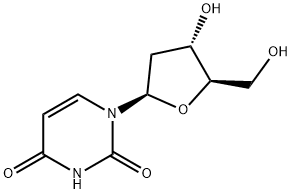
5-Chloro-2'-deoxyuridine
Synonym(s):CldU
- CAS NO.:50-90-8
- Empirical Formula: C9H11ClN2O5
- Molecular Weight: 262.65
- MDL number: MFCD00006531
- SAFETY DATA SHEET (SDS)
- Update Date: 2026-09-12 18:48:01
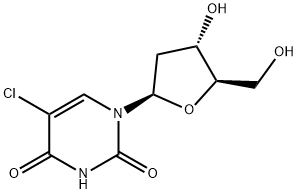
What is 5-Chloro-2'-deoxyuridine?
Description
5-Chloro-2''-deoxyuridine (CldU) is a thymidine analog that is readily incorporated, following phosphorylation, into newly synthesized DNA in place of thymidine. Like 5-bromo-2’-deoxyuridine and 5-iodo-2’-deoxyuridine, CldU can be detected immunologically in cells and tissues. CldU can also be added to cells or tissues sequentially with another thymidine analog to label temporally distinct populations. The insertion of thymidine analogs, including CldU, can significantly alter DNA processing and replication, so these analogs have also been used as mutagens, clastogens, and antiviral compounds.
Chemical properties
White Needles
The Uses of 5-Chloro-2'-deoxyuridine
5-Chloro-2'-deoxyuridine (CldU) is a thymidine analog that is readily incorporated, following phosphorylation, into newly synthesized DNA in place of thymidine. Like 5-bromo-2’-deoxyuridine and 5-iodo-2’-deoxyuridine, CldU can be detected immunologically in cells and tissues. CldU can also be added to cells or tissues sequentially with another thymidine analog to label temporally distinct populations. The insertion of thymidine analogs, including CldU, can significantly alter DNA processing and replication, so these analogs have also been used as mutagens, clastogens, and antiviral compounds.[Cayman Chemical]
The Uses of 5-Chloro-2'-deoxyuridine
A halogenated uridine derivative used in pharmaceutical compositions.
The Uses of 5-Chloro-2'-deoxyuridine
5-Chloro-2′-deoxyuridine (CldU) is used as a thymidine analog to study the miscoding potential of hypochlorous acid damage to DNA and DNA precursors. When used with antibody based immunofluorescent imaging, 5-Chloro-2′-deoxyuridine incorporation may be used in protocols to identify sites of DNA replication. CldU may be used as a labeling substrate in conjunction with other halogenated uridine labeling substrates such as iododeoxyuridine (IdU).
What are the applications of Application
5-Chloro-2′-deoxyuridine is a thymidine analogue
Biochem/physiol Actions
DNA labeled with 5-chloro-2′-deoxyuridine (CldU) serves as an effective tool to analyze and quantify DNA replication, repair, and recombination. CldU is a potent mutagen, clastogen, and toxicant. It is used as a thymidine analog and is found to alter the dNTP pools and might lead to cell-cycle arrest. CldU produces sister-chromatid exchange but has less response to ionizing radiation compared to other thymine analogs. 5-Chloro-2′-deoxyuridine (CldU) is used to study the miscoding potential of hypochlorous acid damage to DNA and DNA precursors. When used with antibody based immunofluorescent imaging, 5-Chloro-2′-deoxyuridine incorporation may be used in protocols to identify sites of DNA replication. CldU may be used as a labeling substrate in conjunction with other halogenated uridine labeling substrates such as iododeoxyuridine (IdU).
Properties of 5-Chloro-2'-deoxyuridine
| Melting point: | 176-179°C |
| Density | 1.5507 (rough estimate) |
| refractive index | 1.6500 (estimate) |
| storage temp. | -20°C |
| solubility | DMSO (Slightly), Methanol (Slightly), Water (Slightly) |
| pka | 7.73±0.10(Predicted) |
| form | Solid |
| color | White to Off-White |
| CAS DataBase Reference | 50-90-8(CAS DataBase Reference) |
Safety information for 5-Chloro-2'-deoxyuridine
| Signal word | Warning |
| Pictogram(s) |
 Exclamation Mark Irritant GHS07  Health Hazard GHS08 |
| GHS Hazard Statements |
H351:Carcinogenicity |
| Precautionary Statement Codes |
P202:Do not handle until all safety precautions have been read and understood. P280:Wear protective gloves/protective clothing/eye protection/face protection. P301+P312:IF SWALLOWED: call a POISON CENTER or doctor/physician IF you feel unwell. P308+P313:IF exposed or concerned: Get medical advice/attention. |
Computed Descriptors for 5-Chloro-2'-deoxyuridine
New Products
5-bromo-4-fluoro-2-nitrobenzaldehyde Cyclobutanone (R)-(-)-2-Amino-1-propanol Fmoc-OSu 1-(2-Chloroethyl)pyrrolidine Hydrochloride 2-Amino-2-(4-methylphenyl)acetic acid 2,4-Dihydroxybenzaldehyde Obidoxime hydrochloride API Pyrrolo[1,2-a]pyrimidine-6-carboxylic acid, 4,6,7,8-tetrahydro-4-oxo-, sodium salt (1:1), (6S) Dipropyl disulfide 4 pentyn 1 ol N-Vinylformamide Methacrylate-PEG-Methacrylate, Mn:35000 2,4-Dihydroxyacetophenone 2-Chloro 5-Fluoro Pyridine Vasicinone 2-Chloroisonicotinic Acid Tween 80 or Polysorbate 80 2-Butyn-1-oL 2-Pentyn-1-oL 4-Nitrobenzotrifluoride N-(4-Cyano-3-(trifluoromethyl)phenyl)-2-methyloxirane-2-carboxamide N-(4-fluoro-2-methoxy-5-nitrophenyl)-4-(1-methyl-1H-indol-3-yl)pyrimidin-2-amine Pirtobrutinib intd.Related products of tetrahydrofuran

You may like
-
 5-Chloro-2′-deoxyuridine CAS 50-90-8View Details
50-90-8 -
7250-67-1 1-(2-Chloroethyl)pyrrolidine Hydrochloride 98+View Details
7250-67-1 -
13227-01-5 98+View Details
13227-01-5 -
545445-44-1 3-Morpholino-1-(4-(2-oxopiperidin-1-yl) phenyl)-5,6-dihyropyridin-2-(1H)-one 98%View Details
545445-44-1 -
6629-04-5 98%View Details
6629-04-5 -
4-(4-Αminophenyl)-3-Morpholinone 98%View Details
438056-69-0 -
1-(4-Aminophenyl)-3-morpholino-5,6-dihydropyridin-2(1H)-one 1267610-26-3 98%View Details
1267610-26-3 -
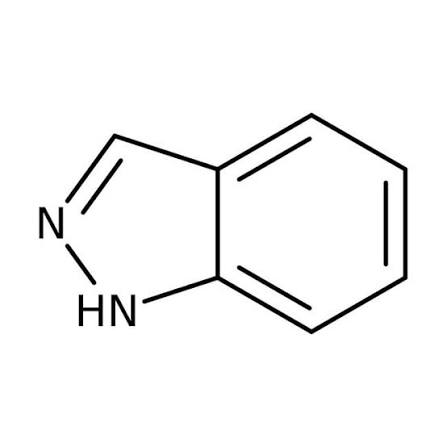 1H-Indazole | CAS No. 271-44-3 | Pharmaceutical IntermediateView Details
271-44-3