
4-Quinolinecarboxaldehyde
Synonym(s):Cinchoninaldehyde
- CAS NO.:4363-93-3
- Empirical Formula: C10H7NO
- Molecular Weight: 157.17
- MDL number: MFCD00006781
- EINECS: 224-453-0
- SAFETY DATA SHEET (SDS)
- Update Date: 2026-05-28 02:25:57
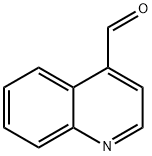
What is 4-Quinolinecarboxaldehyde?
Chemical properties
yellow to yellow-brown crystalline powder
Occurrence
The common presence of 4-quinolinecarboxaldehyde in honey from Galicia (northwest of Spain). As opposed to other quinoline carboxylic acid derivatives, the 4- quinolinecarboxaldehyde species has not been correlated with the anti-diabetic properties of honey; nevertheless, it appears to be active against intestinal bacteria.
The Uses of 4-Quinolinecarboxaldehyde
4-Quinolinecarboxaldehyde was used in the synthesis of lepidylamines. It also shows antimicrobial activity toward human intestinal bacteria such as Clostridium perfringens.
Synthesis Reference(s)
The Journal of Organic Chemistry, 35, p. 841, 1970 DOI: 10.1021/jo00828a074
References
[1] Tamara Rodríguez-Cabo. “Time-of-flight accurate mass spectrometry identification of quinoline alkaloids in honey.” Analytical and Bioanalytical Chemistry 407 20 (2015): 6159–6170.
Properties of 4-Quinolinecarboxaldehyde
| Melting point: | 45-52 °C (lit.) |
| Boiling point: | 131-133°C 5mm |
| Density | 1.1599 (rough estimate) |
| refractive index | 1.5000 (estimate) |
| Flash point: | >230 °F |
| storage temp. | Keep in dark place,Sealed in dry,Room Temperature |
| pka | 2.95±0.13(Predicted) |
| form | Crystalline Powder, Chunks, or Solid |
| color | Off-white to yellow-brown |
| Water Solubility | Slightly soluble in water. |
| Sensitive | Air Sensitive |
| BRN | 113072 |
| InChI | InChI=1S/C10H7NO/c12-7-8-5-6-11-10-4-2-1-3-9(8)10/h1-7H |
| CAS DataBase Reference | 4363-93-3(CAS DataBase Reference) |
Safety information for 4-Quinolinecarboxaldehyde
| Signal word | Warning |
| Pictogram(s) |
 Exclamation Mark Irritant GHS07 |
| GHS Hazard Statements |
H315:Skin corrosion/irritation H335:Specific target organ toxicity, single exposure;Respiratory tract irritation |
| Precautionary Statement Codes |
P261:Avoid breathing dust/fume/gas/mist/vapours/spray. P264:Wash hands thoroughly after handling. P264:Wash skin thouroughly after handling. P271:Use only outdoors or in a well-ventilated area. P280:Wear protective gloves/protective clothing/eye protection/face protection. P302+P352:IF ON SKIN: wash with plenty of soap and water. |
Computed Descriptors for 4-Quinolinecarboxaldehyde
| InChIKey | MGCGJBXTNWUHQE-UHFFFAOYSA-N |
| SMILES | N1C2C(=CC=CC=2)C(C=O)=CC=1 |
New Products
5-bromo-4-fluoro-2-nitrobenzaldehyde (R)-(-)-2-Amino-1-propanol Cyclobutanone Fmoc-OSu 1-(2-Chloroethyl)pyrrolidine Hydrochloride 2-Amino-2-(4-methylphenyl)acetic acid β-Bromostyrene Ethyl 3-phenylpropanoate Phenethyl cinnamate Dipropyl disulfide 4 pentyn 1 ol N-Vinylformamide Methacrylate-PEG-Methacrylate, Mn:35000 2,4-Dihydroxyacetophenone 2-Chloro 5-Fluoro Pyridine Vasicinone 2-Chloroisonicotinic Acid Tween 80 or Polysorbate 80 2-Butyn-1-oL 2-Pentyn-1-oL 4-Nitrobenzotrifluoride N-(4-fluoro-2-methoxy-5-nitrophenyl)-4-(1-methyl-1H-indol-3-yl)pyrimidin-2-amine Pirtobrutinib intd. N-(4-Cyano-3-(trifluoromethyl)phenyl)-2-methyloxirane-2-carboxamideRelated products of tetrahydrofuran



You may like
-
 4-Quinolinecarboxaldehyde CAS 4363-93-3View Details
4363-93-3 -
4-Quinolinecarboxaldehyde CAS 4363-93-3View Details
4363-93-3 -
7250-67-1 1-(2-Chloroethyl)pyrrolidine Hydrochloride 98+View Details
7250-67-1 -
13227-01-5 98+View Details
13227-01-5 -
7250-67-1 1-(2-Chloroethyl)pyrrolidine Hydrochloride 98+View Details
7250-67-1 -
13227-01-5 98+View Details
13227-01-5 -
7250-67-1 1-(2-Chloroethyl)pyrrolidine Hydrochloride 98+View Details
7250-67-1 -
13227-01-5 98+View Details
13227-01-5