
4-Chlorophenyl phosphorodichloridate
Synonym(s):p-Chlorophenyl dichlorophosphate;4-Chlorophenyl dichlorophosphinate;4-Chlorophenyl phosphorodichloridate
- CAS NO.:772-79-2
- Empirical Formula: C6H4Cl3O2P
- Molecular Weight: 245.43
- MDL number: MFCD00009705
- EINECS: 212-254-1
- SAFETY DATA SHEET (SDS)
- Update Date: 2026-09-12 18:47:38
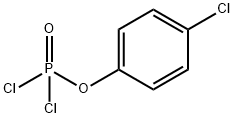
What is 4-Chlorophenyl phosphorodichloridate?
Chemical properties
clear colorless liquid
The Uses of 4-Chlorophenyl phosphorodichloridate
4-Chlorophenyl phosphorodichloridate is used as phosphorylation agent. Reactant for preparation of antimicrobial agents, antioxidant agents, antitumor agents, nucleotide anti-viral prodrug.
Properties of 4-Chlorophenyl phosphorodichloridate
| Boiling point: | 142 °C/11 mmHg (lit.) |
| Density | 1.508 g/mL at 25 °C (lit.) |
| refractive index | n |
| Flash point: | 223 °F |
| storage temp. | Store at 0-5°C |
| form | Liquid |
| color | Clear colorless |
| Water Solubility | Reacts with water. |
| Sensitive | Moisture Sensitive |
| BRN | 910754 |
| CAS DataBase Reference | 772-79-2(CAS DataBase Reference) |
Safety information for 4-Chlorophenyl phosphorodichloridate
| Signal word | Danger |
| Pictogram(s) |
 Corrosion Corrosives GHS05 |
| GHS Hazard Statements |
H290:Corrosive to Metals H314:Skin corrosion/irritation H318:Serious eye damage/eye irritation |
| Precautionary Statement Codes |
P234:Keep only in original container. P260:Do not breathe dust/fume/gas/mist/vapours/spray. P264:Wash hands thoroughly after handling. P264:Wash skin thouroughly after handling. P280:Wear protective gloves/protective clothing/eye protection/face protection. P310:Immediately call a POISON CENTER or doctor/physician. P390:Absorb spillage to prevent material damage. P301+P330+P331:IF SWALLOWED: Rinse mouth. Do NOT induce vomiting. P303+P361+P353:IF ON SKIN (or hair): Remove/Take off Immediately all contaminated clothing. Rinse SKIN with water/shower. P305+P351+P338:IF IN EYES: Rinse cautiously with water for several minutes. Remove contact lenses, if present and easy to do. Continuerinsing. P405:Store locked up. P406:Store in corrosive resistant/… container with a resistant inner liner. P501:Dispose of contents/container to..… |
Computed Descriptors for 4-Chlorophenyl phosphorodichloridate
| InChIKey | CCZMQYGSXWZFKI-UHFFFAOYSA-N |
4-Chlorophenyl phosphorodichloridate manufacturer
New Products
5-bromo-4-fluoro-2-nitrobenzaldehyde (R)-(-)-2-Amino-1-propanol Cyclobutanone Fmoc-OSu 1-(2-Chloroethyl)pyrrolidine Hydrochloride 2-Amino-2-(4-methylphenyl)acetic acid Obidoxime hydrochloride API Decanoic acid, 2-[4-(phenylmethoxy)phenyl]ethyl ester Piperazine, 1-(3-methoxyphenyl)-, hydrochloride (1:1) 4-Bromo-2,6-difluoroaniline 4 pentyn 1 ol N-Vinylformamide Methacrylate-PEG-Methacrylate, Mn:35000 2,4-Dihydroxyacetophenone 2-Chloro 5-Fluoro Pyridine Vasicinone 2-Chloroisonicotinic Acid Tween 80 or Polysorbate 80 2-Pentyn-1-oL 4-Nitrobenzotrifluoride N-(4-Cyano-3-(trifluoromethyl)phenyl)-2-methyloxirane-2-carboxamide N-(4-fluoro-2-methoxy-5-nitrophenyl)-4-(1-methyl-1H-indol-3-yl)pyrimidin-2-amine Pirtobrutinib intd. 2-Butyn-1-oLRelated products of tetrahydrofuran
You may like
-
![4-Chlorophenyl Phosphorodichloridate [Phosphorylating Agent] CAS 772-79-2](https://img.chemicalbook.in//Content/image/CP5.jpg) 4-Chlorophenyl Phosphorodichloridate [Phosphorylating Agent] CAS 772-79-2View Details
4-Chlorophenyl Phosphorodichloridate [Phosphorylating Agent] CAS 772-79-2View Details
772-79-2 -
Fmoc-OSu 98+View Details
82911-69-1 -
7250-67-1 1-(2-Chloroethyl)pyrrolidine Hydrochloride 98+View Details
7250-67-1 -
13227-01-5 98+View Details
13227-01-5 -
7250-67-1 1-(2-Chloroethyl)pyrrolidine Hydrochloride 98+View Details
7250-67-1 -
13227-01-5 98+View Details
13227-01-5 -
7250-67-1 1-(2-Chloroethyl)pyrrolidine Hydrochloride 98+View Details
7250-67-1 -
13227-01-5 98+View Details
13227-01-5
Statement: All products displayed on this website are only used for non medical purposes such as industrial applications or scientific research, and cannot be used for clinical diagnosis or treatment of humans or animals. They are not medicinal or edible.