
3-CHLORO-2,3-BIS(4-METHOXYPHENYL)ACRYLALDEHYDE
Synonym(s):(Z)-3-Chloro-2,3-bis(4-methoxyphenyl)acrylaldehyde;Windorphen - CAS 19881-70-0 - Calbiochem;Windorphen, Inactive Control - CAS 19881-70-0 - Calbiochem;
- CAS NO.:19881-70-0
- Empirical Formula: C17H15ClO3
- Molecular Weight: 302.75
- MDL number: MFCD26940341
- SAFETY DATA SHEET (SDS)
- Update Date: 2026-06-06 22:25:17
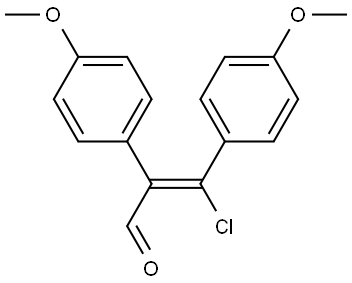
What is 3-CHLORO-2,3-BIS(4-METHOXYPHENYL)ACRYLALDEHYDE?
The Uses of 3-CHLORO-2,3-BIS(4-METHOXYPHENYL)ACRYLALDEHYDE
Windorphen is a selective inhibitor of p300 histone acetyltransferase, a coactivator that associates with?β-catenin,?blocking the Wnt signal required for ventral development.
Biological Activity
windorphen is a wnt inhibitor that selectively abrogates the wnt signaling for ventral development.wnt protein is a family of signaling proteins that interacts on the wnt/β-catenin pathways during embryotic development, cell proliferation, migration and adult tissue homeostasis.in canonical wnt/β-catenin reporter cell line stf293, windorphen dose-dependently inhibits wnt3a-inducible topflash-luciferase activity (ic50 of 1.5 mm). in human colon adenocarcinomasw480 cells with defective apc gene that constitutively activates wnt signaling, 72 h treatment of windorphen causes a wide spread apoptosis. [1]in zebrafish embryos, windorphen leads to apparent expansion of the dorsal markers (pax2.1) and marker of rhombomeres 3 and 5 at the six-somite stage (krox0). windorphen selectively inhibits wnt signaling in ventral and lateral regions of the 50% epiboly stage embryo (5.3 hpf). in addition, windoprhen treatment rescues the telencephalon/eye phenotype in the mbl mutant zebrafish (i.e. a defective axin1/β-catenin destruction complex causes abnormal activation of wnt signaling and the loss of telencephalon and eyes.) [1]
References
1. hao j, ao a, zhou l et al. selective small molecule targeting β-catenin function discovered by invivo chemical genetic screen. cell rep. 2013 sep 12;4(5):898-904.
Properties of 3-CHLORO-2,3-BIS(4-METHOXYPHENYL)ACRYLALDEHYDE
| Melting point: | 160-163°C |
| Boiling point: | 468.1±45.0 °C(Predicted) |
| Density | 1.198±0.06 g/cm3(Predicted) |
| storage temp. | -20°C |
| solubility | DMSO: soluble5mg/mL, clear (warmed) |
| form | powder |
| color | white to beige |
Safety information for 3-CHLORO-2,3-BIS(4-METHOXYPHENYL)ACRYLALDEHYDE
Computed Descriptors for 3-CHLORO-2,3-BIS(4-METHOXYPHENYL)ACRYLALDEHYDE
New Products
N-Carbethoxy-4-piperidone 1-Aminocyclopentane carbonitrile Tetrabutylammonium perchlorate N,O-Dimethylhydroxylamine hydrochloride (RS)-beta-Amino-beta-(4-bromophenyl)propionic acid 2-Amino-5-bromo-4-(trifluoromethyl)pyridine N-Vinylformamide 4 pentyn 1 ol Phenethyl cinnamate Pyrrolo[1,2-a]pyrimidine-6-carboxylic acid, 4,6,7,8-tetrahydro-4-oxo-, sodium salt (1:1), (6S) Ethyl 3-phenylpropanoate β-Bromostyrene Methacrylate-PEG-Methacrylate, Mn:35000 2,4-Dihydroxyacetophenone 2-Chloro 5-Fluoro Pyridine Vasicinone 2-Chloroisonicotinic Acid Tween 80 or Polysorbate 80 5-Bromo-1-Pentyne 1-(2-Methyl-5-nitrophenyl)guanidine Nitrate Methyl trans-4-Aminocyclohexanecarboxylate Hydrochloride 2-Pentyn-1-oL 4-Nitrobenzotrifluoride N-(4-Cyano-3-(trifluoromethyl)phenyl)-2-methyloxirane-2-carboxamideRelated products of tetrahydrofuran


You may like
-
 Windorphen >95% CAS 19881-70-0View Details
19881-70-0 -
Windorphen CAS 19881-70-0View Details
19881-70-0 -
144-83-2 Sulfapyridine 98+View Details
144-83-2 -
29976-53-2 98+View Details
29976-53-2 -
6638-79-5 N,O-Dimethylhydroxylamine hydrochloride 98+View Details
6638-79-5 -
674783-97-2 98+View Details
674783-97-2 -
1-Aminocyclopentane carbonitrile 98+View Details
49830-37-7 -
Tetrabutylammonium perchlorate 1923-70-2 98+View Details
1923-70-2