
3-Chloro-2-hydroxypropyltrimethyl ammonium chloride
- CAS NO.:3327-22-8
- Empirical Formula: C6H15Cl2NO
- Molecular Weight: 188.1
- MDL number: MFCD00055655
- EINECS: 222-048-3
- SAFETY DATA SHEET (SDS)
- Update Date: 2026-06-24 18:39:39
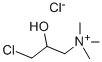
What is 3-Chloro-2-hydroxypropyltrimethyl ammonium chloride?
The Uses of 3-Chloro-2-hydroxypropyltrimethyl ammonium chloride
3-Chloro-2-hydroxypropyltrimethyl ammonium chloride is used in the preparation of multifunctional cationized cotton fabric based on TiO2 nanomaterials.
The Uses of 3-Chloro-2-hydroxypropyltrimethyl ammonium chloride
(3-Chloro-2-hydroxypropyl)trimethylammonium chloride solution (CHTAC) can be used:
- As a cation-generating agent for cellulose cationization by exhaustion method.
- To resolve 2,2′-dihydroxy-1,1′-binaphthyl enantiomers.
- To synthesize cationic glycogen (Cat Gly).
- As a quaternizing agent for quaternization of N-aryl chitosan derivatives.
Flammability and Explosibility
Non flammable
Properties of 3-Chloro-2-hydroxypropyltrimethyl ammonium chloride
| Melting point: | 191-193°C |
| Density | 1.154 g/mL at 25 °C |
| vapor pressure | 0.001Pa at 20℃ |
| refractive index | n |
| Flash point: | >230 °F |
| storage temp. | Sealed in dry,Room Temperature |
| solubility | Methanol (Slightly), Water (Sparingly) |
| form | clear liquid |
| color | Colorless to Light yellow |
| PH | 4.8 to 6.4(50g/L, 25℃) |
| Water Solubility | 835.2g/L at 20℃ |
| BRN | 6576172 |
| InChI | InChI=1S/C6H15ClNO.ClH/c1-8(2,3)5-6(9)4-7;/h6,9H,4-5H2,1-3H3;1H/q+1;/p-1 |
| CAS DataBase Reference | 3327-22-8(CAS DataBase Reference) |
| EPA Substance Registry System | 3-Chloro-2-hydroxypropyltrimethyl ammonium chloride (3327-22-8) |
Safety information for 3-Chloro-2-hydroxypropyltrimethyl ammonium chloride
| Signal word | Warning |
| Pictogram(s) |
 Health Hazard GHS08 |
| GHS Hazard Statements |
H351:Carcinogenicity H412:Hazardous to the aquatic environment, long-term hazard |
| Precautionary Statement Codes |
P202:Do not handle until all safety precautions have been read and understood. P273:Avoid release to the environment. P280:Wear protective gloves/protective clothing/eye protection/face protection. P308+P313:IF exposed or concerned: Get medical advice/attention. P405:Store locked up. P501:Dispose of contents/container to..… |
Computed Descriptors for 3-Chloro-2-hydroxypropyltrimethyl ammonium chloride
| InChIKey | CSPHGSFZFWKVDL-UHFFFAOYSA-M |
| SMILES | [N+](C)(CC(O)CCl)(C)C.[Cl-] |
New Products
N-Carbethoxy-4-piperidone 1-Aminocyclopentane carbonitrile Tetrabutylammonium perchlorate N,O-Dimethylhydroxylamine hydrochloride (RS)-beta-Amino-beta-(4-bromophenyl)propionic acid 2-Amino-5-bromo-4-(trifluoromethyl)pyridine N-Vinylformamide 4 pentyn 1 ol Phenethyl cinnamate Pyrrolo[1,2-a]pyrimidine-6-carboxylic acid, 4,6,7,8-tetrahydro-4-oxo-, sodium salt (1:1), (6S) Ethyl 3-phenylpropanoate β-Bromostyrene Methacrylate-PEG-Methacrylate, Mn:35000 2,4-Dihydroxyacetophenone 2-Chloro 5-Fluoro Pyridine Vasicinone 2-Chloroisonicotinic Acid Tween 80 or Polysorbate 80 5-Bromo-1-Pentyne 1-(2-Methyl-5-nitrophenyl)guanidine Nitrate Methyl trans-4-Aminocyclohexanecarboxylate Hydrochloride 2-Pentyn-1-oL 4-Nitrobenzotrifluoride N-(4-Cyano-3-(trifluoromethyl)phenyl)-2-methyloxirane-2-carboxamideRelated products of tetrahydrofuran

You may like
-
 3327-22-8 3 Chloro 2 Hydroxy Propyl Trimethylammonium Chloride 99%View Details
3327-22-8 -
 (3-Chloro-2-hydroxypropyl)trimethylammonium Chloride (ca. 65% in Water) CAS 3327-22-8View Details
3327-22-8 -
144-83-2 Sulfapyridine 98+View Details
144-83-2 -
29976-53-2 98+View Details
29976-53-2 -
6638-79-5 N,O-Dimethylhydroxylamine hydrochloride 98+View Details
6638-79-5 -
674783-97-2 98+View Details
674783-97-2 -
1-Aminocyclopentane carbonitrile 98+View Details
49830-37-7 -
Tetrabutylammonium perchlorate 1923-70-2 98+View Details
1923-70-2
Statement: All products displayed on this website are only used for non medical purposes such as industrial applications or scientific research, and cannot be used for clinical diagnosis or treatment of humans or animals. They are not medicinal or edible.