
3-AP
- CAS NO.:143621-35-6
- Empirical Formula: C7H9N5S
- Molecular Weight: 195.25
- MDL number: MFCD00924747
- SAFETY DATA SHEET (SDS)
- Update Date: 2026-05-27 17:18:40
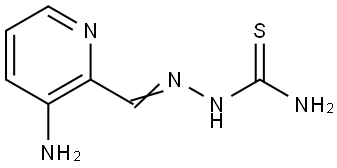
What is 3-AP ?
The Uses of 3-AP
Ribonucleotide reductase, the rate-limiting enzyme for de novo DNA synthesis, is an excellent target for chemotherapy. Its increased activity in cancer cells is associated with malignant transformation and proliferation. 3-AP is a ribonucleotide reductase inhibitor and iron chelator with antitumor activity. At 5 μM it can enhance DU145, U251, and PSN1 tumor cell radiosensitivity in vitro, inhibiting DNA synthesis and repair. It destroys the tyrosine free radical in the R2/p53R2 subunits of ribonucleotide reductase by forming a redox active complex with iron, thus producing reactive oxygen species. Furthermore, 3-AP has been shown to activate an endoplasmic reticulum stress pathway, leading to the unfolded protein response and apoptosis.[Cayman Chemical]
Hazard
A poison.
Biological Activity
3-AP (PAN-811) is a M2 subunit inhibitor of ribonucleotide reductase (RR) and a potent radiosensitizer.
Biochem/physiol Actions
3-aminopyridine carboxaldehyde thiosemicarbazone (3-AP) has a IC50 value of 0.3μM. It exhibits anti-proliferative activity in preclinical models of cancer, such as lung cancer. It also has an ability to increase the cytotoxicity, intracellular uptake and DNA incorporation of gemcitabine in vitro.
Safety Profile
A poison by intravenous route. When heated to decomposition it emits toxic vapors of NOx, and SOx,.
in vitro
3-AP (Triapine) is a potent derivative of α-heterocyclic carboxaldehyde thiosemicarbazone (HCT) that inhibits hRRM2 and p53R2 isoforms of the M2 subunit. 3-AP (Triapine) is thought to inhibit ribonucleotide reductase through its preformed iron chelate, rather than directly by removing iron from the active site. In cells containing less topoisomerase IIα fewer DNA strand breaks will be produced, and thus topoisomerase II poisons will be less inhibitory in the K/VP.5 cell line. The IC 50 s for Dp44mT growth inhibition are 48±9 nM and 60±12 nM, for K562 and K/VP.5 cells, respectively. The IC 50 s for 3-AP growth inhibition are 476±39 nM and 661±69 nM for K562 and K/VP.5 cells, respectively. PKIH and DpT Fe chelators show high antiproliferative activity against a range of tumor cell lines. Dp44mT shows the greatest antitumor efficacy with an IC 50 that ranged from 0.005 to 0.4 μM. The average IC 50 of Dp44mT over 28 cell types is 0.03±0.01 μM, which is significantly lower than that of 3-AP (Triapine; average IC 50 : 1.41±0.37 μM).
in vivo
3-AP (Triapine) causes a significant increase (1.7-fold) in splenic weight when expressed as a percentage of total body weight (1.02±0.06%; n=25) compared with control mice (0.6±0.03%; n=27). In the long-term group, a significant increase in heart weight is observed after Dp44mT (0.4 mg/kg per day) (0.8±0.06%; n=4) compared with control mice (0.5±0.01%; n=6). A significant decrease in the expression of Ndrg1, TfR1, and VEGF1 in the liver is noted for Dp44mT- and 3-AP (12 mg/kg per day)-treated animals. The decreased expression could be related to the increased liver Fe in both Dp44mT- and 3-AP-treated mice.
Storage
Store at +4°C
Properties of 3-AP
| Melting point: | 234 °C |
| Boiling point: | 436.0±55.0 °C(Predicted) |
| Density | 1.46±0.1 g/cm3(Predicted) |
| storage temp. | 2-8°C |
| solubility | DMSO: soluble10Meq/mL, clear |
| form | powder |
| pka | 10.93±0.70(Predicted) |
| color | white to light brown |
| CAS DataBase Reference | 143621-35-6 |
Safety information for 3-AP
| Signal word | Danger |
| Pictogram(s) |
 Skull and Crossbones Acute Toxicity GHS06 |
| GHS Hazard Statements |
H301:Acute toxicity,oral H315:Skin corrosion/irritation H319:Serious eye damage/eye irritation H335:Specific target organ toxicity, single exposure;Respiratory tract irritation |
| Precautionary Statement Codes |
P302+P352:IF ON SKIN: wash with plenty of soap and water. P305+P351+P338:IF IN EYES: Rinse cautiously with water for several minutes. Remove contact lenses, if present and easy to do. Continuerinsing. |
Computed Descriptors for 3-AP
New Products
2-(2-Chlorophenyl)glycine Propiolic Acid 1-(3-Hydroxy-4-methoxyphenyl)-2-nitroethene (±)-amino(2-fluorophenyl)acetic acid trans-3-Benzyloxy-4-methoxy-beta-nitrostyrene 1-Pentadecanol 2,4-Dihydroxybenzaldehyde Dipropyl disulfide Pyrrolo[1,2-a]pyrimidine-6-carboxylic acid, 4,6,7,8-tetrahydro-4-oxo-, sodium salt (1:1), (6S) Obidoxime hydrochloride API 4 pentyn 1 ol N-Vinylformamide Methacrylate-PEG-Methacrylate, Mn:35000 2,4-Dihydroxyacetophenone 2-Chloro 5-Fluoro Pyridine Vasicinone 2-Chloroisonicotinic Acid Tween 80 or Polysorbate 80 2-Butyn-1-oL N-(4-Cyano-3-(trifluoromethyl)phenyl)-2-methyloxirane-2-carboxamide N-(4-fluoro-2-methoxy-5-nitrophenyl)-4-(1-methyl-1H-indol-3-yl)pyrimidin-2-amine Pirtobrutinib intd. 2-Pentyn-1-oL 4-NitrobenzotrifluorideRelated products of tetrahydrofuran
You may like
-
![2-[(3-Aminopyridin-2-yl)methylene]hydrazinecarbothioamide CAS 143621-35-6](https://img.chemicalbook.in//Content/image/CP5.jpg) 2-[(3-Aminopyridin-2-yl)methylene]hydrazinecarbothioamide CAS 143621-35-6View Details
2-[(3-Aminopyridin-2-yl)methylene]hydrazinecarbothioamide CAS 143621-35-6View Details
143621-35-6 -
3-AP CAS 143621-35-6View Details
143621-35-6 -
471-25-0 Propiolic Acid 98+View Details
471-25-0 -
84145-28-8 98+View Details
84145-28-8 -
trans-3-Benzyloxy-4-methoxy-beta-nitrostyrene 98+View Details
63909-29-5 -
2-(2-Chlorophenyl)glycine 88744-36-9 98+View Details
88744-36-9 -
40216-83-9 trans-4-Hydroxy-L-proline methyl ester hydrochloride 98+View Details
40216-83-9 -
1-(3-Hydroxy-4-methoxyphenyl)-2-nitroethene 98+View Details
39816-35-8