
3-Acetyldeoxynivalenol
Synonym(s):3α-Acetoxy-7α,15-dihydroxy-12,13-epoxytrichothec-9-en-8-one;3α-Acetylvomitoxin;3-AcDON;3-ADON
- CAS NO.:50722-38-8
- Empirical Formula: C17H22O7
- Molecular Weight: 338.35
- MDL number: MFCD28143209
- EINECS: 621-771-5
- SAFETY DATA SHEET (SDS)
- Update Date: 2026-09-12 18:48:19
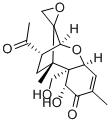
What is 3-Acetyldeoxynivalenol?
Chemical properties
Solid
The Uses of 3-Acetyldeoxynivalenol
3-Acetyldeoxynivalenol is a trichothecene mycotoxin that is produced in a plant-pathogenic fungus, Fusarium graminearum Schwabe.
The Uses of 3-Acetyldeoxynivalenol
3-Acetyldeoxynivalenol solution may be used as an analytical reference standard for the quantification of the analyte in bovine milk using liquid chromatography coupled to tandem mass spectrometry (LC-MS/MS).
Definition
ChEBI: 3-acetyldeoxynivalenol is a trichothecene mycotoxin that is deoxynivalenol acetylated on the oxygen at C-3. A skin and eye irritant, along with its 15-acetyl regioisomer and its parent deoxynivalenol it is considered among the most commonly and widely distributed cereal contaminants. It has a role as an epitope and a mycotoxin. It is functionally related to a deoxynivalenol.
General Description
3-Acetyldeoxynivalenol is a trichothecene mycotoxin, secreted by Fusarium species. It stimulates the activation of c-Jun N-terminal kinase (JNK)/ p38 mitogen-activated protein kinases and prevents protein synthesis. 3-Acetyldeoxynivalenol is a weak inducer of apoptosis.
Properties of 3-Acetyldeoxynivalenol
| Melting point: | 185.75°C |
| Boiling point: | 394.5°C (rough estimate) |
| Density | 1.2179 (rough estimate) |
| refractive index | 1.4790 (estimate) |
| Flash point: | 2 °C |
| storage temp. | -20°C |
| solubility | DMF: 30 mg/ml; DMSO: 25 mg/ml; Ethanol: 30 mg/ml; PBS (pH 7.2): 10 mg/ml |
| pka | 11.84±0.70(Predicted) |
| form | neat |
Safety information for 3-Acetyldeoxynivalenol
| Signal word | Danger |
| Pictogram(s) |
 Skull and Crossbones Acute Toxicity GHS06 |
| GHS Hazard Statements |
H300:Acute toxicity,oral |
| Precautionary Statement Codes |
P261:Avoid breathing dust/fume/gas/mist/vapours/spray. P264:Wash hands thoroughly after handling. P264:Wash skin thouroughly after handling. P280:Wear protective gloves/protective clothing/eye protection/face protection. P301+P310:IF SWALLOWED: Immediately call a POISON CENTER or doctor/physician. |
Computed Descriptors for 3-Acetyldeoxynivalenol
New Products
5-bromo-4-fluoro-2-nitrobenzaldehyde (R)-(-)-2-Amino-1-propanol Cyclobutanone Fmoc-OSu 1-(2-Chloroethyl)pyrrolidine Hydrochloride 2-Amino-2-(4-methylphenyl)acetic acid β-Bromostyrene Ethyl 3-phenylpropanoate Phenethyl cinnamate Dipropyl disulfide 4 pentyn 1 ol N-Vinylformamide Methacrylate-PEG-Methacrylate, Mn:35000 2,4-Dihydroxyacetophenone 2-Chloro 5-Fluoro Pyridine Vasicinone 2-Chloroisonicotinic Acid Tween 80 or Polysorbate 80 2-Butyn-1-oL 2-Pentyn-1-oL 4-Nitrobenzotrifluoride N-(4-fluoro-2-methoxy-5-nitrophenyl)-4-(1-methyl-1H-indol-3-yl)pyrimidin-2-amine Pirtobrutinib intd. N-(4-Cyano-3-(trifluoromethyl)phenyl)-2-methyloxirane-2-carboxamideRelated products of tetrahydrofuran
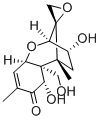

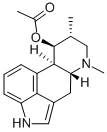
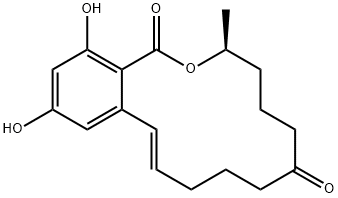
You may like
-
 3-Acetyldeoxynivalenol CAS 50722-38-8View Details
50722-38-8 -
3-Acetyldeoxynivalenol solution CAS 50722-38-8View Details
50722-38-8 -
3-Acetyldeoxynivalenol CAS 50722-38-8View Details
50722-38-8 -
7250-67-1 1-(2-Chloroethyl)pyrrolidine Hydrochloride 98+View Details
7250-67-1 -
7250-67-1 1-(2-Chloroethyl)pyrrolidine Hydrochloride 98+View Details
7250-67-1 -
13227-01-5 98+View Details
13227-01-5 -
7250-67-1 1-(2-Chloroethyl)pyrrolidine Hydrochloride 98+View Details
7250-67-1 -
13227-01-5 98+View Details
13227-01-5