
2-Ethylhexyl glycidyl ether
- CAS NO.:2461-15-6
- Empirical Formula: C11H22O2
- Molecular Weight: 186.29
- MDL number: MFCD00005141
- EINECS: 219-553-6
- SAFETY DATA SHEET (SDS)
- Update Date: 2026-05-28 02:27:57
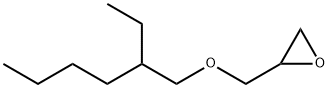
What is 2-Ethylhexyl glycidyl ether?
Chemical properties
colourless liquid
The Uses of 2-Ethylhexyl glycidyl ether
2-Ethylhexyl glycidyl ether is a used as a commercial reactive diluent. 2-Ethylhexyl glycidyl ether is also known to induce sister-chromatid exchanges in Chinese hamster cells.
The Uses of 2-Ethylhexyl glycidyl ether
It constitutes a reactive diluent and may be used as a relatively nonvolatile chloride-scavenging agent and stabilizer for vinyl resins and rubber.
Production Methods
2-Ethylhexyl glycidyl ether is made by condensation of 2-ethylhexanol with epichlorohydrin followed by dehydrochlorination with caustic to form the epoxy ring.
General Description
Clear colorless liquid.
Air & Water Reactions
Insoluble in water.
Reactivity Profile
2-Ethylhexyl glycidyl ether is incompatible with acids, bases and oxidizing agents.
Fire Hazard
2-Ethylhexyl glycidyl ether is combustible.
Flammability and Explosibility
Non flammable
Properties of 2-Ethylhexyl glycidyl ether
| Boiling point: | 60-62 °C/0.3 mmHg (lit.) |
| Density | 0.891 g/mL at 25 °C (lit.) |
| vapor pressure | 29Pa at 25℃ |
| refractive index | 1.434 |
| Flash point: | 206°F |
| form | clear liquid |
| color | Colorless to Almost colorless |
| Specific Gravity | 0.910.891 |
| Water Solubility | <0.1 g/100 mL at 19 ºC |
| Stability: | Stable. Combustible. Incompatible with strong oxidising agents, acids, bases. |
| CAS DataBase Reference | 2461-15-6(CAS DataBase Reference) |
| NIST Chemistry Reference | Oxirane, [[(2-ethylhexyl)oxy]methyl]-(2461-15-6) |
| EPA Substance Registry System | 2-Ethylhexyl glycidyl ether (2461-15-6) |
Safety information for 2-Ethylhexyl glycidyl ether
| Signal word | Warning |
| Pictogram(s) |
 Exclamation Mark Irritant GHS07 |
| GHS Hazard Statements |
H315:Skin corrosion/irritation H317:Sensitisation, Skin |
| Precautionary Statement Codes |
P280:Wear protective gloves/protective clothing/eye protection/face protection. P302+P352:IF ON SKIN: wash with plenty of soap and water. |
Computed Descriptors for 2-Ethylhexyl glycidyl ether
2-Ethylhexyl glycidyl ether manufacturer
New Products
5-bromo-4-fluoro-2-nitrobenzaldehyde (R)-(-)-2-Amino-1-propanol Cyclobutanone Fmoc-OSu 1-(2-Chloroethyl)pyrrolidine Hydrochloride 2-Amino-2-(4-methylphenyl)acetic acid β-Bromostyrene Ethyl 3-phenylpropanoate Phenethyl cinnamate Dipropyl disulfide 4 pentyn 1 ol N-Vinylformamide Methacrylate-PEG-Methacrylate, Mn:35000 2,4-Dihydroxyacetophenone 2-Chloro 5-Fluoro Pyridine Vasicinone 2-Chloroisonicotinic Acid Tween 80 or Polysorbate 80 2-Butyn-1-oL 2-Pentyn-1-oL 4-Nitrobenzotrifluoride N-(4-fluoro-2-methoxy-5-nitrophenyl)-4-(1-methyl-1H-indol-3-yl)pyrimidin-2-amine Pirtobrutinib intd. N-(4-Cyano-3-(trifluoromethyl)phenyl)-2-methyloxirane-2-carboxamideRelated products of tetrahydrofuran



You may like
-
 2-Ethylhexyl Glycidyl Ether CAS 2461-15-6View Details
2461-15-6 -
2-Ethylhexyl glycidyl ether CAS 2461-15-6View Details
2461-15-6 -
7250-67-1 1-(2-Chloroethyl)pyrrolidine Hydrochloride 98+View Details
7250-67-1 -
13227-01-5 98+View Details
13227-01-5 -
7250-67-1 1-(2-Chloroethyl)pyrrolidine Hydrochloride 98+View Details
7250-67-1 -
13227-01-5 98+View Details
13227-01-5 -
7250-67-1 1-(2-Chloroethyl)pyrrolidine Hydrochloride 98+View Details
7250-67-1 -
13227-01-5 98+View Details
13227-01-5
Statement: All products displayed on this website are only used for non medical purposes such as industrial applications or scientific research, and cannot be used for clinical diagnosis or treatment of humans or animals. They are not medicinal or edible.