
2,6-DIMETHYL-1,3-DIOXAN-4-OL ACETATE
- CAS NO.:828-00-2
- Empirical Formula: C8H14O4
- Molecular Weight: 174.19
- MDL number: MFCD00069040
- EINECS: 212-579-9
- SAFETY DATA SHEET (SDS)
- Update Date: 2026-05-28 00:27:20
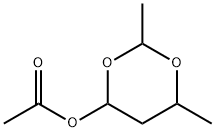
What is 2,6-DIMETHYL-1,3-DIOXAN-4-OL ACETATE?
The Uses of 2,6-DIMETHYL-1,3-DIOXAN-4-OL ACETATE
Dimethoxane is used as an antimicrobial agent in water-based paints, dyestuffs, fabric softeners, sizings, and spinning emulsions.
The Uses of 2,6-DIMETHYL-1,3-DIOXAN-4-OL ACETATE
Preservative for cutting oils, resin emulsions, water-based paints, cosmetics, inks. Effective range of concentration: 0.03-0.1%. Gasoline additive: Chafetz et al., US 3036904 (1962 to Texaco).
Definition
ChEBI: Dimethoxane is a member of dioxanes.
General Description
Clear light yellow to light amber slightly viscous liquid with a mustard-like odor.
Air & Water Reactions
Slowly hydrolyzes upon exposure to moisture. Water soluble.
Reactivity Profile
2,6-DIMETHYL-1,3-DIOXAN-4-OL ACETATE is incompatible with strong acids and strong bases.
Fire Hazard
2,6-DIMETHYL-1,3-DIOXAN-4-OL ACETATE is combustible.
Safety Profile
Questionable carcinogen withexperimental carcinogenic data. Moderately toxic byingestion. Mutation data reported. Whenheated to decomposition it emits acrid smoke and fumes.
Properties of 2,6-DIMETHYL-1,3-DIOXAN-4-OL ACETATE
| Melting point: | -7.15°C |
| Boiling point: | 66-68 °C/3 mmHg(lit.) |
| Density | 1.067 g/mL at 25 °C(lit.) |
| refractive index | n20/D 1.433(lit.) |
| Flash point: | 52 °C |
| storage temp. | Hygroscopic, -20°C Freezer, Under inert atmosphere |
| solubility | Chloroform, Ethyl Acetate |
| form | Oil |
| color | Yellow to amber, clear liquid |
| Merck | 13,3250 |
| IARC | 3 (Vol. 15, Sup 7) 1987 |
| EPA Substance Registry System | Dimethoxane (828-00-2) |
Safety information for 2,6-DIMETHYL-1,3-DIOXAN-4-OL ACETATE
| Signal word | Warning |
| Pictogram(s) |
 Flame Flammables GHS02  Exclamation Mark Irritant GHS07  Health Hazard GHS08 |
| GHS Hazard Statements |
H226:Flammable liquids H302:Acute toxicity,oral H315:Skin corrosion/irritation H319:Serious eye damage/eye irritation H335:Specific target organ toxicity, single exposure;Respiratory tract irritation H351:Carcinogenicity |
| Precautionary Statement Codes |
P261:Avoid breathing dust/fume/gas/mist/vapours/spray. P281:Use personal protective equipment as required. P305+P351+P338:IF IN EYES: Rinse cautiously with water for several minutes. Remove contact lenses, if present and easy to do. Continuerinsing. |
Computed Descriptors for 2,6-DIMETHYL-1,3-DIOXAN-4-OL ACETATE
New Products
9-Mesityl-10-methylacridinium perchlorate Sulfapyridine Fmoc-OSu (R)-(-)-2-Amino-1-propanol Cyclobutanone 5-bromo-4-fluoro-2-nitrobenzaldehyde 4 pentyn 1 ol N-Vinylformamide Phenethyl cinnamate Pyrrolo[1,2-a]pyrimidine-6-carboxylic acid, 4,6,7,8-tetrahydro-4-oxo-, sodium salt (1:1), (6S) Ethyl 3-phenylpropanoate β-Bromostyrene Methacrylate-PEG-Methacrylate, Mn:35000 2,4-Dihydroxyacetophenone 2-Chloro 5-Fluoro Pyridine Vasicinone 2-Chloroisonicotinic Acid Tween 80 or Polysorbate 80 Methyl trans-4-Aminocyclohexanecarboxylate Hydrochloride N-(4-fluoro-2-methoxy-5-nitrophenyl)-4-(1-methyl-1H-indol-3-yl)pyrimidin-2-amine Pirtobrutinib intd. 4-Nitrobenzotrifluoride 2-Pentyn-1-oL N-(4-Cyano-3-(trifluoromethyl)phenyl)-2-methyloxirane-2-carboxamideRelated products of tetrahydrofuran


You may like
-
 1191-95-3 Cyclobutanone 98+View Details
1191-95-3 -
213382-45-7 98+View Details
213382-45-7 -
Fmoc-OSu 98+View Details
82911-69-1 -
(R)-(-)-2-Amino-1-propanol 35320-23-1 98+View Details
35320-23-1 -
1191-95-3 Cyclobutanone 98+View Details
1191-95-3 -
213382-45-7 98+View Details
213382-45-7 -
Fmoc-OSu 98+View Details
82911-69-1 -
(R)-(-)-2-Amino-1-propanol 35320-23-1 98+View Details
35320-23-1