
2,5-Dibromopyrazine
- CAS NO.:23229-26-7
- Empirical Formula: C4H2Br2N2
- Molecular Weight: 237.88
- MDL number: MFCD08061601
- EINECS: 805-812-6
- SAFETY DATA SHEET (SDS)
- Update Date: 2026-05-27 22:49:08
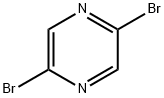
What is 2,5-Dibromopyrazine?
What are the applications of Application
2,5-Dibromopyrazine is a useful halogenated pyrazine for proteomics research
Synthesis
5-bromopyrazin-2-amine (3 g, 17.241 mmol) and bromine (8.2 g, 51.729 mmol) were added to aq. HBr solution at -15° C. Aq. solution of sodium nitrite (2.97 g, 43.0103 mmol) was then added to the mixture over a period of 1 h at -10° C. keeping the internal temperature below 5° C. during addition and stirred for 1 h at 0° C. Progress of reaction was monitored by TLC. After reaction completion reaction mass neutralised with 40percent NaOH solution and extracted with diethyl ether. The organic layer was dried over sodium sulphate and concentrated under reduced pressure (below 30° C.) to yield 2,5-Dibromopyrazine (1 g, 24.4percent) as brown oil.
Properties of 2,5-Dibromopyrazine
| Melting point: | 45.0 to 49.0 °C |
| Boiling point: | 234.0±35.0 °C(Predicted) |
| Density | 2.197 |
| Flash point: | 95℃ |
| storage temp. | Keep in dark place,Sealed in dry,Room Temperature |
| form | powder to crystal |
| pka | -4.28±0.10(Predicted) |
| color | White to Orange to Green |
| CAS DataBase Reference | 23229-26-7 |
Safety information for 2,5-Dibromopyrazine
| Signal word | Warning |
| Pictogram(s) |
 Exclamation Mark Irritant GHS07 |
| GHS Hazard Statements |
H302:Acute toxicity,oral H315:Skin corrosion/irritation H319:Serious eye damage/eye irritation H335:Specific target organ toxicity, single exposure;Respiratory tract irritation |
| Precautionary Statement Codes |
P261:Avoid breathing dust/fume/gas/mist/vapours/spray. P264:Wash hands thoroughly after handling. P264:Wash skin thouroughly after handling. P270:Do not eat, drink or smoke when using this product. P301+P312:IF SWALLOWED: call a POISON CENTER or doctor/physician IF you feel unwell. P302+P352:IF ON SKIN: wash with plenty of soap and water. P305+P351+P338:IF IN EYES: Rinse cautiously with water for several minutes. Remove contact lenses, if present and easy to do. Continuerinsing. |
Computed Descriptors for 2,5-Dibromopyrazine
| InChIKey | KIYKHEOWZLJZSB-UHFFFAOYSA-N |
2,5-Dibromopyrazine manufacturer
Ina pharmaceuticals Pvt Ltd
4Y
Phone:+91-7815933367
Whatsapp: +91-78159 33367
product: 2,5-Dibromopyrazine 99%
New Products
2-Amino-5-bromo-4-(trifluoromethyl)pyridine Sulfapyridine Fmoc-OSu (R)-(-)-2-Amino-1-propanol Cyclobutanone 5-bromo-4-fluoro-2-nitrobenzaldehyde β-Bromostyrene Ethyl 3-phenylpropanoate Phenethyl cinnamate Dipropyl disulfide N-Vinylformamide 4 pentyn 1 ol Methacrylate-PEG-Methacrylate, Mn:35000 2,4-Dihydroxyacetophenone 2-Chloro 5-Fluoro Pyridine Vasicinone 2-Chloroisonicotinic Acid Tween 80 or Polysorbate 80 2-Butyn-1-oL 2-Pentyn-1-oL 4-Nitrobenzotrifluoride N-(4-fluoro-2-methoxy-5-nitrophenyl)-4-(1-methyl-1H-indol-3-yl)pyrimidin-2-amine Pirtobrutinib intd. N-(4-Cyano-3-(trifluoromethyl)phenyl)-2-methyloxirane-2-carboxamideRelated products of tetrahydrofuran

You may like
-
 2,5-Dibromopyrazine CAS 23229-26-7View Details
23229-26-7 -
2,5-Dibromopyrazine CAS 23229-26-7View Details
23229-26-7 -
2,5-Dibromopyrazine 99%View Details
23229-26-7 -
Fmoc-OSu 98+View Details
82911-69-1 -
1191-95-3 Cyclobutanone 98+View Details
1191-95-3 -
213382-45-7 98+View Details
213382-45-7 -
Fmoc-OSu 98+View Details
82911-69-1 -
(R)-(-)-2-Amino-1-propanol 35320-23-1 98+View Details
35320-23-1
Statement: All products displayed on this website are only used for non medical purposes such as industrial applications or scientific research, and cannot be used for clinical diagnosis or treatment of humans or animals. They are not medicinal or edible.