
2,4-DINITROBENZENESULFONIC ACID
- CAS NO.:89-02-1
- Empirical Formula: C6H4N2O7S
- Molecular Weight: 248.17
- MDL number: MFCD00066017
- EINECS: 201-876-9
- SAFETY DATA SHEET (SDS)
- Update Date: 2026-05-28 01:02:12
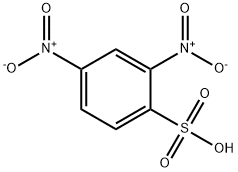
What is 2,4-DINITROBENZENESULFONIC ACID?
Chemical properties
YELLOW TO YELLOW-BROWN CRYSTALLINE POWDER
The Uses of 2,4-DINITROBENZENESULFONIC ACID
Reduction of 2,4-Dinitrobenzenesulfonic Acid gives the colorant intermediate 1,3-diaminobenzene-4-sulfonic acid [88-63-1] as an alternative to the sulfonation of m-phenylenediamine.
Definition
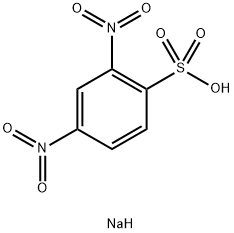
ChEBI: The arenesulfonic acid that is benzenesulfonic acid with two nitro substituents in the 2- and 4-positions.
Production Methods
2,4-Dinitrochlorobenzene is warmed with aqueous sodium sulfite to give an 80 % yield of the sodium salt of 2,4-Dinitrobenzenesulfonic Acid [885-62-1] as yellow needles after salting out. The lower reactivity of 2- and 4- chloronitrobenzene requires much higher temperature for this nucleophilic sulfitation, with too many side reactions to be practicable.
Properties of 2,4-DINITROBENZENESULFONIC ACID
| Melting point: | 95-98 °C(lit.) |
| Density | 1.745 (estimate) |
| refractive index | 1.6430 (estimate) |
| pka | -2.21±0.50(Predicted) |
| form | solid |
| Water Solubility | Soluble in methanol (2.5% w/v), slightly soluble in water. |
| CAS DataBase Reference | 89-02-1(CAS DataBase Reference) |
| EPA Substance Registry System | Benzenesulfonic acid, 2,4-dinitro- (89-02-1) |
Safety information for 2,4-DINITROBENZENESULFONIC ACID
| Signal word | Warning |
| Pictogram(s) |
 Corrosion Corrosives GHS05  Exclamation Mark Irritant GHS07 |
| GHS Hazard Statements |
H314:Skin corrosion/irritation H315:Skin corrosion/irritation H318:Serious eye damage/eye irritation H319:Serious eye damage/eye irritation |
| Precautionary Statement Codes |
P264:Wash hands thoroughly after handling. P264:Wash skin thouroughly after handling. P280:Wear protective gloves/protective clothing/eye protection/face protection. P301+P330+P331:IF SWALLOWED: Rinse mouth. Do NOT induce vomiting. P303+P361+P353:IF ON SKIN (or hair): Remove/Take off Immediately all contaminated clothing. Rinse SKIN with water/shower. P305+P351+P338:IF IN EYES: Rinse cautiously with water for several minutes. Remove contact lenses, if present and easy to do. Continuerinsing. P405:Store locked up. |
Computed Descriptors for 2,4-DINITROBENZENESULFONIC ACID
New Products
Dibenzoyl-L-tartaric acid Anhydrous (Resolution Reagent) 2-Bromo-5-hydroxybenzoic acid. 1-(4-methoxyphenyl)-4-(4-Nitrophenyl)Piperazine (IT-1) Dibenzo[b,f][1,4]thiazepin-11(10H)-one 1-Benzhydrylazetane-3-carbonitrile AMINO-(3-CHLORO-PHENYL)-ACETIC ACID 2-(2-Chlorophenyl)glycine 8-oxa-1,3-diazaspiro[4.5]decane-2,4-dione (±)-amino(2-fluorophenyl)acetic acid 2'-Fluoroacetophenone PHOSPORIC ACID-D3 85 W% IN D2O METHANE-D3-SULFONYL CHLORIDE 3-BROMO PYRIDINE-D4 2-BROMOACETYL BROMIDE-D2 DEUTERIUM OXIDE FOR NMR BENZENE-D6 1-Acetyl-4-(4-hydroxyphenyl)piperazine 1-(3-Chlorophenyl)piperazine hydrochlorideRelated products of tetrahydrofuran

You may like
-
 89-02-1 2,4-dinitrobenzenesulfonic acid 98%View Details
89-02-1 -
 7292-71-9 AMINO-(3-CHLORO-PHENYL)-ACETIC ACID 98+View Details
7292-71-9 -
84145-28-8 98+View Details
84145-28-8 -
2-(2-Chlorophenyl)glycine 98+View Details
88744-36-9 -
8-oxa-1,3-diazaspiro[4.5]decane-2,4-dione 39124-19-1 98+View Details
39124-19-1 -
445-27-2 2'-Fluoroacetophenone 98+View Details
445-27-2 -
445-27-2 2'-Fluoroacetophenone 98+View Details
445-27-2 -
445-27-2 2'-Fluoroacetophenone 98+View Details
445-27-2
Statement: All products displayed on this website are only used for non medical purposes such as industrial applications or scientific research, and cannot be used for clinical diagnosis or treatment of humans or animals. They are not medicinal or edible.