
2,3,5-TRIMETHACARB
- CAS NO.:2655-15-4
- Empirical Formula: C11H15NO2
- Molecular Weight: 193.24
- MDL number: MFCD00155446
- SAFETY DATA SHEET (SDS)
- Update Date: 2026-05-28 05:22:41
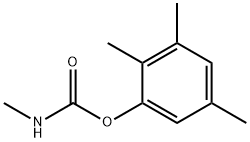
What is 2,3,5-TRIMETHACARB?
The Uses of 2,3,5-TRIMETHACARB
2,3,5-Trimethacarb is a major constituent in landrin insecticide.
What are the applications of Application
2,3,5-Trimethacarb is a major constituent in landrin insecticide
Definition
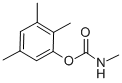
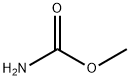
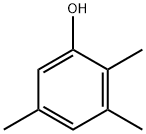
ChEBI: A carbamate ester that consists of 2,3,5-trimethylphenol carrying an O-(N-methylcarbamoyl) group. One of two constituents of trimethacarb.
General Description
Brown crystalline solid. Non corrosive. Used as an insecticide.
Air & Water Reactions
Hydrolyzed in strong acid or alkaline media.
Reactivity Profile
2,3,5-TRIMETHACARB is a carbamate ester. Carbamates are chemically similar to, but more reactive than amides. Like amides they form polymers such as polyurethane resins. Carbamates are incompatible with strong acids and bases, and especially incompatible with strong reducing agents such as hydrides. Flammable gaseous hydrogen is produced by the combination of active metals or nitrides with carbamates. Strongly oxidizing acids, peroxides, and hydroperoxides are incompatible with carbamates.
Properties of 2,3,5-TRIMETHACARB
| Melting point: | 123-124 °C(Solv: methanol (67-56-1); ethanol (64-17-5); octane (111-65-9)) |
| Boiling point: | 287.8±40.0 °C(Predicted) |
| Density | 1.046±0.06 g/cm3(Predicted) |
| Flash point: | >100 °C |
| storage temp. | 0-6°C |
| solubility | Chloroform (Slightly), Methanol (Slightly) |
| pka | 12.39±0.46(Predicted) |
| form | Solid |
| color | White to Off-White |
| EPA Substance Registry System | 2,3,5-Trimethylphenyl methylcarbamate (2655-15-4) |
Safety information for 2,3,5-TRIMETHACARB
| Signal word | Danger |
| Pictogram(s) |
 Flame Flammables GHS02  Exclamation Mark Irritant GHS07  Health Hazard GHS08  Environment GHS09 |
| GHS Hazard Statements |
H225:Flammable liquids H304:Aspiration hazard H315:Skin corrosion/irritation H336:Specific target organ toxicity,single exposure; Narcotic effects H410:Hazardous to the aquatic environment, long-term hazard |
| Precautionary Statement Codes |
P210:Keep away from heat/sparks/open flames/hot surfaces. — No smoking. P273:Avoid release to the environment. P331:Do NOT induce vomiting. P391:Collect spillage. Hazardous to the aquatic environment P301+P310:IF SWALLOWED: Immediately call a POISON CENTER or doctor/physician. P403+P235:Store in a well-ventilated place. Keep cool. |
Computed Descriptors for 2,3,5-TRIMETHACARB
New Products
5-bromo-4-fluoro-2-nitrobenzaldehyde (R)-(-)-2-Amino-1-propanol Cyclobutanone Fmoc-OSu 1-(2-Chloroethyl)pyrrolidine Hydrochloride 2-Amino-2-(4-methylphenyl)acetic acid Obidoxime hydrochloride API Decanoic acid, 2-[4-(phenylmethoxy)phenyl]ethyl ester Piperazine, 1-(3-methoxyphenyl)-, hydrochloride (1:1) 4-Bromo-2,6-difluoroaniline 4 pentyn 1 ol N-Vinylformamide Methacrylate-PEG-Methacrylate, Mn:35000 2,4-Dihydroxyacetophenone 2-Chloro 5-Fluoro Pyridine Vasicinone 2-Chloroisonicotinic Acid Tween 80 or Polysorbate 80 2-Pentyn-1-oL 4-Nitrobenzotrifluoride N-(4-Cyano-3-(trifluoromethyl)phenyl)-2-methyloxirane-2-carboxamide N-(4-fluoro-2-methoxy-5-nitrophenyl)-4-(1-methyl-1H-indol-3-yl)pyrimidin-2-amine Pirtobrutinib intd. 2-Butyn-1-oLRelated products of tetrahydrofuran
You may like
-
 Fmoc-OSu 98+View Details
82911-69-1 -
(R)-(-)-2-Amino-1-propanol 35320-23-1 98+View Details
35320-23-1 -
7250-67-1 1-(2-Chloroethyl)pyrrolidine Hydrochloride 98+View Details
7250-67-1 -
13227-01-5 98+View Details
13227-01-5 -
7250-67-1 1-(2-Chloroethyl)pyrrolidine Hydrochloride 98+View Details
7250-67-1 -
13227-01-5 98+View Details
13227-01-5 -
7250-67-1 1-(2-Chloroethyl)pyrrolidine Hydrochloride 98+View Details
7250-67-1 -
13227-01-5 98+View Details
13227-01-5