
2,3,5-TRIMETHACARB
- CAS NO.:12407-86-2
- Empirical Formula: C11H15NO2
- Molecular Weight: 193.24
- MDL number: MFCD00155446
- SAFETY DATA SHEET (SDS)
- Update Date: 2026-07-31 15:25:13
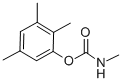
What is 2,3,5-TRIMETHACARB?
The Uses of 2,3,5-TRIMETHACARB
2,3,5-Trimethacarb is a major constituent in landrin insecticide.
The Uses of 2,3,5-TRIMETHACARB
Trimethacarb is an insecticide with primarily stomach action. It is mainly used to control corn root worm larvae in maize but it also controls a wide range of insect and mollusc pests. Trimethacarb acts as a bird and mammal repellent.
Definition
ChEBI: 2,3,5-trimethylphenyl methylcarbamate is a carbamate ester that consists of 2,3,5-trimethylphenol carrying an O-(N-methylcarbamoyl) group. One of two constituents of trimethacarb. It has a role as an agrochemical and an insecticide. It is functionally related to a 2,3,5-trimethylphenol.
Metabolic pathway
The metabolic pathways of trimethacarb in plants, mammals and insects involve mainly oxidation of N-methyl or ring-methyl substituents and conjugation. Some hydroxylation of the phenyl ring and ester hydrolysis occurs. The metabolism of trimethacarb was reviewed by Fukuto (1972), Kuhr and Dorough (1976) and by Schlagbauer and Schlagbauer (1972).
Degradation
Trimethacarb is hydrolysed by strong acids and alkalis but aqueous solutions are stable to light (PM). Trimethacarb was applied to bean leaves and exposed to natural sunlight for 4 days. Both isomers were decomposed more rapidly when exposed to sunlight compared with normal light in the laboratory. The compounds were almost completely decomposed. Major photoproducts resulted from hydroxylation of methyl substituents of the phenyl ring (2 and 3) and of the N-methyl group (5 and 6) (see Schemes 1 and 2). There were few products of hydrolysis (Slade and Casida, 1970; Kuhr and Dorough, 1976).
Properties of 2,3,5-TRIMETHACARB
| Melting point: | 118-123°C |
| Boiling point: | 329.46°C (rough estimate) |
| Density | 1.0945 (rough estimate) |
| vapor pressure | 6.8 x 10⁻³ Pa (25 °C) |
| refractive index | 1.5080 (estimate) |
| storage temp. | Refrigerator |
| solubility | Chloroform (Slightly), Methanol (Slightly) |
| Water Solubility | >58 mg l-1 (23 °C) |
| form | Solid |
| color | White to Off-White |
| EPA Substance Registry System | Trimethacarb (12407-86-2) |
Safety information for 2,3,5-TRIMETHACARB
Computed Descriptors for 2,3,5-TRIMETHACARB
New Products
5-bromo-4-fluoro-2-nitrobenzaldehyde (R)-(-)-2-Amino-1-propanol Cyclobutanone Fmoc-OSu 1-(2-Chloroethyl)pyrrolidine Hydrochloride 2-Amino-2-(4-methylphenyl)acetic acid Obidoxime hydrochloride API Decanoic acid, 2-[4-(phenylmethoxy)phenyl]ethyl ester Piperazine, 1-(3-methoxyphenyl)-, hydrochloride (1:1) 4-Bromo-2,6-difluoroaniline 4 pentyn 1 ol N-Vinylformamide Methacrylate-PEG-Methacrylate, Mn:35000 2,4-Dihydroxyacetophenone 2-Chloro 5-Fluoro Pyridine Vasicinone 2-Chloroisonicotinic Acid Tween 80 or Polysorbate 80 2-Pentyn-1-oL 4-Nitrobenzotrifluoride N-(4-Cyano-3-(trifluoromethyl)phenyl)-2-methyloxirane-2-carboxamide N-(4-fluoro-2-methoxy-5-nitrophenyl)-4-(1-methyl-1H-indol-3-yl)pyrimidin-2-amine Pirtobrutinib intd. 2-Butyn-1-oLRelated products of tetrahydrofuran
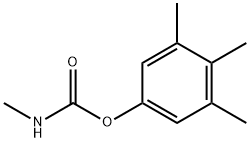
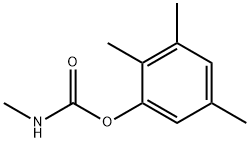
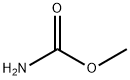
You may like
-
 Fmoc-OSu 98+View Details
82911-69-1 -
(R)-(-)-2-Amino-1-propanol 35320-23-1 98+View Details
35320-23-1 -
7250-67-1 1-(2-Chloroethyl)pyrrolidine Hydrochloride 98+View Details
7250-67-1 -
13227-01-5 98+View Details
13227-01-5 -
7250-67-1 1-(2-Chloroethyl)pyrrolidine Hydrochloride 98+View Details
7250-67-1 -
13227-01-5 98+View Details
13227-01-5 -
7250-67-1 1-(2-Chloroethyl)pyrrolidine Hydrochloride 98+View Details
7250-67-1 -
13227-01-5 98+View Details
13227-01-5