
2,3-Dichloro-5-(trichloromethyl)pyridine
- CAS NO.:69045-83-6
- Empirical Formula: C6H2Cl5N
- Molecular Weight: 265.35
- MDL number: MFCD03701543
- EINECS: 614-912-7
- SAFETY DATA SHEET (SDS)
- Update Date: 2026-05-27 22:46:28
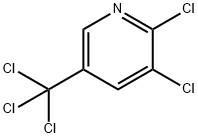
What is 2,3-Dichloro-5-(trichloromethyl)pyridine?
The Uses of 2,3-Dichloro-5-(trichloromethyl)pyridine
2,3-dichloro-5-(trifluoromethyl)pyridine (DCTF) is an important organic intermediate for the agrochemical industry in particular for use in the synthesis of fluazinam and fluopicolide as well as other pesticidal active pyridine compounds.
Synthesis
Conversion of Nicotinic acid to 2,3-dichloro-5-(trichloromethyl)pyridine. Nicotinic acid (2 g, 16.25 mmole) and phosphorous pentachloride (27 g, 130 mmole) was mixed in a 50 ml Teflon autoclave. The autoclave was closed and heated in a 180 °C warm metal block. After 48 hours was the autoclave cooled to 25 °C and opened. The resulting suspension was quenched in a mixture of NaOH (10 %) and dichlorom ethane under stirring, keeping the temperature below 30 °C. The phases were separated and the organic phase was evaporated to dryness to get the crude product. The product was hereafter distilled and 2,8 g of 2,3-dichloro-5-(trichloromethyl)pyridine was obtained (65% yield).
Properties of 2,3-Dichloro-5-(trichloromethyl)pyridine
| Boiling point: | 278-279 °C(lit.) |
| Density | 1.636 g/mL at 25 °C(lit.) |
| refractive index | n |
| Flash point: | 150 °F |
| storage temp. | under inert gas (nitrogen or Argon) at 2-8°C |
| pka | -3.03±0.10(Predicted) |
| EPA Substance Registry System | 2,3-Dichloro-5-(trichloromethyl)pyridine (69045-83-6) |
Safety information for 2,3-Dichloro-5-(trichloromethyl)pyridine
| Signal word | Warning |
| Pictogram(s) |
 Exclamation Mark Irritant GHS07 |
| GHS Hazard Statements |
H315:Skin corrosion/irritation H319:Serious eye damage/eye irritation H335:Specific target organ toxicity, single exposure;Respiratory tract irritation |
| Precautionary Statement Codes |
P261:Avoid breathing dust/fume/gas/mist/vapours/spray. P271:Use only outdoors or in a well-ventilated area. P280:Wear protective gloves/protective clothing/eye protection/face protection. |
Computed Descriptors for 2,3-Dichloro-5-(trichloromethyl)pyridine
New Products
9-Mesityl-10-methylacridinium perchlorate Sulfapyridine Fmoc-OSu (R)-(-)-2-Amino-1-propanol Cyclobutanone 5-bromo-4-fluoro-2-nitrobenzaldehyde 4 pentyn 1 ol N-Vinylformamide Phenethyl cinnamate Pyrrolo[1,2-a]pyrimidine-6-carboxylic acid, 4,6,7,8-tetrahydro-4-oxo-, sodium salt (1:1), (6S) Ethyl 3-phenylpropanoate β-Bromostyrene Methacrylate-PEG-Methacrylate, Mn:35000 2,4-Dihydroxyacetophenone 2-Chloro 5-Fluoro Pyridine Vasicinone 2-Chloroisonicotinic Acid Tween 80 or Polysorbate 80 5-Bromo-1-Pentyne 1-(2-Methyl-5-nitrophenyl)guanidine Nitrate Methyl trans-4-Aminocyclohexanecarboxylate Hydrochloride N-(4-Cyano-3-(trifluoromethyl)phenyl)-2-methyloxirane-2-carboxamide 4-Nitrobenzotrifluoride 2-Pentyn-1-oLRelated products of tetrahydrofuran

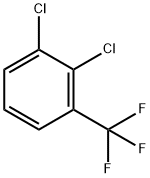
![2,3,6-TRICHLORO-4-[(4-METHYLPHENYL)THIO]-5-(TRIFLUOROMETHYL)PYRIDINE](https://img.chemicalbook.in/StructureFile/ChemBookStructure8/GIF/CB9710296.gif)
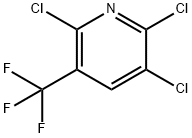
![N-[2,3,6-TRICHLORO-5-(TRIFLUOROMETHYL)PYRIDIN-4-YL]BENZENE-1,2-DIAMINE](https://img.chemicalbook.in/StructureFile/ChemBookStructure8/GIF/CB4377656.gif)

You may like
-
 69045-83-6 2,3-Dichloro-5-trichloromethyl pyridine 98%View Details
69045-83-6 -
 1191-95-3 Cyclobutanone 98+View Details
1191-95-3 -
Fmoc-OSu 98+View Details
82911-69-1 -
(R)-(-)-2-Amino-1-propanol 35320-23-1 98+View Details
35320-23-1 -
1191-95-3 Cyclobutanone 98+View Details
1191-95-3 -
213382-45-7 98+View Details
213382-45-7 -
Fmoc-OSu 98+View Details
82911-69-1 -
(R)-(-)-2-Amino-1-propanol 35320-23-1 98+View Details
35320-23-1