
2,2,6,6-Tetramethyl-4-piperidinol
Synonym(s):4-Hydroxy-2,2,6,6-tetramethylpiperidine
- CAS NO.:2403-88-5
- Empirical Formula: C9H19NO
- Molecular Weight: 157.25
- MDL number: MFCD00005983
- EINECS: 219-291-2
- SAFETY DATA SHEET (SDS)
- Update Date: 2026-07-19 22:55:08
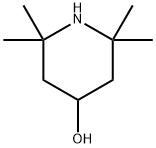
What is 2,2,6,6-Tetramethyl-4-piperidinol?
Chemical properties
white to slightly beige crystalline powder
The Uses of 2,2,6,6-Tetramethyl-4-piperidinol
2,2,6,6-tetramethyl-4-piperidinol has been used to study the irradiation of Camptothecin (CPT) in aerated dimethylsulfoxide (DMSO) solution that leads to formation of singlet oxygen.
The Uses of 2,2,6,6-Tetramethyl-4-piperidinol
An intermediate in the preparation of Piperidinyloxy free radical derivatives.
Synthesis Reference(s)
The Journal of Organic Chemistry, 37, p. 2050, 1972 DOI: 10.1021/jo00977a047
Purification Methods
The piperidine crystallises from water as a hydrate and crystallises from dry ether or *C6H6 as the anhydrous base. The hydrochloride has m 282-284o (from EtOH/H2O), and the formate has m 207o(dec, from EtOH/EtOAc). [Mailey & Day J Org Chem 22 1061 1957, Beilstein 21 I 195, 21 III/IV 146, 21/1 V 159.]
Properties of 2,2,6,6-Tetramethyl-4-piperidinol
| Melting point: | 129-131 °C(lit.) |
| Boiling point: | 212-215 °C(lit.) |
| Density | 1.085 |
| refractive index | 1.4248 (estimate) |
| Flash point: | 212-215°C |
| storage temp. | Keep in dark place,Inert atmosphere,Room temperature |
| solubility | methanol: 0.1 g/mL, clear |
| pka | 14.99±0.60(Predicted) |
| form | Crystals, Crystalline Powder and/or Chunks |
| color | White to off-white or slightly beige |
| PH | 11.2 (4g/l, H2O, 20℃) |
| Water Solubility | 130 g/L (23 ºC) |
| BRN | 105039 |
| CAS DataBase Reference | 2403-88-5(CAS DataBase Reference) |
| NIST Chemistry Reference | 4-Piperidinol, 2,2,6,6-tetramethyl-(2403-88-5) |
| EPA Substance Registry System | 4-Piperidinol, 2,2,6,6-tetramethyl- (2403-88-5) |
Safety information for 2,2,6,6-Tetramethyl-4-piperidinol
| Signal word | Danger |
| Pictogram(s) |
 Corrosion Corrosives GHS05  Exclamation Mark Irritant GHS07 |
| GHS Hazard Statements |
H314:Skin corrosion/irritation H317:Sensitisation, Skin |
| Precautionary Statement Codes |
P260:Do not breathe dust/fume/gas/mist/vapours/spray. P272:Contaminated work clothing should not be allowed out of the workplace. P280:Wear protective gloves/protective clothing/eye protection/face protection. P303+P361+P353:IF ON SKIN (or hair): Remove/Take off Immediately all contaminated clothing. Rinse SKIN with water/shower. P305+P351+P338:IF IN EYES: Rinse cautiously with water for several minutes. Remove contact lenses, if present and easy to do. Continuerinsing. |
Computed Descriptors for 2,2,6,6-Tetramethyl-4-piperidinol
| InChIKey | VDVUCLWJZJHFAV-UHFFFAOYSA-N |
New Products
N-Carbethoxy-4-piperidone 1-Aminocyclopentane carbonitrile Tetrabutylammonium perchlorate N,O-Dimethylhydroxylamine hydrochloride (RS)-beta-Amino-beta-(4-bromophenyl)propionic acid 2-Amino-5-bromo-4-(trifluoromethyl)pyridine N-Vinylformamide 4 pentyn 1 ol Phenethyl cinnamate Dipropyl disulfide Ethyl 3-phenylpropanoate β-Bromostyrene Methacrylate-PEG-Methacrylate, Mn:35000 2,4-Dihydroxyacetophenone 2-Chloro 5-Fluoro Pyridine Vasicinone 2-Chloroisonicotinic Acid Tween 80 or Polysorbate 80 5-Bromo-1-Pentyne 1-(2-Methyl-5-nitrophenyl)guanidine Nitrate Methyl trans-4-Aminocyclohexanecarboxylate Hydrochloride N-(4-Cyano-3-(trifluoromethyl)phenyl)-2-methyloxirane-2-carboxamide 2-Pentyn-1-oL 4-NitrobenzotrifluorideRelated products of tetrahydrofuran
You may like
-
 4-Hydroxy-2,2,6,6-tetramethylpiperidine CAS 2403-88-5View Details
2403-88-5 -
2,2,6,6-Tetramethyl-4-piperidinol CAS 2403-88-5View Details
2403-88-5 -
144-83-2 Sulfapyridine 98+View Details
144-83-2 -
29976-53-2 98+View Details
29976-53-2 -
6638-79-5 N,O-Dimethylhydroxylamine hydrochloride 98+View Details
6638-79-5 -
674783-97-2 98+View Details
674783-97-2 -
1-Aminocyclopentane carbonitrile 98+View Details
49830-37-7 -
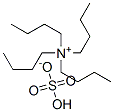
Tetrabutylammonium perchlorate 1923-70-2 98+View Details
1923-70-2
Statement: All products displayed on this website are only used for non medical purposes such as industrial applications or scientific research, and cannot be used for clinical diagnosis or treatment of humans or animals. They are not medicinal or edible.