
2,2,6,6-Tetramethyl-3,5-heptanedione
Synonym(s):Dipivaloylmethane
- CAS NO.:1118-71-4
- Empirical Formula: C11H20O2
- Molecular Weight: 184.28
- MDL number: MFCD00008848
- EINECS: 214-268-3
- SAFETY DATA SHEET (SDS)
- Update Date: 2026-06-04 18:03:49
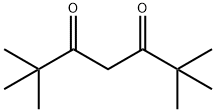
What is 2,2,6,6-Tetramethyl-3,5-heptanedione?
Chemical properties
CLEAR COLOURLESS TO SLIGHTLY YELLOW LIQUID
The Uses of 2,2,6,6-Tetramethyl-3,5-heptanedione
2,2,6,6-tetramethyl-3,5-heptanedione was used in the synthesis of α-aryl-β-diketones1 and dicyanamidobenzene-bridge diruthenium complex.
The Uses of 2,2,6,6-Tetramethyl-3,5-heptanedione
suzuki reaction
The Uses of 2,2,6,6-Tetramethyl-3,5-heptanedione
2,2,6,6-Tetramethyl-3,5-heptanedione is a beta diketone with antibacterial activity.
Definition
2,2,6,6-Tetramethyl-3,5-heptanedioneis a stable, anhydrous reagent. It undergoes O-additions and C-additions. In various reactions, it acts as an air-stable ligand for metal catalysts. Furthermore, it serves as a substrate for heterocycles.
Synthesis Reference(s)
Journal of the American Chemical Society, 100, p. 5428, 1978 DOI: 10.1021/ja00485a030
General Description
Acylation, a replacement to silylation, allows the conversion of compounds that consist of active hydrogens (-OH, -SH and -NH) into esters, thioesters, and amides via the action of a carboxylic acid or derivative. The carbonyl group adjacent to the halogenated carbons is known to improve the electron capture detector (ECD) response. Acylation has several advantages:
- It enhances the stability of compounds by protecting unstable groups.
- It may confer volatility on substances like carbohydrates or amino acids, that have several polar groups that they are non-volatile and usually decompose on heating.
- It facilitates the separations not possible with underivatized compounds.
- Compounds are detectable at very low levels with an ECD.
2,2,6,6-Tetramethyl-3,5-heptanedione is a reagent used to form fragmentation-directing derivatives for GC/MS analysis.
Synthesis
Methyl pivalate and formamide could be used as starting materials to synthesize 2,2,6,6-Tetramethyl-3,5-heptanedione.
Properties of 2,2,6,6-Tetramethyl-3,5-heptanedione
| Melting point: | >400 °C (decomp) |
| Boiling point: | 72-73 °C/6 mmHg (lit.) |
| Density | 0.883 g/mL at 25 °C (lit.) |
| refractive index | n |
| Flash point: | 153 °F |
| storage temp. | Sealed in dry,Room Temperature |
| solubility | Difficult to mix. |
| form | Liquid |
| pka | 11.60±0.10(Predicted) |
| Specific Gravity | 0.883 |
| color | Clear colorless to slightly yellow |
| BRN | 1447269 |
| CAS DataBase Reference | 1118-71-4(CAS DataBase Reference) |
| EPA Substance Registry System | 3,5-Heptanedione, 2,2,6,6-tetramethyl- (1118-71-4) |
Safety information for 2,2,6,6-Tetramethyl-3,5-heptanedione
| Signal word | Warning |
| Pictogram(s) |
 Exclamation Mark Irritant GHS07 |
| GHS Hazard Statements |
H227:Flammable liquids H302:Acute toxicity,oral |
| Precautionary Statement Codes |
P210:Keep away from heat/sparks/open flames/hot surfaces. — No smoking. P264:Wash hands thoroughly after handling. P264:Wash skin thouroughly after handling. P280:Wear protective gloves/protective clothing/eye protection/face protection. P370+P378:In case of fire: Use … for extinction. P403+P235:Store in a well-ventilated place. Keep cool. P501:Dispose of contents/container to..… |
Computed Descriptors for 2,2,6,6-Tetramethyl-3,5-heptanedione
| InChIKey | YRAJNWYBUCUFBD-UHFFFAOYSA-N |
New Products
9-Mesityl-10-methylacridinium perchlorate Sulfapyridine Fmoc-OSu (R)-(-)-2-Amino-1-propanol Cyclobutanone 5-bromo-4-fluoro-2-nitrobenzaldehyde 4 pentyn 1 ol N-Vinylformamide Phenethyl cinnamate Pyrrolo[1,2-a]pyrimidine-6-carboxylic acid, 4,6,7,8-tetrahydro-4-oxo-, sodium salt (1:1), (6S) Ethyl 3-phenylpropanoate β-Bromostyrene Methacrylate-PEG-Methacrylate, Mn:35000 2,4-Dihydroxyacetophenone 2-Chloro 5-Fluoro Pyridine Vasicinone 2-Chloroisonicotinic Acid Tween 80 or Polysorbate 80 5-Bromo-1-Pentyne 1-(2-Methyl-5-nitrophenyl)guanidine Nitrate Methyl trans-4-Aminocyclohexanecarboxylate Hydrochloride N-(4-Cyano-3-(trifluoromethyl)phenyl)-2-methyloxirane-2-carboxamide 4-Nitrobenzotrifluoride 2-Pentyn-1-oLRelated products of tetrahydrofuran
You may like
-
 Dipivaloylmethane CAS 1118-71-4View Details
1118-71-4 -
2,2,6,6-Tetramethyl-3,5-heptanedione CAS 1118-71-4View Details
1118-71-4 -
Fmoc-OSu 98+View Details
82911-69-1 -
(R)-(-)-2-Amino-1-propanol 35320-23-1 98+View Details
35320-23-1 -
1191-95-3 Cyclobutanone 98+View Details
1191-95-3 -
213382-45-7 98+View Details
213382-45-7 -
Fmoc-OSu 98+View Details
82911-69-1 -
(R)-(-)-2-Amino-1-propanol 35320-23-1 98+View Details
35320-23-1