
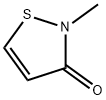
2-Methyl-4-isothiazolin-3-one hydrochloride
Synonym(s):Methylisothiazolinone hydrochloride;MIT
- CAS NO.:26172-54-3
- Empirical Formula: C4H6ClNOS
- Molecular Weight: 151.61
- MDL number: MFCD06804636
- EINECS: 247-499-3
- SAFETY DATA SHEET (SDS)
- Update Date: 2026-06-16 21:18:09
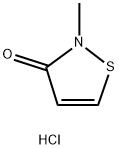
What is 2-Methyl-4-isothiazolin-3-one hydrochloride?
The Uses of 2-Methyl-4-isothiazolin-3-one hydrochloride
2-Methyl-4-isothiazolin-3-one Hydrochloride is an isothiazolinone based biocide and preservative used in personal care products. It is also implicated as an allergen. It is also used for controlling microbial growth in water-containing solution.
What are the applications of Application
Methylisothiazolinone (MIT) has been used:
as a cytotoxic substance to investigate its effect on bronchial epithelial cells (BEAS-2B cells) and its role in apoptotic cell death
to study the effects of tyrosine phosphorylation on focal adhesion kinase (FAK) activity in the development of neural axons and dendrites
General Description
2-Methyl-4-isothiazolin-3-one hydrochloride (MIT) is a derivative of the synthetic isothiazolinone.
Biochem/physiol Actions
2-Methyl-4-isothiazolin-3-one hydrochloride (MIT) is a skin sensitizer known to cause contact dermatitis and allergy. It is extensively used in the cosmetic industry as a preservative. MIT is a neurotoxin and its prolonged exposure may lead to neuronal death and inhibition of neurite outgrowth.
Storage
store at 2°C - 8°C,close container well.
Properties of 2-Methyl-4-isothiazolin-3-one hydrochloride
| Density | 1.551 at 21℃ |
| vapor pressure | 0.777-1Pa at 20-25℃ |
| storage temp. | 2-8°C |
| solubility | DMSO (Slightly), Methanol (Slightly) |
| form | Solid |
| color | White to Off-White |
| BRN | 3993054 |
| Stability: | Hygroscopic |
| CAS DataBase Reference | 26172-54-3(CAS DataBase Reference) |
| EPA Substance Registry System | 3(2H)-Isothiazolone, 2-methyl-, hydrochloride (26172-54-3) |
Safety information for 2-Methyl-4-isothiazolin-3-one hydrochloride
| Signal word | Danger |
| Pictogram(s) |
 Corrosion Corrosives GHS05  Skull and Crossbones Acute Toxicity GHS06  Environment GHS09 |
| GHS Hazard Statements |
H301:Acute toxicity,oral H314:Skin corrosion/irritation H317:Sensitisation, Skin H410:Hazardous to the aquatic environment, long-term hazard |
| Precautionary Statement Codes |
P260:Do not breathe dust/fume/gas/mist/vapours/spray. P273:Avoid release to the environment. P280:Wear protective gloves/protective clothing/eye protection/face protection. P303+P361+P353:IF ON SKIN (or hair): Remove/Take off Immediately all contaminated clothing. Rinse SKIN with water/shower. P305+P351+P338:IF IN EYES: Rinse cautiously with water for several minutes. Remove contact lenses, if present and easy to do. Continuerinsing. |
Computed Descriptors for 2-Methyl-4-isothiazolin-3-one hydrochloride
2-Methyl-4-isothiazolin-3-one hydrochloride manufacturer
Ina pharmaceuticals Pvt Ltd
New Products
2-(2-Chlorophenyl)glycine Propiolic Acid 1-(3-Hydroxy-4-methoxyphenyl)-2-nitroethene (±)-amino(2-fluorophenyl)acetic acid trans-3-Benzyloxy-4-methoxy-beta-nitrostyrene 1-Pentadecanol 4-(4-Αminophenyl)-3-Morpholinone 3-Morpholino-1-(4-(2-oxopiperidin-1-yl) phenyl)-5,6-dihyropyridin-2-(1H)-one 1-(4-Aminophenyl)-3-morpholino-5,6-dihydropyridin-2(1H)-one N-cyanoacetylurethane 1H-IndazoleRelated products of tetrahydrofuran

You may like
-
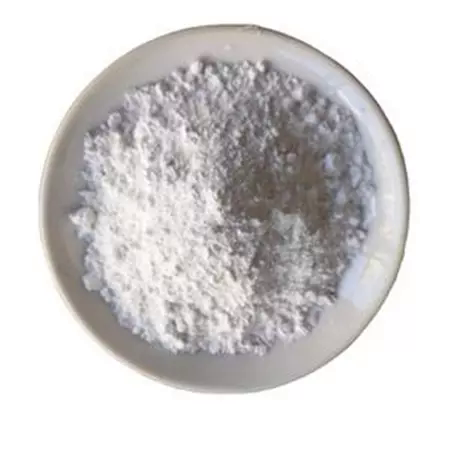 26172-54-3 2-Methyl-4-isothiazolin-3-one Hydrochloride 98%View Details
26172-54-3 -
 2-Methyl-4-isothiazolin-3-one hydrochloride CAS 26172-54-3View Details
26172-54-3 -
2-Methyl-4-isothiazolin-3-one hydrochloride 26172-54-3 99%View Details
26172-54-3 -
471-25-0 Propiolic Acid 98+View Details
471-25-0 -
84145-28-8 98+View Details
84145-28-8 -
2-(2-Chlorophenyl)glycine 88744-36-9 98+View Details
88744-36-9 -
40216-83-9 trans-4-Hydroxy-L-proline methyl ester hydrochloride 98+View Details
40216-83-9 -
1-(3-Hydroxy-4-methoxyphenyl)-2-nitroethene 98+View Details
39816-35-8