
2-Hydroxyethylhydrazine
Synonym(s):2-Hydrazinoethanol
- CAS NO.:109-84-2
- Empirical Formula: C2H8N2O
- Molecular Weight: 76.1
- MDL number: MFCD00007623
- EINECS: 203-711-6
- SAFETY DATA SHEET (SDS)
- Update Date: 2026-07-31 15:25:14
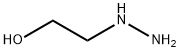
What is 2-Hydroxyethylhydrazine?
Chemical properties
Clear colorless oily liquid
The Uses of 2-Hydroxyethylhydrazine
Intermediate, plant growth regulator, flowering inducer for pineapples.
The Uses of 2-Hydroxyethylhydrazine
(2-Hydroxyethyl)hydrazine is used as a plant growth regulant, a component in jet fuels, intermediate for organic synthesis especially heterocycles used in agrochemicals, pharmaceuticals, stabilizers and polymerizations, Chain extender for urethane formulations, corrosion inhibitor.
Definition
ChEBI: 2-hydrazinoethanol is a member of hydrazines. It has a role as a herbicide. It is functionally related to an ethanol.
General Description
2-Hydroxyethylhydrazine reacts with β-diketones having strong electron-withdrawing substituents to yield 5-hydroxy-4,5-dihydropyrazoles.
Hazard
Moderate fire risk. Irritant.
Properties of 2-Hydroxyethylhydrazine
| Melting point: | −70 °C(lit.) |
| Boiling point: | 155-160 °C32 mm Hg(lit.) |
| Density | 1.123 g/mL at 25 °C(lit.) |
| refractive index | n |
| Flash point: | 165 °F |
| storage temp. | Keep in dark place,Inert atmosphere,Store in freezer, under -20°C |
| solubility | soluble in DMSO, Methanol |
| form | Liquid |
| pka | 14.79±0.10(Predicted) |
| color | Colorless to Almost colorless |
| Water Solubility | Soluble in water, alcohols and glycols. |
| Merck | 13,4794 |
| BRN | 1731669 |
| CAS DataBase Reference | 109-84-2(CAS DataBase Reference) |
| NIST Chemistry Reference | 2-Hydroxyethylhydrazine(109-84-2) |
| EPA Substance Registry System | 2-Hydroxyethylhydrazine (109-84-2) |
Safety information for 2-Hydroxyethylhydrazine
| Signal word | Danger |
| Pictogram(s) |
 Skull and Crossbones Acute Toxicity GHS06  Health Hazard GHS08 |
| GHS Hazard Statements |
H315:Skin corrosion/irritation H319:Serious eye damage/eye irritation H335:Specific target organ toxicity, single exposure;Respiratory tract irritation H351:Carcinogenicity |
| Precautionary Statement Codes |
P201:Obtain special instructions before use. P280:Wear protective gloves/protective clothing/eye protection/face protection. P305+P351+P338:IF IN EYES: Rinse cautiously with water for several minutes. Remove contact lenses, if present and easy to do. Continuerinsing. |
Computed Descriptors for 2-Hydroxyethylhydrazine
| InChIKey | GBHCABUWWQUMAJ-UHFFFAOYSA-N |
New Products
Cyclobutanone (R)-(-)-2-Amino-1-propanol Fmoc-OSu 5-bromo-4-fluoro-2-nitrobenzaldehyde 2-Amino-2-(4-methylphenyl)acetic acid 1-(2-Chloroethyl)pyrrolidine Hydrochloride 2,4-Dihydroxybenzaldehyde Obidoxime hydrochloride API Pyrrolo[1,2-a]pyrimidine-6-carboxylic acid, 4,6,7,8-tetrahydro-4-oxo-, sodium salt (1:1), (6S) Dipropyl disulfide N-Vinylformamide 4 pentyn 1 ol Methacrylate-PEG-Methacrylate, Mn:35000 2,4-Dihydroxyacetophenone 2-Chloro 5-Fluoro Pyridine Vasicinone 2-Chloroisonicotinic Acid Tween 80 or Polysorbate 80 2-Butyn-1-oL N-(4-fluoro-2-methoxy-5-nitrophenyl)-4-(1-methyl-1H-indol-3-yl)pyrimidin-2-amine Pirtobrutinib intd. 2-Pentyn-1-oL 4-Nitrobenzotrifluoride N-(4-Cyano-3-(trifluoromethyl)phenyl)-2-methyloxirane-2-carboxamideRelated products of tetrahydrofuran

You may like
-
 (2-Hydroxyethyl)hydrazine CAS 109-84-2View Details
109-84-2 -
(2-Hydroxyethyl)hydrazine CAS 109-84-2View Details
109-84-2 -
(2-Hydroxyethyl)hydrazine CAS 109-84-2View Details
109-84-2 -
2-Hydrazinoethanol CAS 109-84-2View Details
109-84-2 -
2-Hydroxyethylhydrazine CAS 109-84-2View Details
109-84-2 -
545445-44-1 3-Morpholino-1-(4-(2-oxopiperidin-1-yl) phenyl)-5,6-dihyropyridin-2-(1H)-one 98%View Details
545445-44-1 -
6629-04-5 98%View Details
6629-04-5 -
1-(4-Aminophenyl)-3-morpholino-5,6-dihydropyridin-2(1H)-one 1267610-26-3 98%View Details
1267610-26-3
Statement: All products displayed on this website are only used for non medical purposes such as industrial applications or scientific research, and cannot be used for clinical diagnosis or treatment of humans or animals. They are not medicinal or edible.