
2-(Diethylamino)-ethyl acrylate
Synonym(s):(N ,N -Diethylamino)ethyl acrylate;[2-(Acryloyloxy)ethyl]diethylamine
- CAS NO.:2426-54-2
- Empirical Formula: C9H17NO2
- Molecular Weight: 171.24
- MDL number: MFCD00042882
- EINECS: 219-378-5
- SAFETY DATA SHEET (SDS)
- Update Date: 2026-05-28 02:38:04
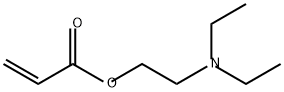
What is 2-(Diethylamino)-ethyl acrylate ?
The Uses of 2-(Diethylamino)-ethyl acrylate
Rodrigues et al. prepared novel temperature and pH-responsive copolymers of [2-(acryloyloxy)ethyl] trimethylammonium chloride (AEtMACl) and 2-(diethylamino)ethyl acrylate (DEAEA) by RAFT polymerization. Such copolymers show a volume phase transition temperature that explains the excellent performance of hydrogels of the same monomers, selected among 600 monomer combinations, to release cultured stem cells using only a mild temperature stimulus[1].
References
[1] Ana Sofia Rodrigues . “Temperature-responsive copolymers without compositional drift by RAFT copolymerization of 2-(acryloyloxy)ethyl trimethylammonium chloride and 2-(diethylamino)ethyl acrylate1.” Polymer Chemistry 10 17 (2019): Pages 2106-2116.
Properties of 2-(Diethylamino)-ethyl acrylate
| Melting point: | -60°C |
| Boiling point: | 199 °C(lit.) |
| Density | 0.922 g/mL at 25 °C(lit.) |
| vapor pressure | 0.77 psi ( 20 °C) |
| refractive index | n |
| Flash point: | 165 °F |
| pka | 9.20±0.25(Predicted) |
| InChI | InChI=1S/C9H17NO2/c1-4-9(11)12-8-7-10(5-2)6-3/h4H,1,5-8H2,2-3H3 |
| CAS DataBase Reference | 2426-54-2(CAS DataBase Reference) |
| EPA Substance Registry System | 2-(Diethylamino)ethyl acrylate (2426-54-2) |
Safety information for 2-(Diethylamino)-ethyl acrylate
| Signal word | Danger |
| Pictogram(s) |
 Corrosion Corrosives GHS05  Skull and Crossbones Acute Toxicity GHS06 |
| GHS Hazard Statements |
H302:Acute toxicity,oral H310:Acute toxicity,dermal H314:Skin corrosion/irritation H317:Sensitisation, Skin |
| Precautionary Statement Codes |
P261:Avoid breathing dust/fume/gas/mist/vapours/spray. P270:Do not eat, drink or smoke when using this product. P280:Wear protective gloves/protective clothing/eye protection/face protection. P301+P312:IF SWALLOWED: call a POISON CENTER or doctor/physician IF you feel unwell. P303+P361+P353:IF ON SKIN (or hair): Remove/Take off Immediately all contaminated clothing. Rinse SKIN with water/shower. P305+P351+P338:IF IN EYES: Rinse cautiously with water for several minutes. Remove contact lenses, if present and easy to do. Continuerinsing. |
Computed Descriptors for 2-(Diethylamino)-ethyl acrylate
| InChIKey | QHVBLSNVXDSMEB-UHFFFAOYSA-N |
| SMILES | C(OCCN(CC)CC)(=O)C=C |
New Products
9-Mesityl-10-methylacridinium perchlorate Sulfapyridine Fmoc-OSu (R)-(-)-2-Amino-1-propanol Cyclobutanone 5-bromo-4-fluoro-2-nitrobenzaldehyde 4 pentyn 1 ol N-Vinylformamide Phenethyl cinnamate Pyrrolo[1,2-a]pyrimidine-6-carboxylic acid, 4,6,7,8-tetrahydro-4-oxo-, sodium salt (1:1), (6S) Ethyl 3-phenylpropanoate β-Bromostyrene Methacrylate-PEG-Methacrylate, Mn:35000 2,4-Dihydroxyacetophenone 2-Chloro 5-Fluoro Pyridine Vasicinone 2-Chloroisonicotinic Acid Tween 80 or Polysorbate 80 5-Bromo-1-Pentyne 1-(2-Methyl-5-nitrophenyl)guanidine Nitrate Methyl trans-4-Aminocyclohexanecarboxylate Hydrochloride N-(4-Cyano-3-(trifluoromethyl)phenyl)-2-methyloxirane-2-carboxamide 4-Nitrobenzotrifluoride 2-Pentyn-1-oLRelated products of tetrahydrofuran



You may like
-
 2-(Diethylamino)ethyl acrylate CAS 2426-54-2View Details
2426-54-2 -
1191-95-3 Cyclobutanone 98+View Details
1191-95-3 -
Fmoc-OSu 98+View Details
82911-69-1 -
(R)-(-)-2-Amino-1-propanol 35320-23-1 98+View Details
35320-23-1 -
1191-95-3 Cyclobutanone 98+View Details
1191-95-3 -
213382-45-7 98+View Details
213382-45-7 -
Fmoc-OSu 98+View Details
82911-69-1 -
(R)-(-)-2-Amino-1-propanol 35320-23-1 98+View Details
35320-23-1
Statement: All products displayed on this website are only used for non medical purposes such as industrial applications or scientific research, and cannot be used for clinical diagnosis or treatment of humans or animals. They are not medicinal or edible.