
Binodenoson
- CAS NO.:144348-08-3
- Empirical Formula: C17H25N7O4
- Molecular Weight: 391.42
- MDL number: MFCD00467988
- SAFETY DATA SHEET (SDS)
- Update Date: 2026-05-28 03:08:45
What is Binodenoson ?
Description
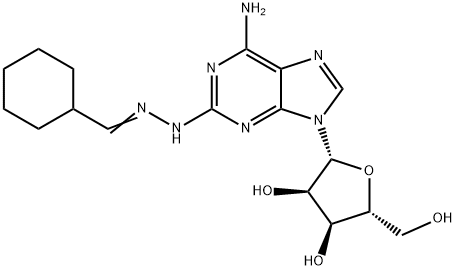
Binodenoson, 2-[(cyclohexylmethylene)hydrazino] adenosine (MRE0470), is being developed as a short-acting coronary vasodilator, administered intravenously, as an adjunct to radiotracers in myocardial stress imaging techniques to detect the presence and severity of CAD in patients unable to exercise. The compound is a highly selective agonist at the adenosine A2A receptor and also has a weaker affinity for adenosine A1-, A2B-, and A3-receptor subtypes than adenosine[1].
The Uses of Binodenoson
2-(cyclohexylmethylidenehydrazino)adenosine is used in the diagnosis of coronary heart disease (adenosine A2A agonist).
Pharmacokinetics
The mean values for the apparent elimination half-life of binodenoson ranged from 7.4 minutes (at 1 g/kg) to 14.9 minutes (6 g/kg), with a slight tendency toward higher values with increasing doses. However, because the plasma concentrations for the lowest dose level (0.4 g/kg) were only marginally higher than the assay's lower limit of quantitation, the plasma concentrations could be determined for a longer period of time at the higher dose levels. On average (harmonic mean), the terminal half-life of binodenoson across all doses was 10±4 minutes[1].
in vitro
Binodenoson (MRE-0470) (30-300 nM) decreases oxidative activity of tumor necrosis factor-α–primed FMLP-stimulated polymorphonuclear leukocytes in human whole blood and acts synergistically with Rolipram.
in vivo
Binodenoson (infused 0-0.9 μg/kg/h; adult Wistar rat; rat bacterial meningitis model), with or without rolipram (0-0.01 μg/kg/h), inhibits pleocytosis and reduces the lipopolysaccharide-induced increase in blood-brain barrier permeability (BBBP), indicative of decreased neutrophil-induced damage.
References
[1] Richard J. Barrett PhD . “Pharmacokinetics and safety of binodenoson after intravenous dose escalation in healthy volunteers.” Journal of Nuclear Cardiology 12 2 (2005): Pages 166-171.
Properties of Binodenoson
| Melting point: | 154-157° |
| Boiling point: | 765.6±70.0 °C(Predicted) |
| Density | 1.76 |
| storage temp. | Store at -20°C |
| solubility | DMSO : 125 mg/mL (319.35 mM; Need ultrasonic) |
| pka | 6.92±0.70(Predicted) |
| form | Solid |
| color | White to off-white |
Safety information for Binodenoson
Computed Descriptors for Binodenoson
| InChIKey | XJFMHMFFBSOEPR-XNIJJKJLSA-N |
| SMILES | OC[C@H]1O[C@@H](N2C3C(=C(N=C(NN=CC4CCCCC4)N=3)N)N=C2)[C@H](O)[C@@H]1O |
New Products
N-Carbethoxy-4-piperidone 1-Aminocyclopentane carbonitrile Tetrabutylammonium perchlorate N,O-Dimethylhydroxylamine hydrochloride (RS)-beta-Amino-beta-(4-bromophenyl)propionic acid 2-Amino-5-bromo-4-(trifluoromethyl)pyridine N-Vinylformamide 4 pentyn 1 ol Phenethyl cinnamate Dipropyl disulfide Ethyl 3-phenylpropanoate β-Bromostyrene Methacrylate-PEG-Methacrylate, Mn:35000 2,4-Dihydroxyacetophenone 2-Chloro 5-Fluoro Pyridine Vasicinone 2-Chloroisonicotinic Acid Tween 80 or Polysorbate 80 5-Bromo-1-Pentyne 1-(2-Methyl-5-nitrophenyl)guanidine Nitrate Methyl trans-4-Aminocyclohexanecarboxylate Hydrochloride N-(4-Cyano-3-(trifluoromethyl)phenyl)-2-methyloxirane-2-carboxamide 2-Pentyn-1-oL 4-NitrobenzotrifluorideRelated products of tetrahydrofuran
You may like
-
 144-83-2 Sulfapyridine 98+View Details
144-83-2 -
29976-53-2 98+View Details
29976-53-2 -
2-Amino-5-bromo-4-(trifluoromethyl)pyridine 98+View Details
944401-56-3 -
(RS)-beta-Amino-beta-(4-bromophenyl)propionic acid 39773-47-2 98+View Details
39773-47-2 -
6638-79-5 N,O-Dimethylhydroxylamine hydrochloride 98+View Details
6638-79-5 -
674783-97-2 98+View Details
674783-97-2 -
1-Aminocyclopentane carbonitrile 98+View Details
49830-37-7 -
Tetrabutylammonium perchlorate 1923-70-2 98+View Details
1923-70-2