
1,4-Diaminobutane dihydrochloride
Synonym(s):1,4-Butanediamine dihydrochloride;1,4-Butanediammonium dichloride, Putrescine dihydrochloride, Tetramethylenediammonium dichloride;1,4-Diaminobutane dihydrochloride;Putrescine dihydrochloride;Tetramethylenediamine dihydrochloride
- CAS NO.:333-93-7
- Empirical Formula: C4H14Cl2N2
- Molecular Weight: 161.07
- MDL number: MFCD00012526
- EINECS: 206-375-9
- SAFETY DATA SHEET (SDS)
- Update Date: 2026-05-28 06:32:13
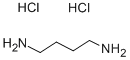
What is 1,4-Diaminobutane dihydrochloride?
Chemical properties
white powder
The Uses of 1,4-Diaminobutane dihydrochloride
Putrescine dihydrochloride has been used as medium component in F-12 + GlutaMax medium for mice ganglia culture, retinal ganglion cell culture and in HCT116 colon carcinoma cells for ornithine decarboxylase (ODC) assay.
What are the applications of Application
Putrescine dihydrochloride is an NMDA agonist
General Description
Putrescine is an end product of fatty acid metabolism in dead tissues. It is a volatile diamine with pungent odour. It is synthesized by the decarboxylation of ornithine in the presence of enzyme, ornithine decarboxylase. Molecular docking studies reveal the binding of putrescine to human receptors called the trace amine-associated receptors (TAAR6 and TAAR8), present in olfactory epithelium.
Biochem/physiol Actions
Binds to the polyamine modulatory site of the NMDA receptor and potentiates NMDA-induced currents; precursor of spermidine.
Purification Methods
Crystallise the salt from EtOH/H2O. [Beilstein 4 IV 1284.]
Properties of 1,4-Diaminobutane dihydrochloride
| Melting point: | 280 °C (dec.)(lit.) |
| Boiling point: | 265.47°C (rough estimate) |
| Density | 1.2524 (rough estimate) |
| refractive index | 1.6300 (estimate) |
| storage temp. | Store below +30°C. |
| solubility | H2O: 100 mg/mL |
| form | powder |
| color | White |
| Water Solubility | almost transparency |
| Sensitive | Hygroscopic |
| Merck | 14,7947 |
| BRN | 3906680 |
| Stability: | Stable, but hygroscopic. Substances to be avoided: strong oxidizing agents. Combustible. |
| CAS DataBase Reference | 333-93-7(CAS DataBase Reference) |
| EPA Substance Registry System | 1,4-Diaminobutane dihydrochloride (333-93-7) |
Safety information for 1,4-Diaminobutane dihydrochloride
| Signal word | Danger |
| Pictogram(s) |
 Corrosion Corrosives GHS05  Skull and Crossbones Acute Toxicity GHS06 |
| GHS Hazard Statements |
H290:Corrosive to Metals H302:Acute toxicity,oral H311:Acute toxicity,dermal H314:Skin corrosion/irritation H330:Acute toxicity,inhalation |
| Precautionary Statement Codes |
P260:Do not breathe dust/fume/gas/mist/vapours/spray. P280:Wear protective gloves/protective clothing/eye protection/face protection. P301+P312:IF SWALLOWED: call a POISON CENTER or doctor/physician IF you feel unwell. P303+P361+P353:IF ON SKIN (or hair): Remove/Take off Immediately all contaminated clothing. Rinse SKIN with water/shower. P305+P351+P338:IF IN EYES: Rinse cautiously with water for several minutes. Remove contact lenses, if present and easy to do. Continuerinsing. |
Computed Descriptors for 1,4-Diaminobutane dihydrochloride
| InChIKey | XXWCODXIQWIHQN-UHFFFAOYSA-N |
New Products
N-Carbethoxy-4-piperidone 1-Aminocyclopentane carbonitrile Tetrabutylammonium perchlorate N,O-Dimethylhydroxylamine hydrochloride (RS)-beta-Amino-beta-(4-bromophenyl)propionic acid 2-Amino-5-bromo-4-(trifluoromethyl)pyridine N-Vinylformamide 4 pentyn 1 ol Phenethyl cinnamate Pyrrolo[1,2-a]pyrimidine-6-carboxylic acid, 4,6,7,8-tetrahydro-4-oxo-, sodium salt (1:1), (6S) Ethyl 3-phenylpropanoate β-Bromostyrene Methacrylate-PEG-Methacrylate, Mn:35000 2,4-Dihydroxyacetophenone 2-Chloro 5-Fluoro Pyridine Vasicinone 2-Chloroisonicotinic Acid Tween 80 or Polysorbate 80 5-Bromo-1-Pentyne 1-(2-Methyl-5-nitrophenyl)guanidine Nitrate Methyl trans-4-Aminocyclohexanecarboxylate Hydrochloride 2-Pentyn-1-oL 4-Nitrobenzotrifluoride N-(4-Cyano-3-(trifluoromethyl)phenyl)-2-methyloxirane-2-carboxamideRelated products of tetrahydrofuran




You may like
-
![Putrescine Dihydrochloride [for Protein Research] CAS 333-93-7](https://img.chemicalbook.in//Content/image/CP5.jpg) Putrescine Dihydrochloride [for Protein Research] CAS 333-93-7View Details
Putrescine Dihydrochloride [for Protein Research] CAS 333-93-7View Details
333-93-7 -
Putrescine Dihydrochloride for tissue culture CAS 333-93-7View Details
333-93-7 -
Putrescine Dihydrochloride extrapure CAS 333-93-7View Details
333-93-7 -
1,4-Diaminobutane dihydrochloride, 95% CAS 333-93-7View Details
333-93-7 -
Putrescine dihydrochloride CAS 333-93-7View Details
333-93-7 -
Putrescine dihydrochloride CAS 333-93-7View Details
333-93-7 -
1,4-Diaminobutane dihydrochloride CAS 333-93-7View Details
333-93-7 -
 PUTRESCINE DIHYDROCHLORIDE CAS No : 333-93-7View Details
333-93-7