
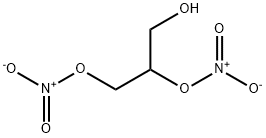
1,2-PROPANEDIOL DINITRATE
- CAS NO.:6423-43-4
- Empirical Formula: C3H6N2O6
- Molecular Weight: 166.09
- MDL number: MFCD01698023
- EINECS: 229-180-0
- SAFETY DATA SHEET (SDS)
- Update Date: 2026-05-20 15:44:42
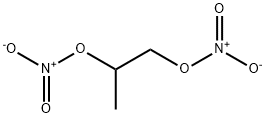
What is 1,2-PROPANEDIOL DINITRATE?
Chemical properties
Colorless liquid; unpleasant odor. Slightly soluble in water.
Chemical properties
Propylene glycol dinitrate is an explosive. It is a colorless, high-boiling liquid (solid below -8℃) with a disagreeable odor.
The Uses of 1,2-PROPANEDIOL DINITRATE
Torpedo propellant in Otto Fuel II.
The Uses of 1,2-PROPANEDIOL DINITRATE
In the torpedo propellant Otto fuel II
General Description
Colorless liquid with a disagreeable odor. Mp: -30°C. Density 1.37 g cm-3 at 20°C. Slightly soluble in water (7.97 g L-1 H2O at 24.85°C).
Reactivity Profile
1,2-PROPANEDIOL DINITRATE is explosive. Acts as a strong oxidizing agent. Heating may cause a violent combustion or explosion producing toxic fumes (nitrogen oxides). May also decompose explosively from shock, friction or from a build-up of electrostatic charge that sparks suddenly to ground. Can begin a vigorous reaction that culminates in an explosion if mixed with reducing agents including hydrides, sulfides, and nitrides and numerous ordinary combustible materials. Reacts violently with Al, BP, cyanides, esters, PN2H, P, NaCN, SnCl2, sodium hypophosphite, and thiocyanates. Reacts with acids and with alkalis, including ammonia and amines. Must be stored in a cool, ventilated place, away from acute fire hazards and easily oxidized materials.
Hazard
Toxic by inhalation and skin absorption. Headache and central nervous system impairment.
Health Hazard
Propylene glycol dinitrate (PGDN) is a vasodilator, and at extremely high concentrations it causes methemoglobin formation.
Safety Profile
Poison by ingestion and subcutaneous routes. Moderately toxic by intraperitoneal and intravenous routes. Human systemic effects by inhalation: conjunctiva irritation, headache. An eye irritant. When heated to decomposition it emits toxic fumes of NOx. See also NITRATES.
Potential Exposure
Propylene glycol dinitrate has been used as a torpedo propellant. The explosion potential is similar to ethylene glycol dinitrate.
Carcinogenicity
Negative results were reported in various mutagenic assays including the Ames Salmonella assay (with or without microsomal activation), sister chromatid exchange assay in mouse lymphoma cells, mouse bone marrow cytogenic analysis, and mouse dominant lethal assay.
Shipping
UN0473 Substances, explosive, n.o.s., Hazard Class: 1.1A; Labels:1.1A-Explosive (with a mass explosion hazard); A-Substances which are expected to mass detonate very soon after fire reaches them, Technical Name Required.
Incompatibilities
Explosive. A strong oxidizer. Contact with ammonia compounds, amines, strong acids; reducing agents; combustible materials may result in fire and explo- sion. It is similar to ethylene glycol dinitrate in explosion potential. Propylene glycol dinitrate may explode if strongly shocked or heated. Propylene glycol dinitrate is explosive. Acts as a strong oxidizing agent. Heating may cause a violent combustion or explosion producing toxic fumes (nitrogen oxides). May also decompose explosively from shock, friction or from a build-up of electrostatic charge that sparks suddenly to ground. Can begin a vigorous reaction that culminates in an explosion if mixed with reducing agents including hydrides, sulfides, and nitrides and numerous ordinary combustible materials. Reacts violently with al, bp, cyanides, esters, pn2h, p, nacn, sncl2, sodium hypophosphite, and thiocyanates. Reacts with acids and with alkalis, including ammonia and amines .
Waste Disposal
Dissolve or mix the material with a combustible solvent and burn in a chemical incinerator equipped with an afterburner and scrubber. All federal, state, and local environmental regulations must be observed.
Properties of 1,2-PROPANEDIOL DINITRATE
| Boiling point: | 294.26°C (rough estimate) |
| refractive index | 1.4715 (estimate) |
| form | Red-orange or colorless
liquid with a disagreeable odor. |
| Dielectric constant | 26.800000000000001 |
| EPA Substance Registry System | Propylene glycol dinitrate (6423-43-4) |
Safety information for 1,2-PROPANEDIOL DINITRATE
Computed Descriptors for 1,2-PROPANEDIOL DINITRATE
New Products
9-Mesityl-10-methylacridinium perchlorate Sulfapyridine Fmoc-OSu (R)-(-)-2-Amino-1-propanol Cyclobutanone 5-bromo-4-fluoro-2-nitrobenzaldehyde 4 pentyn 1 ol N-Vinylformamide Phenethyl cinnamate Pyrrolo[1,2-a]pyrimidine-6-carboxylic acid, 4,6,7,8-tetrahydro-4-oxo-, sodium salt (1:1), (6S) Ethyl 3-phenylpropanoate β-Bromostyrene Methacrylate-PEG-Methacrylate, Mn:35000 2,4-Dihydroxyacetophenone 2-Chloro 5-Fluoro Pyridine Vasicinone 2-Chloroisonicotinic Acid Tween 80 or Polysorbate 80 Methyl trans-4-Aminocyclohexanecarboxylate Hydrochloride N-(4-fluoro-2-methoxy-5-nitrophenyl)-4-(1-methyl-1H-indol-3-yl)pyrimidin-2-amine Pirtobrutinib intd. 4-Nitrobenzotrifluoride 2-Pentyn-1-oL N-(4-Cyano-3-(trifluoromethyl)phenyl)-2-methyloxirane-2-carboxamideRelated products of tetrahydrofuran
![1,2-PROPANEDIOL DINITRATE, [1-14C]](https://img.chemicalbook.in/StructureFile/ChemBookStructure2/GIF/CB4383934.gif)

![GLYCEROL TRINITRATE, [2-14C]](https://img.chemicalbook.in/StructureFile/ChemBookStructure2/GIF/CB1151093.gif)
You may like
-
 1191-95-3 Cyclobutanone 98+View Details
1191-95-3 -
213382-45-7 98+View Details
213382-45-7 -
Fmoc-OSu 98+View Details
82911-69-1 -
(R)-(-)-2-Amino-1-propanol 35320-23-1 98+View Details
35320-23-1 -
1191-95-3 Cyclobutanone 98+View Details
1191-95-3 -
213382-45-7 98+View Details
213382-45-7 -
Fmoc-OSu 98+View Details
82911-69-1 -
(R)-(-)-2-Amino-1-propanol 35320-23-1 98+View Details
35320-23-1