
1-(Bromoacetyl)pyrene
- CAS NO.:80480-15-5
- Empirical Formula: C18H11BrO
- Molecular Weight: 323.18
- MDL number: MFCD00191839
- SAFETY DATA SHEET (SDS)
- Update Date: 2026-09-12 18:44:25
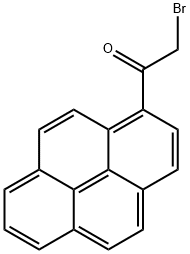
What is 1-(Bromoacetyl)pyrene?
Chemical properties
Yellow solid
The Uses of 1-(Bromoacetyl)pyrene
1-(Bromoacetyl)pyrene is suitable for use in the following studies:
- As an initiator in the bulk polymerization of 2-ethyl-2-oxazoline to generate pyrene labelled poly(2-ethyl-2-oxazoline) (PETOX-py).
- As a fluorophore in the generation of podand-type fluoroionophores with two pyrene moieties.
- As a fluorescent labeling agent for the determination of okadaic acid toxin by HPLC with fluorescence detection.
- As a photoremovable protecting group for carboxylic acids and amino acids.
- As a photoinitiator in the photopolymerization of styrene with methylmethacrylate.
- As a reactant in the synthesis of potentially tetradentate pyrene appended ligands.
- As a derivatizing agent of dialkyl phosphates (DAP) in the HPTLC method of quantitative determination of DAP in fruit juices.
General Description
1-(Bromoacetyl)pyrene (BAP) is a pyrene derivative. It has been synthesized by reacting cupric bromide with 1-acetylpyrene. Studies suggest that the introduction of a bromoacetyl chromophoric moiety to pyrene drastically increases the photoinitiating efficiency of pyrenes.
Properties of 1-(Bromoacetyl)pyrene
| Melting point: | 129-131 °C (lit.) |
| Boiling point: | 476.7±18.0 °C(Predicted) |
| Density | 1.563±0.06 g/cm3(Predicted) |
| storage temp. | 2-8°C |
| form | Solid |
| color | Yellow to Dark Yellow |
Safety information for 1-(Bromoacetyl)pyrene
| Signal word | Danger |
| Pictogram(s) |
 Corrosion Corrosives GHS05 |
| GHS Hazard Statements |
H314:Skin corrosion/irritation H413:Hazardous to the aquatic environment, long-term hazard |
| Precautionary Statement Codes |
P260:Do not breathe dust/fume/gas/mist/vapours/spray. P273:Avoid release to the environment. P280:Wear protective gloves/protective clothing/eye protection/face protection. P303+P361+P353:IF ON SKIN (or hair): Remove/Take off Immediately all contaminated clothing. Rinse SKIN with water/shower. P305+P351+P338:IF IN EYES: Rinse cautiously with water for several minutes. Remove contact lenses, if present and easy to do. Continuerinsing. |
Computed Descriptors for 1-(Bromoacetyl)pyrene
New Products
2-(2-Chlorophenyl)glycine Propiolic Acid 1-(3-Hydroxy-4-methoxyphenyl)-2-nitroethene (±)-amino(2-fluorophenyl)acetic acid trans-3-Benzyloxy-4-methoxy-beta-nitrostyrene 1-Pentadecanol 2,4-Dihydroxybenzaldehyde Dipropyl disulfide Pyrrolo[1,2-a]pyrimidine-6-carboxylic acid, 4,6,7,8-tetrahydro-4-oxo-, sodium salt (1:1), (6S) Obidoxime hydrochloride API 4 pentyn 1 ol N-Vinylformamide Methacrylate-PEG-Methacrylate, Mn:35000 2,4-Dihydroxyacetophenone 2-Chloro 5-Fluoro Pyridine Vasicinone 2-Chloroisonicotinic Acid Tween 80 or Polysorbate 80 2-Butyn-1-oL N-(4-Cyano-3-(trifluoromethyl)phenyl)-2-methyloxirane-2-carboxamide N-(4-fluoro-2-methoxy-5-nitrophenyl)-4-(1-methyl-1H-indol-3-yl)pyrimidin-2-amine Pirtobrutinib intd. 2-Pentyn-1-oL 4-NitrobenzotrifluorideRelated products of tetrahydrofuran
You may like
-
 80480-15-5 1-(Bromoacetyl)pyrene 97%View Details
80480-15-5 -
 1-(Bromoacetyl)pyrene CAS 80480-15-5View Details
80480-15-5 -
471-25-0 Propiolic Acid 98+View Details
471-25-0 -
84145-28-8 98+View Details
84145-28-8 -
trans-3-Benzyloxy-4-methoxy-beta-nitrostyrene 98+View Details
63909-29-5 -
2-(2-Chlorophenyl)glycine 88744-36-9 98+View Details
88744-36-9 -
40216-83-9 trans-4-Hydroxy-L-proline methyl ester hydrochloride 98+View Details
40216-83-9 -
1-(3-Hydroxy-4-methoxyphenyl)-2-nitroethene 98+View Details
39816-35-8
Statement: All products displayed on this website are only used for non medical purposes such as industrial applications or scientific research, and cannot be used for clinical diagnosis or treatment of humans or animals. They are not medicinal or edible.