
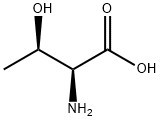
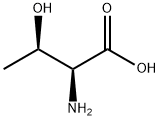
DL-Threonine hydrate(2:1)
Synonym(s):(2S,3R)-(-)-Threonine;Thr, 2-Amino-3-hydroxybutanoic acid
- CAS NO.:6028-28-0
- Empirical Formula: C4H9NO3
- Molecular Weight: 119.12
- MDL number: MFCD30478130
- EINECS: 200-774-1
- SAFETY DATA SHEET (SDS)
- Update Date: 2025-09-18 19:10:02

Properties of DL-Threonine hydrate(2:1)
| Melting point: | 256 °C (dec.)(lit.) |
| solubility | H2O: 50 mg/mL |
| form | powder |
| pka | 2.09(at 25℃) |
| Water Solubility | 200 G/L (25 ºC) |
| CAS DataBase Reference | 6028-28-0(CAS DataBase Reference) |
Safety information for DL-Threonine hydrate(2:1)
Computed Descriptors for DL-Threonine hydrate(2:1)
New Products
N-Carbethoxy-4-piperidone 1-Aminocyclopentane carbonitrile Tetrabutylammonium perchlorate N,O-Dimethylhydroxylamine hydrochloride (RS)-beta-Amino-beta-(4-bromophenyl)propionic acid 2-Amino-5-bromo-4-(trifluoromethyl)pyridine N-Vinylformamide 4 pentyn 1 ol Phenethyl cinnamate Dipropyl disulfide Ethyl 3-phenylpropanoate β-Bromostyrene Methacrylate-PEG-Methacrylate, Mn:35000 2,4-Dihydroxyacetophenone 2-Chloro 5-Fluoro Pyridine Vasicinone 2-Chloroisonicotinic Acid Tween 80 or Polysorbate 80 5-Bromo-1-Pentyne 1-(2-Methyl-5-nitrophenyl)guanidine Nitrate Methyl trans-4-Aminocyclohexanecarboxylate Hydrochloride N-(4-Cyano-3-(trifluoromethyl)phenyl)-2-methyloxirane-2-carboxamide 2-Pentyn-1-oL 4-NitrobenzotrifluorideRelated products of tetrahydrofuran

You may like
-
 Dl-threonine 95% CAS 6028-28-0View Details
6028-28-0 -
 Threonine chemical product Manufacturers, Suppliers, Exporters From Vasai Mumbai IndiaView Details
72-19-5 -
144-83-2 Sulfapyridine 98+View Details
144-83-2 -
29976-53-2 98+View Details
29976-53-2 -
6638-79-5 N,O-Dimethylhydroxylamine hydrochloride 98+View Details
6638-79-5 -
674783-97-2 98+View Details
674783-97-2 -
1-Aminocyclopentane carbonitrile 98+View Details
49830-37-7 -
Tetrabutylammonium perchlorate 1923-70-2 98+View Details
1923-70-2
Statement: All products displayed on this website are only used for non medical purposes such as industrial applications or scientific research, and cannot be used for clinical diagnosis or treatment of humans or animals. They are not medicinal or edible.