
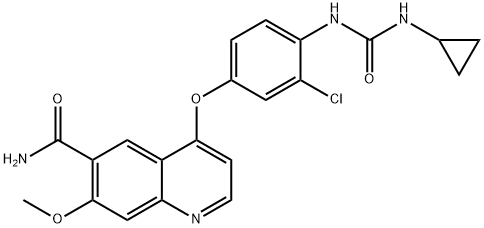
CHEMICAL AND PHYSICAL PROPERTIES
| LogP | 3.3 |
|---|---|
| Dissociation Constants | 5.05 |
COMPUTED DESCRIPTORS
| Molecular Weight | 426.9 g/mol |
|---|---|
| XLogP3 | 2.8 |
| Hydrogen Bond Donor Count | 3 |
| Hydrogen Bond Acceptor Count | 5 |
| Rotatable Bond Count | 6 |
| Exact Mass | 426.1094828 g/mol |
| Monoisotopic Mass | 426.1094828 g/mol |
| Topological Polar Surface Area | 116 Ų |
| Heavy Atom Count | 30 |
| Formal Charge | 0 |
| Complexity | 634 |
| Isotope Atom Count | 0 |
| Defined Atom Stereocenter Count | 0 |
| Undefined Atom Stereocenter Count | 0 |
| Defined Bond Stereocenter Count | 0 |
| Undefined Bond Stereocenter Count | 0 |
| Covalently-Bonded Unit Count | 1 |
| Compound Is Canonicalized | Yes |
PRODUCT INTRODUCTION
description
Lenvatinib is a member of the class of quinolines that is the carboxamide of 4-{3-chloro-4-[(cyclopropylcarbamoyl)amino]phenoxy}-7-methoxyquinoline-6-carboxylic acid. A multi-kinase inhibitor and orphan drug used (as its mesylate salt) for the treatment of various types of thyroid cancer that do not respond to radioiodine. It has a role as a vascular endothelial growth factor receptor antagonist, an orphan drug, an antineoplastic agent, an EC 2.7.10.1 (receptor protein-tyrosine kinase) inhibitor and a fibroblast growth factor receptor antagonist. It is a member of quinolines, an aromatic ether, a monocarboxylic acid amide, an aromatic amide, a member of monochlorobenzenes, a member of cyclopropanes and a member of phenylureas. It is a conjugate base of a lenvatinib(1+).