
Zygadenine
- CAS NO.:545-45-9
- Empirical Formula: C27H43NO7
- Molecular Weight: 493.63
- MDL number: MFCD22380979
- SAFETY DATA SHEET (SDS)
- Update Date: 2023-05-04 17:34:39
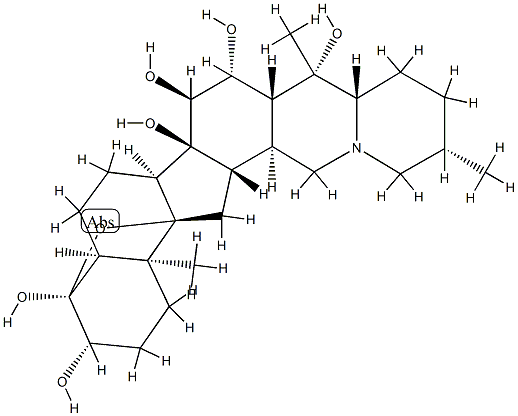
What is Zygadenine?
Description
A steroidal alkaloid isolated from the leaves of Zygadenus intermedius, this base forms clusters of colourless needles from C6H6 or Et20 or prisms of the diethanolate from EtOH. It is laevorotatory with [α]20/sup>D - 48.2° (c 1.26, CHCl3). The salts and derivative crystallize well: hydrochloride, m.p. 23l-4°C; sulphate, m.p. 237-242°C; aurichloride monohydrate, decomposing at l40-l65°C; hexaacetate, m.p. 265-270°C and the vanilloyl derivative, m.p. 258-9°C; [α]23/sup>D - 27.5° (CHCl3). The monoacetate is identical with Zygacine (q.v.) and the veratroyl derivative also occurs naturally in the rhizomes of Veratrum album. The structure of the alkaloid as 7-deoxygermine, has been established by chemical and spectroscopic investigation. The alkaloid is highly toxic and resembles cevadine in its action.
Description
Zygadenine is an alkaloid and a principal component of several flowering plants in the family Melanthiaceae. In common terminology, many of these plants are called “death camas”. Some species in this family, all found in North America, are Toxicoscordion venenosum (meadow death camas), Anticlea elegans (mountain death camas), and Zigadenus glaberrimus (sandbog death camas), from which zygadenine gets its name. Zygacine1, the 3-acetyl ester of zygadenine is another principal component of death camas.
In 1913, F. W. Heyl*, F. E. Hefner, and S. K. Loy at the University of Wyoming (Laramie) identified an alkaloid in Zygadenus intermedius2 that they called zygadenine. They assigned it an empirical formula of C39H68NO10, which is impossible for a neutral molecule. Not until 36 years later did Heyl, now at Upjohn (Kalamazoo, MI), and colleague M. E. Herr correct the formula to C27H43NO7.
In a brief 1956 communication, S. Morris Kupchan at the University of Wisconsin (Madison) reported the structure of zygadenine. In a full article in 1959, Kupchan verified the structure and explored several zygadenine derivatives.
Why has so much attention been given to zygadenine and zygacine? Originally, of course, it was because they are such deadly poisons. Even today, there is no antidote; atropine or dopamine is usually administered to treat symptoms such as bradycardia (slow heart rate) and hypotension (low blood pressure).
Like many natural toxins, zygadenine and its derivatives have been evaluated for medical uses. A 2019 Chinese patent states that zygadenine showed some improvement against histamine-induced vascular permeability increase and allergen-induced anaphylactic shock. And last year, Baoquan Bao, Ping Zhang, and co-workers at Inner Mongolia Medical University (Hohhot, China) included zygacine in a screening of traditional Mongolian medicines to determine whether any might show activity against COVID-19. Their conclusion: All 20 compounds they studied are worthy of further study as antivirals.
Although zygadenine and zygacine are highly toxic, no regulation-based hazard information is available.
1. CAS Reg. No. 2777-79-9.
2. The original name of Toxicoscordion venenosum.
Definition
ChEBI: Zygadenine is an alkaloid.
References
Heyl, Hepner, Loy.,!. Arner. Chern. Soc., 35,258 (1913) Heyl, Herr., ibid, 71, 1751 (1949) Stoll, Seebeck., Helv. Chirn. Acta, 36, 1570 (1953) Kupchan., J. Arner. Chern. Soc., 78,3546 (1956) Kupchan., ibid, 81, 1925 (1959) Gilbertson., Phytochern., 12,2079 (1973)
Properties of Zygadenine
| Melting point: | 214-216° |
| alpha | D20 -48.4° (c = 1.26 in chloroform) |
| solubility | not reported, probably insoluble |
| appearance | white crystals |
Safety information for Zygadenine
Computed Descriptors for Zygadenine
New Products
2-(2-Chlorophenyl)glycine Propiolic Acid 1-(3-Hydroxy-4-methoxyphenyl)-2-nitroethene (±)-amino(2-fluorophenyl)acetic acid trans-3-Benzyloxy-4-methoxy-beta-nitrostyrene 1-Pentadecanol 2,4-Dihydroxybenzaldehyde Dipropyl disulfide Pyrrolo[1,2-a]pyrimidine-6-carboxylic acid, 4,6,7,8-tetrahydro-4-oxo-, sodium salt (1:1), (6S) Obidoxime hydrochloride API 4 pentyn 1 ol N-Vinylformamide Methacrylate-PEG-Methacrylate, Mn:35000 2,4-Dihydroxyacetophenone 2-Chloro 5-Fluoro Pyridine Vasicinone 2-Chloroisonicotinic Acid Tween 80 or Polysorbate 80 2-Butyn-1-oL N-(4-Cyano-3-(trifluoromethyl)phenyl)-2-methyloxirane-2-carboxamide N-(4-fluoro-2-methoxy-5-nitrophenyl)-4-(1-methyl-1H-indol-3-yl)pyrimidin-2-amine Pirtobrutinib intd. 2-Pentyn-1-oL 4-NitrobenzotrifluorideYou may like
-
 40216-83-9 trans-4-Hydroxy-L-proline methyl ester hydrochloride 98+View Details
40216-83-9 -
471-25-0 Propiolic Acid 98+View Details
471-25-0 -
84145-28-8 98+View Details
84145-28-8 -
trans-3-Benzyloxy-4-methoxy-beta-nitrostyrene 98+View Details
63909-29-5 -
2-(2-Chlorophenyl)glycine 88744-36-9 98+View Details
88744-36-9 -
40216-83-9 trans-4-Hydroxy-L-proline methyl ester hydrochloride 98+View Details
40216-83-9 -
629-76-5 98+View Details
629-76-5 -
1-(3-Hydroxy-4-methoxyphenyl)-2-nitroethene 98+View Details
39816-35-8