
White camphor oil
Synonym(s):Camphora oil;Cinnamomum Camphora Sieb
- CAS NO.:8008-51-3
- Molecular Weight: 0
- MDL number: MFCD01770588
- EINECS: 616-922-7
- Update Date: 2026-05-28 05:12:11
What is White camphor oil?
Chemical properties
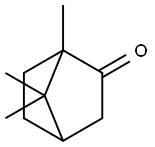
Camphor is a colorless glassy solid. Penetrating, characteristic odor.
Chemical properties
White camphor oil is the first distillation fraction (about 20% of the crude camphor oil). It is a colorless or almost colorless liquid with a cineole-like odor. d2525 0.855–0.875; n20D 1.4670–1.4720; αD +16° to +28°; solubility: 1 vol in 1 vol of 95% ethanol; solutions usually become cloudy on further dilution. In addition to monoterpene hydrocarbons, this oil contains up to 35% 1,8-cineole.
Chemical properties
The oil is produced by fractional distillation of the crude camphor oil after the camphor has been crystallized. It is obtained from the bark and tree. The white oil contains cineole as the principal component along with monoterpenes.
Physical properties
A white viscous liquid.
Definition
Extractives and their physically modified derivatives. Cinnamomum camphora, Lauraceae, hon-sho.
General Description
A colorless liquid with a characteristic odor. Flash point 125°F. Insoluble in water and generally less dense than water. Vapors heavier than air.
Air & Water Reactions
Flammable. Insoluble in water.
Reactivity Profile
White camphor oil containing ether can act as bases. They form salts with strong acids and addition complexes with Lewis acids. The complex between diethyl ether and boron trifluoride is an example. Ethers may react violently with strong oxidizing agents. In other reactions, which typically involve the breaking of the carbon-oxygen bond, ethers are relatively inert.
Health Hazard
Within 5 to 90 minutes after swallowing, the following may be noted: nausea and vomiting; feeling of warmth; headache; confusion, vertigo, excitement, restlessness, delirium, and hallucinations; increased muscular excitability, tremors, and jerky movements; epileptiform convulsions, followed by depression (convulsions sometimes occur early in the syndrome and may be severe, but they do not have the grave prognosis of strychnine convulsions); coma; central nervous depression may at times be the primary clinical response; death results from respiratory failure or from status epilepticus; slow convalescence (days or weeks), often with persistent gastric distress.
Fire Hazard
Behavior in Fire: The solid often evaporates without first melting.
Safety Profile
A human poison by ingestion. Human systemic effects by ingestion: convulsions, tremors, and unspecified respiratory system effects. A skin irritant. Flammable liquid when exposed to heat or flame; can react with oxidzing materials. To fight fire, use foam, CO2, dry chemical, mist, fog. See also SAFROL and CAMPHOR.
Potential Exposure
Camphor, a natural product, is used as a plasticizer for cellulose esters and ethers; it is used in lacquers and varnishes; and in explosives and pyrotechnics formulations. It is used as a moth repellent and as a medicinal.
Shipping
UN2717 Camphor, synthetic, Hazard Class: 4.1; Labels: 4.1-Flammable solid. UN1130 camphor oil, Hazard Class: 3; Labels: 3-Flammable liquid
Incompatibilities
May form explosive mixture with air. Violent, possibly explosive, reaction with strong oxidizers, especially chromic anhydride, potassium permanganate. May accumulate static electrical charges, and may cause ignition of its vapors.
Waste Disposal
ncineration of a solution in a flammable solven.
Properties of White camphor oil
| Boiling point: | 171 °C(lit.) |
| refractive index | n |
| FEMA | 2231 | CAMPHOR, JAPANESE, WHITE, OIL (CINNAMOMUM CAMPHORA (L.) NEES ET EBERM.) |
| Flash point: | 110 °F |
| storage temp. | 2-8°C |
| Odor | at 10.00 % in dipropylene glycol. camphor aromatic cooling minty herbal balsamic pine |
| EPA Substance Registry System | Camphor oil (8008-51-3) |
Safety information for White camphor oil
| Signal word | Warning |
| Pictogram(s) |
 Flame Flammables GHS02  Exclamation Mark Irritant GHS07 |
| GHS Hazard Statements |
H226:Flammable liquids H315:Skin corrosion/irritation H319:Serious eye damage/eye irritation |
| Precautionary Statement Codes |
P305+P351+P338:IF IN EYES: Rinse cautiously with water for several minutes. Remove contact lenses, if present and easy to do. Continuerinsing. |
Computed Descriptors for White camphor oil
White camphor oil manufacturer
New Products
5-bromo-4-fluoro-2-nitrobenzaldehyde (R)-(-)-2-Amino-1-propanol Cyclobutanone Fmoc-OSu 1-(2-Chloroethyl)pyrrolidine Hydrochloride 2-Amino-2-(4-methylphenyl)acetic acid β-Bromostyrene Ethyl 3-phenylpropanoate Phenethyl cinnamate Dipropyl disulfide 4 pentyn 1 ol N-Vinylformamide Methacrylate-PEG-Methacrylate, Mn:35000 2,4-Dihydroxyacetophenone 2-Chloro 5-Fluoro Pyridine Vasicinone 2-Chloroisonicotinic Acid Tween 80 or Polysorbate 80 2-Butyn-1-oL 2-Pentyn-1-oL 4-Nitrobenzotrifluoride N-(4-fluoro-2-methoxy-5-nitrophenyl)-4-(1-methyl-1H-indol-3-yl)pyrimidin-2-amine Pirtobrutinib intd. N-(4-Cyano-3-(trifluoromethyl)phenyl)-2-methyloxirane-2-carboxamideRelated products of tetrahydrofuran



You may like
-
 Camphor oil 8008-51-3 98%View Details
8008-51-3 -
Camphor Oil 99%View Details
-
Camphor white oil, natural CAS 8008-51-3View Details
8008-51-3 -
7250-67-1 1-(2-Chloroethyl)pyrrolidine Hydrochloride 98+View Details
7250-67-1 -
7250-67-1 1-(2-Chloroethyl)pyrrolidine Hydrochloride 98+View Details
7250-67-1 -
13227-01-5 98+View Details
13227-01-5 -
7250-67-1 1-(2-Chloroethyl)pyrrolidine Hydrochloride 98+View Details
7250-67-1 -
13227-01-5 98+View Details
13227-01-5