
Vitamin D
- CAS NO.:1406-16-2
- Empirical Formula: C27H44O
- Molecular Weight: 384.63766
- MDL number: MFCD01777970
- EINECS: 215-797-2
- Update Date: 2026-05-24 22:25:33
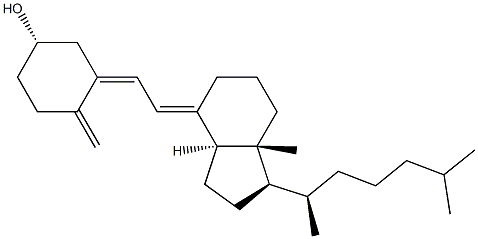
What is Vitamin D?
Absorption
Vitamin D3 and D2 are readily absorbed from the small intestine (proximal or distal) .
Toxicity
The use of pharmacological or nutraceutical vitamin d and/or even excessive dietary intake of vitamin d is contraindicated in patients with hypercalcemia, malabsorption syndrome, abnormal sensitivity to the toxic effects of vitamin d, and hypervitaminosis D .
Hypersensitivity to vitamin d is one plausible etiologic factor in infants with idiopathic hypercalcemia - a case in which vitamin d use must be strictly restricted .
As vitamin d intake is available via fortified foods, dietary supplements, and clinical drug sources, serum concentrations and therapeutic dosages should be reviewed regularly and readjusted as soon as there is clinical improvement . Dosage levels are required to be individualized on an individual patient by patient basis as caution must be exercised to prevent the presence of too much vitamin d in the body and the various potentially serious toxic effects associated with such circumstances .
In particular, the range between therapeutic and toxic doses is quite narrow in vitamin d resistant rickets . When high therapeutic doses are used, progress should be followed with frequent blood calcium determinations .
When treating hypoparathyroidism, intravenous calcium, parathyroid hormone, and/or dihydrotachysterol may be required .
Maintenance of normal serum phosphorus levels by dietary phosphate restriction and/or administration of aluminum gels as intestinal phosphate binders in those patients with hyperphosphatemia as frequently seen in renal osteodystrophy is essential to prevent metastatic calcification .
Mineral oil interferes with the absorption of lipid-soluble vitamins, including vitamin d preparations .
The administration of thiazide diuretics to hypoparathyroid patients who are concurrently being treated with vitamin d can result in hypercalcemia .
At this time, no long term animal studies have been performed to evaluate vitamin potential for carcinogens, mutagenesis, or fertility .
As various animal reproduction studies have demonstrated fetal abnormalities in several species associated with hypervitaminosis D, the use of vitamin d in excess of the recommended dietary allowance during normal pregnancy should be avoided . The safety in excess of 400 USP units of vitamin d daily during pregnancy has not been established . The abnormalities observed are similar to the supravalvular aortic stenosis syndrome described in infants that is characterized by supravalvular aortic stenosis, elfin facies, and mental retardation .
In a nursing mother given large doses of vitamin D, 25-hydroxycholecalciferol appeared in the milk and caused hypercalcemia in her child. Caution is subsequently required when contemplating the use of vitamin d in a nursing woman, and the necessity of monitoring infants' serum calcium concentration if vitamin d is administered to a breastfeeding woman .
Adverse reactions associated with the use of vitamin d are primarily linked to having hypervitaminosis D occurring [FDA Lanel]. In particular, hypervitaminosis D is characterized by effects specific effects on specific organ systems. At the renal system, hypervitaminosis D can cause impairment of renal function with polyuria, nocturne, polydipsia, hypercalciuria, reversible asotemia, hypertension, nephrocalcinosis, generalized vascular calcification, or even irreversible renal insufficiency which may result in death . Elsewhere, hypervitaminosis D can also cause CNS mental retardation . At the level of soft tissues, it can widespread calcification of the soft tissues, including the heart, blood vessels, renal tubules, and lungs . In the skeletal system, bone demineralization (osteoporosis) in adults can occur while a decline in the average rate of linear growth and increased mineralization of bones, dwarfism, vague aches, stiffness, and weakness can occur in infants and children . Finally, hypervitaminosis D can also lead to nausea, anorexia, and constipation at the gastrointestinal level as well as mild acidosis, anemia, or weight loss via metabolic processes .
The LD(50) in animals is unknown .
The Uses of Vitamin D
vitamin D acts as a keratinization regulator, helping to improve skin feel and firmness with repeated use. This vitamin is absorbed through the skin’s outer layers. Studies are indicating that vitamin D is an important factor in epidermal cell turnover. It is generally found in combination with vitamin A, as such a mixture appears to help epithelial growth and promote good skin pigmentation. Like vitamin A, vitamin D is a major constituent of many fish and vegetable oils.
Background
Vitamin D ultimately comprises a group of lipid-soluble secosteroids responsible for a variety of biological effects, some of which include increasing the intestinal absorption of calcium, magnesium, and phosphate. With reference to human use, there are 2 main forms of vitamin D - vitamin D3 (cholecalciferol) and vitamin D2 (ergocalciferol). When non-specific references are made about 'vitamin d', the references are usually about the use of vitamin D3 and/or D2.
Vitamin D3 and D2 require hydroxylation in order to become biologically active in the human body. Since vitamin D can be endogenously synthesized in adequate amounts by most mammals exposed to sufficient quantities of sunlight, vitamin D functions like a hormone on vitamin D receptors to regulate calcium in opposition to parathyroid hormone. Vitamin D plays an essential physiological role in maintaining calcium homeostasis and metabolism. There are several different vitamin D supplements that are given to treat or to prevent osteomalacia and rickets, or to meet the daily criteria of vitamin D consumption.
Indications
Vitamin D is indicated for use in the treatment of hypoparathyroidism, refractory rickets (also known as vitamin D resistant rickets), and familial hypophosphatemia .
Definition
ChEBI: Calciol is a hydroxy seco-steroid that is (5Z,7E)-9,10-secocholesta-5,7,10(19)-triene in which the pro-S hydrogen at position 3 has been replaced by a hydroxy group. It is the inactive form of vitamin D3, being hydroxylated in the liver to calcidiol (25-hydroxyvitamin D3), which is then further hydroxylated in the kidney to give calcitriol (1,25-dihydroxyvitamin D3), the active hormone. It has a role as a human metabolite and a geroprotector. It is a seco-cholestane, a hydroxy seco-steroid, a member of D3 vitamins, a secondary alcohol and a steroid hormone.
General Description
Cream colored powder. Insoluble in water.
Air & Water Reactions
Sensitive to moisture, air and light. . Water insoluble.
Reactivity Profile
VITAMIN D3 may react vigorously with strong oxidizing agents. May react exothermically with reducing agents to release hydrogen gas.
Pharmacokinetics
The in vivo synthesis of the predominant two biologically active metabolites of vitamin D occurs in two steps. The first hydroxylation of vitamin D3 or D2 occurs in the liver to yield 25-hydroxyvitamin D while the second hydroxylation happens in the kidneys to give 1, 25-dihydroxyvitamin D . These vitamin D metabolites subsequently facilitate the active absorption of calcium and phosphorus in the small intestine, serving to increase serum calcium and phosphate levels sufficiently to allow bone mineralization . Conversely, these vitamin D metabolites also assist in mobilizing calcium and phosphate from bone and likely increase the reabsorption of calcium and perhaps also of phosphate via the renal tubules . There exists a period of 10 to 24 hours between the administration of vitamin D and the initiation of its action in the body due to the necessity of synthesis of the active vitamin D metabolites in the liver and kidneys . It is parathyroid hormone that is responsible for the regulation of such metabolism at the level of the kidneys .
Metabolism
In the liver, vitamin D3 and D2 are hydroxylated to calcidiol (25-hydroxycholecalciferol) and ercalcidiol (25-hydroxyergocalciferol) , respectively, by the enzyme 25-hydroxylase. At the level of the kidney, calcidiol and ercalcidiol are hydroxylated to yield calcitriol (1,25-dihydroxycholecalciferol) and ercalcitriol (1,25-dihydroxyergocalciferol) , the primary biologically active forms of vitamin D3 and D2 respectively, by the enzyme 1-alpha-hydroxylase.
Properties of Vitamin D
| EPA Substance Registry System | Vitamin D (1406-16-2) |
Safety information for Vitamin D
Computed Descriptors for Vitamin D
New Products
2-(2-Chlorophenyl)glycine Propiolic Acid 1-(3-Hydroxy-4-methoxyphenyl)-2-nitroethene (±)-amino(2-fluorophenyl)acetic acid trans-3-Benzyloxy-4-methoxy-beta-nitrostyrene 1-Pentadecanol 2,4-Dihydroxybenzaldehyde Dipropyl disulfide Pyrrolo[1,2-a]pyrimidine-6-carboxylic acid, 4,6,7,8-tetrahydro-4-oxo-, sodium salt (1:1), (6S) Obidoxime hydrochloride API 4 pentyn 1 ol N-Vinylformamide Methacrylate-PEG-Methacrylate, Mn:35000 2,4-Dihydroxyacetophenone 2-Chloro 5-Fluoro Pyridine Vasicinone 2-Chloroisonicotinic Acid Tween 80 or Polysorbate 80 2-Butyn-1-oL N-(4-Cyano-3-(trifluoromethyl)phenyl)-2-methyloxirane-2-carboxamide N-(4-fluoro-2-methoxy-5-nitrophenyl)-4-(1-methyl-1H-indol-3-yl)pyrimidin-2-amine Pirtobrutinib intd. 2-Pentyn-1-oL 4-NitrobenzotrifluorideRelated products of tetrahydrofuran




You may like
-
 40216-83-9 trans-4-Hydroxy-L-proline methyl ester hydrochloride 98+View Details
40216-83-9 -
471-25-0 Propiolic Acid 98+View Details
471-25-0 -
84145-28-8 98+View Details
84145-28-8 -
trans-3-Benzyloxy-4-methoxy-beta-nitrostyrene 98+View Details
63909-29-5 -
2-(2-Chlorophenyl)glycine 88744-36-9 98+View Details
88744-36-9 -
40216-83-9 trans-4-Hydroxy-L-proline methyl ester hydrochloride 98+View Details
40216-83-9 -
629-76-5 98+View Details
629-76-5 -
1-(3-Hydroxy-4-methoxyphenyl)-2-nitroethene 98+View Details
39816-35-8