
Vinflunine Ditartrate
- CAS NO.:194468-36-5
- Empirical Formula: C49H59F2N4O14
- Molecular Weight: 966.0079664
- MDL number: MFCD12756258
- SAFETY DATA SHEET (SDS)
- Update Date: 2026-05-28 02:44:46
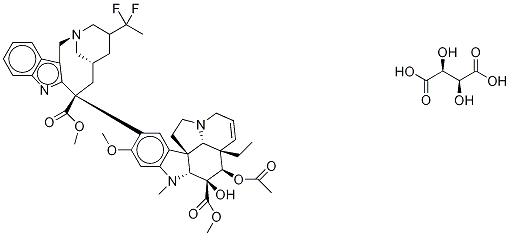
What is Vinflunine Ditartrate?
Chemical properties
White Solid
The Uses of Vinflunine Ditartrate
Vinflunine Ditartrate can be used as Semisynthetic Vinca alkaloid with microtubule destabilizing and antiangiogenic activity; derivative of Vinorelbine.
The Uses of Vinflunine Ditartrate
Vinflunine is a semisynthetic Vinca alkaloid with microtubule destabilizing and antiangiogenic activity. Vinflunine is a derivative of Vinorelbine. Vinflunine is used as an antineoplastic.
Clinical Use
Vinflunine ditartrate is a second generation difluorinated analog of the naturally-occuring substance vinorelbine and it is approved for the treatment of non-small cell lung cancer, metastatic breast cancer and ovarian cancer. Vinflunine, a tubulin polymerization inhibitor, belongs to the vinca alkaloid class of anti-cancer agents. Introduction of the difluoro group of vinflunine dramatically improved antitumor activity of the parent vinorelbine structure. Vinflunine was discovered by Pierre Fabre Laboratories and in 2004 was licensed to Bristol-Myers Squibb for development and commercialization. In 2007, the rights to venflunine were returned to Pierre Fabre which completed its development.
Synthesis
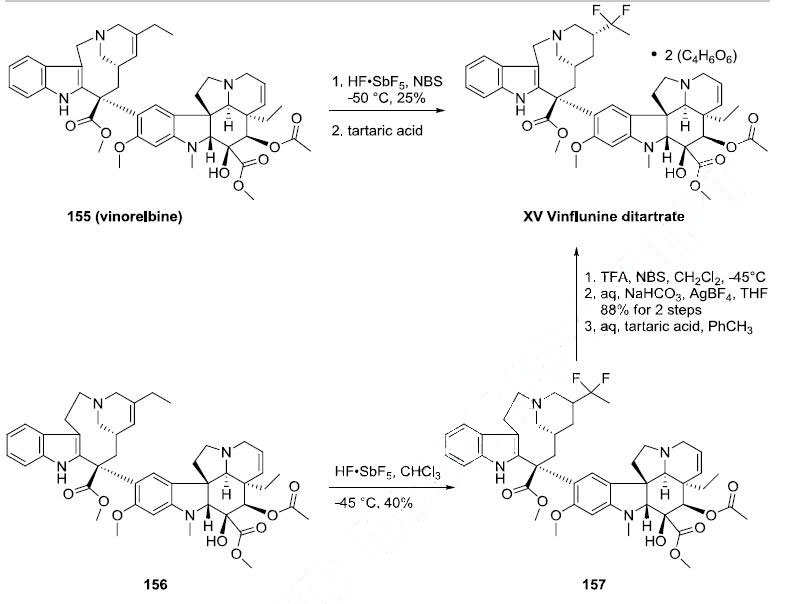
Vinflunine can be prepared directly from vinorelbine (155) through the use of superacid chemistry. Reaction of 155 with antimony pentaflouride in hydrofluoric acid and Nbromosuccinimide followed by treatment with two equivalents of tartaric acid produced vinflunine ditartrate (XV) in 25% yield. An alternative synthesis of vinflunine was realized through reaction of vinblastine or 3?ˉ,4?ˉ-dihydrovinblastine (156) with antimony pentaflouride and hydrofluoric acid in chloroform to give the difluoro alkaloid 157 in 40% yield Ring contraction was effected by reaction with trifluoroacetic acid and N-bromosuccinimide followed by aqueous sodium bicarbonate and silver tetrafluoroborate to give vinflunine in 88% yield. Vinflunine ditartrate (XV) was prepared by treating a solution of vinflunine in toluene with two equivalents of tartaric acid.
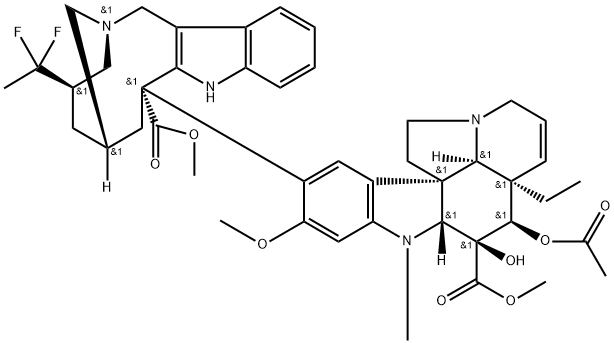
Properties of Vinflunine Ditartrate
| Melting point: | 244-246°C (dec) |
| storage temp. | -20°C Freezer |
| solubility | DMSO (Slightly), Methanol (Slightly) |
| form | Solid |
| color | White to Light Beige |
Safety information for Vinflunine Ditartrate
Computed Descriptors for Vinflunine Ditartrate
New Products
5-bromo-4-fluoro-2-nitrobenzaldehyde Cyclobutanone (R)-(-)-2-Amino-1-propanol Fmoc-OSu 1-(2-Chloroethyl)pyrrolidine Hydrochloride 2-Amino-2-(4-methylphenyl)acetic acid 2,4-Dihydroxybenzaldehyde Obidoxime hydrochloride API Pyrrolo[1,2-a]pyrimidine-6-carboxylic acid, 4,6,7,8-tetrahydro-4-oxo-, sodium salt (1:1), (6S) Dipropyl disulfide 4 pentyn 1 ol N-Vinylformamide Methacrylate-PEG-Methacrylate, Mn:35000 2,4-Dihydroxyacetophenone 2-Chloro 5-Fluoro Pyridine Vasicinone 2-Chloroisonicotinic Acid Tween 80 or Polysorbate 80 2-Butyn-1-oL 2-Pentyn-1-oL 4-Nitrobenzotrifluoride N-(4-Cyano-3-(trifluoromethyl)phenyl)-2-methyloxirane-2-carboxamide N-(4-fluoro-2-methoxy-5-nitrophenyl)-4-(1-methyl-1H-indol-3-yl)pyrimidin-2-amine Pirtobrutinib intd.Related products of tetrahydrofuran
You may like
-
 7250-67-1 1-(2-Chloroethyl)pyrrolidine Hydrochloride 98+View Details
7250-67-1 -
7250-67-1 1-(2-Chloroethyl)pyrrolidine Hydrochloride 98+View Details
7250-67-1 -
13227-01-5 98+View Details
13227-01-5 -
545445-44-1 3-Morpholino-1-(4-(2-oxopiperidin-1-yl) phenyl)-5,6-dihyropyridin-2-(1H)-one 98%View Details
545445-44-1 -
6629-04-5 98%View Details
6629-04-5 -
4-(4-Αminophenyl)-3-Morpholinone 98%View Details
438056-69-0 -
1-(4-Aminophenyl)-3-morpholino-5,6-dihydropyridin-2(1H)-one 1267610-26-3 98%View Details
1267610-26-3 -
 1H-Indazole | CAS No. 271-44-3 | Pharmaceutical IntermediateView Details
271-44-3