
VETIVERYL ACETATE
- CAS NO.:62563-80-8
- Empirical Formula: C17H26O2
- Molecular Weight: 262.39
- MDL number: MFCD00046328
- EINECS: 263-597-9
- SAFETY DATA SHEET (SDS)
- Update Date: 2025-12-17 09:49:57
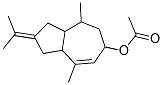
What is VETIVERYL ACETATE?
Chemical properties
Vetiveryl Acetate is not a single compound;
its main component is khusimyl acetate.
Vetiveryl acetate is prepared by esterification of the sesquiterpene alcohols isolated
from vetiver oils.
Vetiveryl acetate is a light yellow liquid with a dry, fresh, woody odor. It is a
popular fragrance mixture that is frequently used in luxury perfumery; it is also
used as a fixative in many fine fragrances.
Chemical properties
Colorless solid; sweet woody aroma.
The Uses of VETIVERYL ACETATE
Vetiveryl Acetate is a useful chemical reagent used mainly by flavors and fragrances industry. It is produced from Vetiver Oil.
Definition
ChEBI: Vetiveryl acetate is a sesquiterpenoid.
Production Methods
Vetiveryl acetate can be produced by Acetylation of Vetiver oil with Acetic
anhydride, followed by fractionated distillation.
Crude products are sometimes made by
Acetylation of Vetiver oil without subsequent fractionation, but perhaps only "topping" of 5 to 10% light fractions.
The product is dark and of very inferior
odor.
Aroma threshold values
Medium strength odor, woody type.
Properties of VETIVERYL ACETATE
| Boiling point: | 286 °C(lit.) |
| Density | 0.976 g/mL at 25 °C(lit.) |
| refractive index | n |
| Flash point: | >230 °F |
| Odor | dry, fresh, woody odor |
Safety information for VETIVERYL ACETATE
Computed Descriptors for VETIVERYL ACETATE
New Products
Dexamethasone Sodium Phosphate p-Anisaldehyde m-Tolualdehyde 2-Bromobenzaldehyde 4-Fluorobenzaldehyde 1-Propyl-4-piperidone 3-Amino-3-(3-fluorophenyl)propanoic acid Raloxifene EP Impurity D N-Nitroso Nortriptyline Nitroso Irbesartan 2-(p-Tolyl)acetaldehyde Sulfonic acid Impurity 2,2-dibromo-1-cyclopropyl-2-(2-fluorophenyl)ethan-1-one 5-Chloro-2-Methoxy-4-Picoline 2-Amino-6-nitrobenzoic Acid (6-Nitroanthranilic acid) Cis-3,5 Diacetoxy-1-cyclopentene 3-Bromo-2-Methoxy-4-Methylpyridine 2-Amino-5-Chloro-3-Nitro-6-picoline 3-Methoxy-5-methylpyrazin-2-amine Pentachlorobenzonitrile Budesonide Nicotinic acid RAPAMYCIN Alpha CyclodextrinRelated products of tetrahydrofuran
You may like
-
 Vetiveryl Acetate (62563-80-8)View Details
117-98-6 -
 12029-98-0 >98%View Details
12029-98-0 -
1177-87-3 Dexamethasone Acetate >98%View Details
1177-87-3 -
Hydrocortisone 50-23-7 >98%View Details
50-23-7 -
106-43-4 Parachlorotoluene >99%View Details
106-43-4 -
Pyrrolidin >98%View Details
123-75-1 -
cis-p-Menth-2,8-diene-1-ol 7212-40-0 >98%View Details
7212-40-0 -
Para Chloro toluene (PCT) 106-43-4 >99%View Details
106-43-4