
VETIVEROL
- CAS NO.:68129-81-7
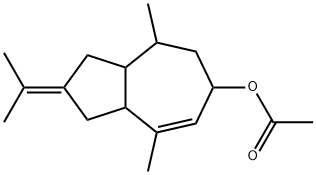
- Empirical Formula: C15H24O
- Molecular Weight: 220.35
- MDL number: MFCD00046329
- EINECS: 268-578-9
- SAFETY DATA SHEET (SDS)
- Update Date: 2026-05-28 00:06:30
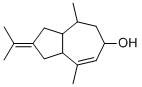
What is VETIVEROL?
Description
Vetiverol is a relatively expensive material, and its use, often in the amount of 5 to 10% of the composition, is restricted to better perfumes (better priced perfumes). It blends particularly well with Sandalwood odors, Ionones, Styrax and various materials for “Oriental” and woody bases or perfumes.
The Uses of VETIVEROL
In “modem” perfumes, Vetiverol tinds extensive use as a fixative under mossy and certain floral bases, but it is most attractive in the nontloral types, Chypres, etc. A high grade Vetiverol will not introduce Vetiver oil notes, but only lend soft, sweet, velvety fixation. Minor amounts of the material are used in flavors, where imitation Asparagus and Cucumber may benefit from the peculiar taste of this item. The author would however, by far recommend the lower boiling fractions of Vetiver oil for this purpose.
Synthesis
Vetiverol is prepared:
1) by isolation from Vetiver oil, by fractionated
vacuumdistillation.
2) by isolation from saponified Vetiver oil, by
fractionated vacuumdistillation.
3) by treatment of Vetiver oil with Acetic
anhydride, thereby acetylating the primary
alcohols, and dehydrating the tertiary alcohols
to hydrocarbons. Fractionated distillation
isolates Vetiver acetate from primary
alcohols exclusively, and subsequent
saponification yields Vetiverol consisting
almost exclusively of the two above named
alcohols. It has been suggested, but not
confirmed with certainty, that the tertiary
alcohols will contribute undesirable drycamphoraceous
notes to the odor of
Vetiverol.
Properties of VETIVEROL
| Boiling point: | 170-174 °C(Press: 13 Torr) |
| Density | 1.0209 g/cm3 |
Safety information for VETIVEROL
Computed Descriptors for VETIVEROL
New Products
2-(2-Chlorophenyl)glycine Propiolic Acid 1-(3-Hydroxy-4-methoxyphenyl)-2-nitroethene (±)-amino(2-fluorophenyl)acetic acid trans-3-Benzyloxy-4-methoxy-beta-nitrostyrene 1-Pentadecanol 2,4-Dihydroxybenzaldehyde Dipropyl disulfide Pyrrolo[1,2-a]pyrimidine-6-carboxylic acid, 4,6,7,8-tetrahydro-4-oxo-, sodium salt (1:1), (6S) Obidoxime hydrochloride API 4 pentyn 1 ol N-Vinylformamide Methacrylate-PEG-Methacrylate, Mn:35000 2,4-Dihydroxyacetophenone 2-Chloro 5-Fluoro Pyridine Vasicinone 2-Chloroisonicotinic Acid Tween 80 or Polysorbate 80 2-Butyn-1-oL N-(4-Cyano-3-(trifluoromethyl)phenyl)-2-methyloxirane-2-carboxamide N-(4-fluoro-2-methoxy-5-nitrophenyl)-4-(1-methyl-1H-indol-3-yl)pyrimidin-2-amine Pirtobrutinib intd. 2-Pentyn-1-oL 4-NitrobenzotrifluorideRelated products of tetrahydrofuran


You may like
-
 40216-83-9 trans-4-Hydroxy-L-proline methyl ester hydrochloride 98+View Details
40216-83-9 -
471-25-0 Propiolic Acid 98+View Details
471-25-0 -
84145-28-8 98+View Details
84145-28-8 -
trans-3-Benzyloxy-4-methoxy-beta-nitrostyrene 98+View Details
63909-29-5 -
2-(2-Chlorophenyl)glycine 88744-36-9 98+View Details
88744-36-9 -
40216-83-9 trans-4-Hydroxy-L-proline methyl ester hydrochloride 98+View Details
40216-83-9 -
629-76-5 98+View Details
629-76-5 -
1-(3-Hydroxy-4-methoxyphenyl)-2-nitroethene 98+View Details
39816-35-8