
Verlukast
- CAS NO.:120443-16-5
- Empirical Formula: C26H27ClN2O3S2
- Molecular Weight: 515.09
- MDL number: MFCD00864779
- EINECS: 200-258-5
- SAFETY DATA SHEET (SDS)
- Update Date: 2026-01-05 15:21:26
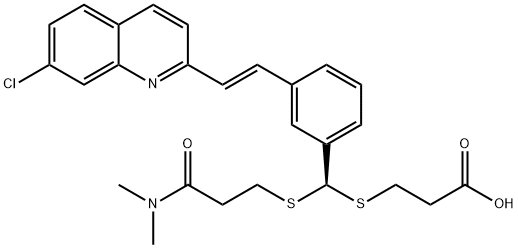
What is Verlukast?
Chemical properties
Dark Yellow Solid
Originator
Verlukast,Merck Frosst (Merck and Co.)
The Uses of Verlukast
A receptor antagonist for the treatment of respiratory diseases
The Uses of Verlukast
A receptor antagonist for the treatment of respiratory diseases.
Manufacturing Process
5-(3-(2-(7-Chloroquinolin-2-yl)ethenyl)phenyl)-8-dimethylcarbamyl-4,6-
dithiaoctanoic acid was prepared in 7 steps:
Step 1: Preparation of 2-bromomethyl-7-chloroquinoline:
A solution of 7-chloroquinaldine (177 g, 1 mole) N-bromosuccinimide (178 g,
1 mole), benzoylperoxide (1 g) in 2 L CCl 4 were heated at reflux for 2 days
under a sun lamp. The reaction mixture was cooled, and passed through a
plug of SiO 2 (approx. 1 Kg) using toluene as eluent. Chromatography on 2 x 1
kg SiO 2 columns using toluene as eluent afforded 110-120 g of the title
compound, MP: 112°C.
Step 2: Preparation of (7-chloroquinolin-2-yl)-methyltriphenylphosphonium
bromide:
To a suspension of 2-bromomethyl-7-chloroquinoline (120 g, 0.5 mol) in 800
ml of CH 3 CN at 60°C was added triphenylphosphine (183 g). The reaction
mixture was heated overnight at 60°C, cooled and 400 ml ether was added.
The solid was filtered and dried to yield 170 g phosphonium salt.
Step 3: Preparation of dimethyl 5-(3-formylphenyl)-4,6-dithianonanedioate:
To a solution of isophthalaldehyde (40 g, 0.3 mol.) in chloroform (400 ml) and
methyl 3-mercaptopropanoate (68 ml, 0.6 mol) was added dropwise
trimethylsilyl chloride (48 ml, 0.38 mol) over 30 min. The reaction mixture
was stirred at room temperature for 2 hours. The reaction was quenched with
25% aq. NH 4 OAc, extracted with ethyl acetate, dried and evaporated. Flash
chromatography of the residue afforded 50 g of the title compound.
Step 4: Preparation of dimethyl 5-(3-(2-(7-chloroquinolin-2-
yl)ethenyl)phenyl)-4,6-dithianonanedioate:
To a suspension of 190 g phosphonium salt from Step 2 (0.36 mol.) in THF (2
L) at -78°C were added 1.6 M BuLi (220 ml) dropwise over 1.5 hrs. The
resulting brown suspension was stirred 30 min at -78°C. To the suspension
was added the aldehyde (Step 3) (11.7 g, 0.32 mol.) in THF (400 ml)
dropwise over 1.5 hrs. The reaction mixture was allowed to warm to room
temperature and quenched with pH 7 buffer (approx. 2 L). Ethyl acetate (1 L)
was added. The organic phase was separated, dried and evaporated. Flash
chromatography of the residue using 30% ethyl acetate hexane; followed by
crystallization with 3:1 hexane/ether afforded 135 g of the title compound as
a white solid. MP: 53°C.
Step 5: Preparation of methyl 5-(3-(2-(7-chloroquinolin-2-yl)ethenyl)phenyl)-8-dimethylcarbamyl-4,6-dithiaoctanoate:
A solution of the aluminum reagent was prepared by adding dropwise 150 ml
of 2 M trimethylaluminum in hexane at -20°C to a solution of 2 M
dimethylamine in toluene (300 ml). The solution was allowed to warm to room
temperature. To the diester (step 4) (95 g) in CH 2 Cl 2 (1 L) was added
dropwise 150 ml of the aluminum reagent. The reaction was stirred 7-8 hrs at
room temperature. The reaction was carefully quenched at 0°C with 2 N HCl
(until the vigorous reaction subsided); then pH 7 buffer (25% NH 4 OAc in H 2 O)
(1 L) and CH 2 Cl 2 (1 L) were added. The organic phase was separated, dried
and evaporated. Flash chromatography of the residue using first 50% ethyl
acetate hexane followed by ethyl acetate afforded 38 g recovered di-ester and
38 g desired amide. The recovered di-ester was recycled through the
sequence to give 18 g di-ester and 14 g desired amide. Total yield: 52 g of
amide.
Step 6: Preparation of 5-(3-(2-(7-chloroquinolin-2-yl)ethenyl)phenyl)-8-
dimethylcarbamyl-4,6-dithiaoctanoic acid:
To the amide (30 g) in 800 ml 1,2-dimethoxyethane (DME) was added 1.5 eq
1 N LiOH (75 ml). The reaction mixture was stirred one hour under N 2 . The
DME was evaporated. The residue was partitioned between H 2 O (500 ml) and
ethyl acetate (1 L). The aqueous phase was reextracted with ethyl acetate
(500 ml). The aqueous phase was acidified with AcOH and a little 2 N HCl to
pH 4 and extracted with ethyl acetate (2 x 600 ml). The organic phase was
dried and evaporated. The residue was co-evaporated with toluene (300 ml)
and triturated with cold ethyl acetate to give 18 g of the acid. MP: 153-155°C.
Recrystallization from 2-butanone gave MP: 157-158°C.
Therapeutic Function
Anti-asthmatic, Antiallergic
Properties of Verlukast
| Melting point: | 57-62°C |
| Boiling point: | 712.3±60.0 °C(Predicted) |
| Density | 1.327 |
| storage temp. | -20°C Freezer |
| solubility | DMSO (Slightly), Methanol (Slightly, Heated, Sonicated), THF (Slightly, Sonicate |
| form | Solid |
| pka | 4.27±0.10(Predicted) |
| color | Light Yellow to Dark Yellow |
Safety information for Verlukast
Computed Descriptors for Verlukast
New Products
Mirtazapine Impurity C/Mirtazapine Lactam Impurity N,O-Dimethylhydroxylamine hydrochloride Tetrabutylammonium perchlorate N,N CARBONYL DIIMIDAZOLE 2-Amino-5-bromo-4-(trifluoromethyl)pyridine(RM for Indian lab) (RS)-beta-Amino-beta-(4-bromophenyl)propionic acid (R)-1-Benzyl-3-pyrrolidinecarbonitrile N-Nitroso hydroxy Cetrizine EP Impurity-A Noradrenaline EP Impurity D/Noradrenaline Methyl Ether Cetirizine EP Impurity A/Cetirizine CBHP Impurity Lantanoprost rc B Clidinium Bromide Impurity 2,2'-(5-methyl-1,3-phenylene)-di(2-Methylpropionitrile) 1-methyl amino-2,4-dinitro benzene 5-Methyl-1,3-benzenediacetonitrile 4-Fluorothiophenol (R)-BoroLeu-(+)-Pinanediol-CF3COOH 4-(5-amino-1-methyl-1h-benzoimidazol-2-yl)-butyric acid isopropyl ester. 3,4 Diethoxy Benzylcyanide 2-Chloro Benzylcyanide 3-chlorobenzyl cyanide 3,4 Dimethoxy Benzylcyanide valeronitrile 4-Bromo BenzylcyanideRelated products of tetrahydrofuran
![(E)-3-[[[3-[2-(7-CHLORO-2-QUINOLINYL)ETHENYL]PHENYL]-[[(3-DIMETHYLAMINO)-3-OXOPROPYL]THIO]METHYL]THIO]-PROPANOIC ACID, SODIUM SALT](https://img.chemicalbook.in/CAS/GIF/115104-28-4.gif)
You may like
-
 Bendamustine deschloroethyl acid ethyl ester 2517968-40-8 NLT 95%View Details
2517968-40-8 -
Acebutolol EP Impurity K NLT 95%View Details
74143-33-2 -
Clidinium Bromide Impurity NLT 95%View Details
.6581-06-2 -
192110-67-2 NLT 95%View Details
192110-67-2 -
Cetirizine EP Impurity A/Cetirizine CBHP Impurity NLT 95%View Details
59872-62-1 -
90717-17-2 Ketamine Impurity-C NLT 95%View Details
90717-17-2 -
.2005-04-1 N-Nitroso hydroxy Cetrizine EP Impurity-A NLT 95%View Details
.2005-04-1 -
145773-22-1 Lantanoprost rc B NLT 95%View Details
145773-22-1