
troclosene potassium
- CAS NO.:2244-21-5
- Empirical Formula: C3Cl2KN3O3
- Molecular Weight: 236.055
- MDL number: MFCD00865980
- EINECS: 2188288
- SAFETY DATA SHEET (SDS)
- Update Date: 2026-06-24 18:39:39
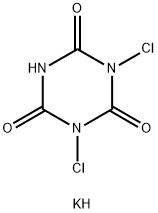
What is troclosene potassium ?
Chemical properties
White, slightly hygroscopic, crystalline powder or granules. Active ingredient 59% available chlorine; decomposes at 240C.
Chemical properties
Potassium dichloroisocyanurate is a white crys- talline solid. Chlorine odor.
The Uses of troclosene potassium
Useful source of available Cl in solid bleach and detergent formulations.
Definition
A cyclic com- pound.
General Description
White solid with an odor of chlorine. Mixes with water.
Air & Water Reactions
Water soluble. troclosene potassium may vigorously react with water releasing chlorine gas. Material containing less than 39% available chlorine will undergo reactions as described herein, but may take longer to initiate, and the resulting reaction may not be as vigorous [AAR 1992].
Reactivity Profile
Contact with ammonium compounds or hydrated salts can cause a very vigorous reaction. Prolonged exposure to heat /fire may result in the vigorous decomposition of the material with the rupture of its containers, troclosene potassium will accelerate the burning of combustible materials [AAR 1991]. Chlorine plus alcohols would yield alkyl hypochlorites. They decompose in the cold and explode on exposure to sunlight or heat. Tertiary hypochlorites are less unstable than secondary or primary hypochlorites [NFPA 491 M. 1991].
Hazard
Moderately toxic by ingestion. Dangerous fire risk in contact with organic materials. A strong oxidizing agent.
Health Hazard
Dust causes sneezing and coughing; is moderately irritating to the eyes and causes itching and redness of skin. Ingestion causes burns of mouth and stomach.
Safety Profile
Moderately toxic by ingestion, causing ulceration or bleeding from stomach. A skin and severe eye irritant. Causes emaciation, weakness, lethargy, darrhea, weight loss. Autopsy indicates gastrointestinal tract irritation, tissue edema, liver and hdney congestion. A powerful oxidizer. When heated to decomposition it emits very toxic fumes of K2O, Cl-, and NOx.
Potential Exposure
Potassium dichloroisocyanurate is used in household bleaches, dishwashing compounds and detergents.
Shipping
UN2465 Dichloroisocyanuric acid, dry or Dichloroisocyanuric acid salts, Hazard Class: 5.1; Labels: 5.1-Oxidizer.
Incompatibilities
A strong oxidizer; violent reaction with reducing agents; combustibles, organics; easily chlorinated or oxidized materials; ammonia, urea, other nitrogen com- pounds; calcium hypochloride; other alkalies and moisture. Contact with ammonium compounds or hydrated salts can cause a very vigorous reaction. Prolonged exposure to heat/ fire may result in the vigorous decomposition of the mate- rial with the rupture of its containers, it will accelerate the burning of combustible materials. Chlorine plus alcohols would yield alkyl hypochlorites. They decompose in the cold and explode on exposure to sunlight or heat. Tertiary hypochlorites are less unstable than secondary or primary hypochlorites .
Properties of troclosene potassium
| Melting point: | 250°C (rough estimate) |
| EPA Substance Registry System | Potassium dichloro-s-triazinetrione (2244-21-5) |
Safety information for troclosene potassium
Computed Descriptors for troclosene potassium
New Products
N-Carbethoxy-4-piperidone 1-Aminocyclopentane carbonitrile Tetrabutylammonium perchlorate N,O-Dimethylhydroxylamine hydrochloride (RS)-beta-Amino-beta-(4-bromophenyl)propionic acid 2-Amino-5-bromo-4-(trifluoromethyl)pyridine N-Vinylformamide 4 pentyn 1 ol Phenethyl cinnamate Pyrrolo[1,2-a]pyrimidine-6-carboxylic acid, 4,6,7,8-tetrahydro-4-oxo-, sodium salt (1:1), (6S) Ethyl 3-phenylpropanoate β-Bromostyrene Methacrylate-PEG-Methacrylate, Mn:35000 2,4-Dihydroxyacetophenone 2-Chloro 5-Fluoro Pyridine Vasicinone 2-Chloroisonicotinic Acid Tween 80 or Polysorbate 80 5-Bromo-1-Pentyne 1-(2-Methyl-5-nitrophenyl)guanidine Nitrate Methyl trans-4-Aminocyclohexanecarboxylate Hydrochloride 2-Pentyn-1-oL 4-Nitrobenzotrifluoride N-(4-Cyano-3-(trifluoromethyl)phenyl)-2-methyloxirane-2-carboxamideRelated products of tetrahydrofuran

You may like
-
 144-83-2 Sulfapyridine 98+View Details
144-83-2 -
29976-53-2 98+View Details
29976-53-2 -
2-Amino-5-bromo-4-(trifluoromethyl)pyridine 98+View Details
944401-56-3 -
(RS)-beta-Amino-beta-(4-bromophenyl)propionic acid 39773-47-2 98+View Details
39773-47-2 -
6638-79-5 N,O-Dimethylhydroxylamine hydrochloride 98+View Details
6638-79-5 -
674783-97-2 98+View Details
674783-97-2 -
1-Aminocyclopentane carbonitrile 98+View Details
49830-37-7 -
Tetrabutylammonium perchlorate 1923-70-2 98+View Details
1923-70-2