
Triphenyltin hydride
- CAS NO.:892-20-6
- Empirical Formula: C18H16Sn
- Molecular Weight: 351.03
- MDL number: MFCD00003004
- EINECS: 212-967-8
- SAFETY DATA SHEET (SDS)
- Update Date: 2026-10-13 16:36:52
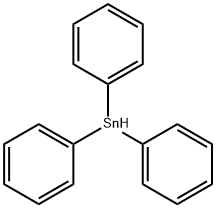
What is Triphenyltin hydride?
Chemical properties
opalescent colorless or milky white to pale yellow
The Uses of Triphenyltin hydride
Although the triphenyltins exhibit some curative effect, they are used mainly as protectants for control of a range of diseases, examples being early and late blights of potato and leaf spots on sugar beet and peanut.
Properties of Triphenyltin hydride
| Melting point: | 28 °C (lit.) |
| Boiling point: | 163-165 °C/0.3 mmHg (lit.) |
| Density | 1.374 g/mL at 25 °C (lit.) |
| refractive index | n |
| Flash point: | >230 °F |
| storage temp. | 2-8°C |
| form | solid |
| Specific Gravity | 1.374 |
| Water Solubility | Insoluble in water. |
| Sensitive | Moisture Sensitive |
| Hydrolytic Sensitivity | 8: reacts rapidly with moisture, water, protic solvents |
| BRN | 3544353 |
| Exposure limits | ACGIH: TWA 0.1 mg/m3; STEL 0.2 mg/m3 (Skin) NIOSH: IDLH 25 mg/m3; TWA 0.1 mg/m3 |
| CAS DataBase Reference | 892-20-6(CAS DataBase Reference) |
| EPA Substance Registry System | Triphenyltin (892-20-6) |
Safety information for Triphenyltin hydride
| Signal word | Danger |
| Pictogram(s) |
 Skull and Crossbones Acute Toxicity GHS06  Environment GHS09 |
| GHS Hazard Statements |
H410:Hazardous to the aquatic environment, long-term hazard |
| Precautionary Statement Codes |
P273:Avoid release to the environment. P280:Wear protective gloves/protective clothing/eye protection/face protection. |
Computed Descriptors for Triphenyltin hydride
New Products
2-(2-Chlorophenyl)glycine Propiolic Acid 1-(3-Hydroxy-4-methoxyphenyl)-2-nitroethene (±)-amino(2-fluorophenyl)acetic acid trans-3-Benzyloxy-4-methoxy-beta-nitrostyrene 1-Pentadecanol 4-(4-Αminophenyl)-3-Morpholinone 3-Morpholino-1-(4-(2-oxopiperidin-1-yl) phenyl)-5,6-dihyropyridin-2-(1H)-one 1-(4-Aminophenyl)-3-morpholino-5,6-dihydropyridin-2(1H)-one N-cyanoacetylurethane 1H-IndazoleRelated products of tetrahydrofuran
![TRIETHYLGERMYL[TRIS(PENTAFLUOROPHENYL)STANNYL]SULFIDE](https://img.chemicalbook.in/StructureFile/ChemBookStructure3/GIF/CB7126460.gif)
You may like
-
 40216-83-9 trans-4-Hydroxy-L-proline methyl ester hydrochloride 98+View Details
40216-83-9 -
471-25-0 Propiolic Acid 98+View Details
471-25-0 -
84145-28-8 98+View Details
84145-28-8 -
trans-3-Benzyloxy-4-methoxy-beta-nitrostyrene 98+View Details
63909-29-5 -
2-(2-Chlorophenyl)glycine 88744-36-9 98+View Details
88744-36-9 -
40216-83-9 trans-4-Hydroxy-L-proline methyl ester hydrochloride 98+View Details
40216-83-9 -
629-76-5 98+View Details
629-76-5 -
1-(3-Hydroxy-4-methoxyphenyl)-2-nitroethene 98+View Details
39816-35-8
Statement: All products displayed on this website are only used for non medical purposes such as industrial applications or scientific research, and cannot be used for clinical diagnosis or treatment of humans or animals. They are not medicinal or edible.