
(TRIMETHYLSILYL)ACETONITRILE
Synonym(s):(Cyanomethyl)trimethylsilane;TMSAN
- CAS NO.:18293-53-3
- Empirical Formula: C5H11NSi
- Molecular Weight: 113.23
- MDL number: MFCD00001882
- EINECS: 242-169-5
- SAFETY DATA SHEET (SDS)
- Update Date: 2026-05-28 00:24:57
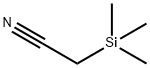
What is (TRIMETHYLSILYL)ACETONITRILE?
Physical properties
bp 84–85 °C/54 mmHg, 66 °C/35 mmHg, 65–70 °C/20 mmHg;3 d 0.827 g cm?3.
The Uses of (TRIMETHYLSILYL)ACETONITRILE
(Trimethylsilyl)acetonitrile has been used in catalytic cyanomethylation of various carbonyl compounds in the presence of Lewis bases.
The Uses of (TRIMETHYLSILYL)ACETONITRILE
α-carbanion is a useful alternative to LiCH2CN for nucleophilic cyanomethylation; (Z)-selective Peterson alkenation). Trimethylsilylacetonitrile participates in the following synthesis reactions: Metalation, Peterson Alkenation (Cyanomethylenation), Michael Addition, Reactions with Other Electrophiles, Cyanomethylation, Metal-Catalyzed Reactions etc.
Preparation
From chlorotrimethylsilane, zinc, and XCH2CN, (X = Cl, 61% yield; X = Br, 81% yield).
Purification Methods
Check if NMR and IR spectra show impurities; if present dissolve it in *C6H6 (10volumes), wash it with buffer (AcOH/AcONa pH ca 7) several times, dry (CaCl2) it, evaporate and distil it. IR: (CCl4) 2215 (CN) cm-1, NMR (CCl4): 0.23 (s, 9H, SiMe3), and 1.53 (s, 2H, CH2CN). [Matsuda et al. J Chem Soc, Perkin Trans 1 26 1979, Beilstein 4 IV 3974.]
Properties of (TRIMETHYLSILYL)ACETONITRILE
| Boiling point: | 65-70 °C20 mm Hg(lit.) |
| Density | 0.827 g/mL at 25 °C(lit.) |
| refractive index | n |
| Flash point: | 122 °F |
| storage temp. | Sealed in dry,Room Temperature |
| solubility | Sol most common organic solvents. |
| form | Liquid |
| color | Clear colorless to straw |
| Specific Gravity | 0.829 |
| Hydrolytic Sensitivity | 4: no reaction with water under neutral conditions |
| BRN | 1738845 |
Safety information for (TRIMETHYLSILYL)ACETONITRILE
| Signal word | Danger |
| Pictogram(s) |
 Flame Flammables GHS02  Skull and Crossbones Acute Toxicity GHS06 |
| GHS Hazard Statements |
H226:Flammable liquids H315:Skin corrosion/irritation H319:Serious eye damage/eye irritation H335:Specific target organ toxicity, single exposure;Respiratory tract irritation |
| Precautionary Statement Codes |
P261:Avoid breathing dust/fume/gas/mist/vapours/spray. P280:Wear protective gloves/protective clothing/eye protection/face protection. P311:Call a POISON CENTER or doctor/physician. P301+P310:IF SWALLOWED: Immediately call a POISON CENTER or doctor/physician. P305+P351+P338:IF IN EYES: Rinse cautiously with water for several minutes. Remove contact lenses, if present and easy to do. Continuerinsing. |
Computed Descriptors for (TRIMETHYLSILYL)ACETONITRILE
| InChIKey | WJKMUGYQMMXILX-UHFFFAOYSA-N |
New Products
Dibenzoyl-L-tartaric acid Anhydrous (Resolution Reagent) Cis-Tosylate Dibenzo[b,f][1,4]thiazepin-11(10H)-one 1,2,3,9-Tetrahydro-9-Methyl-4H-Carbazole-4-One 1-(4-methoxyphenyl)-4-(4-Nitrophenyl)Piperazine (IT-1) BOC Piperazine 1-Benzhydrylazetane-3-carbonitrile 8-oxa-1,3-diazaspiro[4.5]decane-2,4-dione (±)-amino(2-fluorophenyl)acetic acid 2-(2-Chlorophenyl)glycine AMINO-(3-CHLORO-PHENYL)-ACETIC ACID 2'-Fluoroacetophenone METHANOL-D1(OD) TERTIARY BUTANOL-D9 N-ETHYL-D5-AMINE HYDROCHLORIDE BENZOIC ACID-D CHLOROFORM-D TOLUENE-D3 Trans,trans muconic acid HC Blue-16 4-Amino-2-chloro-6,7-dimethoxyquinazoline Ethyl 4,5-bis(2-methoxyethoxy)-2-nitrobenzoate 2,3-Dimethoxypyridine 1-(3-Chlorophenyl)piperazine hydrochlorideRelated products of tetrahydrofuran





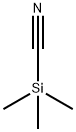

You may like
-
 Trimethylsilyl)acetonitrile CAS 18293-53-3View Details
18293-53-3 -
 Trimethylsilyl acetonitrile ( 18293-53-3)View Details
18293-53-3 -
 Product IntroductionView Details
 -
 Product InrtroductionView Details
 -
 DGO24View Details
 -
 DGO25View Details
 -
 DGO29View Details
 -
 DGO32View Details