
trimethyl isocyanurate
- CAS NO.:827-16-7
- Empirical Formula: C6H9N3O3
- Molecular Weight: 171.15
- SAFETY DATA SHEET (SDS)
- Update Date: 2026-05-27 17:18:09
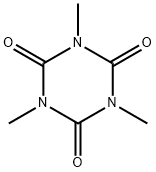
What is trimethyl isocyanurate?
The Uses of trimethyl isocyanurate
The crystal structure of Trimethyl-1,3,5-triazinane-2,4,6-trione has been reported previously to have low accurancy and without H-atom position, this compound in its molecular complex with 1,3,5-trinitrobenzene has been used in the construction of suprmolecular networks stabilized by hydrogen bonds.
Synthesis Reference(s)
Journal of the American Chemical Society, 78, p. 4358, 1956 DOI: 10.1021/ja01598a043
General Description
Monoclinic prisms (from water or alcohol).
Reactivity Profile
Isocyanates and thioisocyanates, such as trimethyl isocyanurate, are incompatible with many classes of compounds, reacting exothermically to release toxic gases. Reactions with amines, aldehydes, alcohols, alkali metals, ketones, mercaptans, strong oxidizers, hydrides, phenols, and peroxides can cause vigorous releases of heat. Acids and bases initiate polymerization reactions in these materials. Some isocyanates react with water to form amines and liberate carbon dioxide. Polyurethanes are formed by the condensation reaction of diisocyanates with, for example, ethyl glycol.
Fire Hazard
Flash point data for trimethyl isocyanurate are not available. trimethyl isocyanurate is probably combustible.
Properties of trimethyl isocyanurate
| Melting point: | 176.5°C |
| Boiling point: | 301.12°C (rough estimate) |
| Density | 1.3994 (rough estimate) |
| refractive index | 1.5800 (estimate) |
| storage temp. | Sealed in dry,Room Temperature |
| pka | -2.13±0.20(Predicted) |
| EPA Substance Registry System | Trimethyl isocyanurate (827-16-7) |
Safety information for trimethyl isocyanurate
| Signal word | Warning |
| Pictogram(s) |
 Exclamation Mark Irritant GHS07 |
| GHS Hazard Statements |
H302:Acute toxicity,oral H315:Skin corrosion/irritation H319:Serious eye damage/eye irritation H335:Specific target organ toxicity, single exposure;Respiratory tract irritation |
| Precautionary Statement Codes |
P261:Avoid breathing dust/fume/gas/mist/vapours/spray. P305+P351+P338:IF IN EYES: Rinse cautiously with water for several minutes. Remove contact lenses, if present and easy to do. Continuerinsing. |
Computed Descriptors for trimethyl isocyanurate
New Products
2-(2-Chlorophenyl)glycine Propiolic Acid 1-(3-Hydroxy-4-methoxyphenyl)-2-nitroethene (±)-amino(2-fluorophenyl)acetic acid trans-3-Benzyloxy-4-methoxy-beta-nitrostyrene 1-Pentadecanol 2,4-Dihydroxybenzaldehyde Obidoxime hydrochloride API Pyrrolo[1,2-a]pyrimidine-6-carboxylic acid, 4,6,7,8-tetrahydro-4-oxo-, sodium salt (1:1), (6S) Dipropyl disulfide 4 pentyn 1 ol N-Vinylformamide Methacrylate-PEG-Methacrylate, Mn:35000 2,4-Dihydroxyacetophenone 2-Chloro 5-Fluoro Pyridine Vasicinone 2-Chloroisonicotinic Acid Tween 80 or Polysorbate 80 2-Butyn-1-oL N-(4-Cyano-3-(trifluoromethyl)phenyl)-2-methyloxirane-2-carboxamide N-(4-fluoro-2-methoxy-5-nitrophenyl)-4-(1-methyl-1H-indol-3-yl)pyrimidin-2-amine Pirtobrutinib intd. 2-Pentyn-1-oL 4-NitrobenzotrifluorideRelated products of tetrahydrofuran
![TRIS[2-(3-MERCAPTOPROPIONYLOXY)ETHYL] ISOCYANURATE](https://img.chemicalbook.in/CAS/GIF/36196-44-8.gif)
You may like
-
 40216-83-9 trans-4-Hydroxy-L-proline methyl ester hydrochloride 98+View Details
40216-83-9 -
471-25-0 Propiolic Acid 98+View Details
471-25-0 -
84145-28-8 98+View Details
84145-28-8 -
trans-3-Benzyloxy-4-methoxy-beta-nitrostyrene 98+View Details
63909-29-5 -
2-(2-Chlorophenyl)glycine 88744-36-9 98+View Details
88744-36-9 -
40216-83-9 trans-4-Hydroxy-L-proline methyl ester hydrochloride 98+View Details
40216-83-9 -
629-76-5 98+View Details
629-76-5 -
1-(3-Hydroxy-4-methoxyphenyl)-2-nitroethene 98+View Details
39816-35-8