
Triisopropyl phosphite
- CAS NO.:116-17-6
- Empirical Formula: C9H21O3P
- Molecular Weight: 208.24
- MDL number: MFCD00008874
- EINECS: 204-130-0
- SAFETY DATA SHEET (SDS)
- Update Date: 2026-05-28 06:12:38
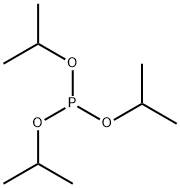
What is Triisopropyl phosphite?
Chemical properties
Colorless liquid; characteristic odor. Miscible with most common organic solvents; insoluble in water; hydrolyzes slowly in water; exposure to air should be minimum; high thermal stability. Combustible.
The Uses of Triisopropyl phosphite
Triisopropyl phosphite can be used as a reactant:
- With Ru-based indenylidene complexes to form 1st generation complexes for metathesis reactions.
- In Perkow-type reaction to synthesize compounds containing polarized carbon-carbon double bonds.
- For the synthesis of phosphonohydrazines by reacting with arylamines and isoamyl nitrite.
It can also be used as an alternative to triphenylphosphine in Mitsunobu reaction to facilitate the isolation of products.
The Uses of Triisopropyl phosphite
Intermediate for insecticides, component of vinyl stabilizers, lubricant additive, specialty solvent.
Purification Methods
Distil it from sodium, under vacuum, through a column packed with glass helices. (This removes any dialkyl phosphonate.) [Ford-Moore & Williams J Chem Soc 1465 1947, Arbuzov Chem Ber 38 1171 1905, see Verkade & Coskren in Organo Phosphorus Compound (Kosolapoff & Maier eds) Wiley Vol 2 pp 1-187 1972, Beilstein 1 IV 1476.]
Properties of Triisopropyl phosphite
| Boiling point: | 63-64 °C11 mm Hg(lit.) |
| Density | 0.844 g/mL at 25 °C(lit.) |
| vapor pressure | <2 mm Hg ( 20 °C) |
| refractive index | n |
| Flash point: | 154 °F |
| storage temp. | -20°C |
| form | Liquid |
| color | Clear |
| Specific Gravity | 0.844 |
| Water Solubility | Insoluble |
| Sensitive | Moisture Sensitive |
| BRN | 1701528 |
| CAS DataBase Reference | 116-17-6(CAS DataBase Reference) |
| NIST Chemistry Reference | Phosphorous acid, tris(1-methylethyl) ester(116-17-6) |
| EPA Substance Registry System | Phosphorous acid, tris(1-methylethyl) ester (116-17-6) |
Safety information for Triisopropyl phosphite
| Signal word | Danger |
| Pictogram(s) |
 Skull and Crossbones Acute Toxicity GHS06 |
| GHS Hazard Statements |
H301:Acute toxicity,oral H315:Skin corrosion/irritation |
| Precautionary Statement Codes |
P302+P352:IF ON SKIN: wash with plenty of soap and water. |
Computed Descriptors for Triisopropyl phosphite
New Products
2-(2-Chlorophenyl)glycine Propiolic Acid 1-(3-Hydroxy-4-methoxyphenyl)-2-nitroethene (±)-amino(2-fluorophenyl)acetic acid trans-3-Benzyloxy-4-methoxy-beta-nitrostyrene 1-Pentadecanol 2,4-Dihydroxybenzaldehyde Dipropyl disulfide Pyrrolo[1,2-a]pyrimidine-6-carboxylic acid, 4,6,7,8-tetrahydro-4-oxo-, sodium salt (1:1), (6S) Obidoxime hydrochloride API 4 pentyn 1 ol N-Vinylformamide Methacrylate-PEG-Methacrylate, Mn:35000 2,4-Dihydroxyacetophenone 2-Chloro 5-Fluoro Pyridine Vasicinone 2-Chloroisonicotinic Acid Tween 80 or Polysorbate 80 2-Butyn-1-oL N-(4-Cyano-3-(trifluoromethyl)phenyl)-2-methyloxirane-2-carboxamide N-(4-fluoro-2-methoxy-5-nitrophenyl)-4-(1-methyl-1H-indol-3-yl)pyrimidin-2-amine Pirtobrutinib intd. 2-Pentyn-1-oL 4-NitrobenzotrifluorideRelated products of tetrahydrofuran

You may like
-
 Medronic acid impurity A CAS 116-17-6View Details
116-17-6 -
Triisopropyl phosphite CAS 116-17-6View Details
116-17-6 -
Tri isopropyl phosphite 116-17-6 99.0%View Details
116-17-6 -
471-25-0 Propiolic Acid 98+View Details
471-25-0 -
84145-28-8 98+View Details
84145-28-8 -
2-(2-Chlorophenyl)glycine 88744-36-9 98+View Details
88744-36-9 -
40216-83-9 trans-4-Hydroxy-L-proline methyl ester hydrochloride 98+View Details
40216-83-9 -
1-(3-Hydroxy-4-methoxyphenyl)-2-nitroethene 98+View Details
39816-35-8
Statement: All products displayed on this website are only used for non medical purposes such as industrial applications or scientific research, and cannot be used for clinical diagnosis or treatment of humans or animals. They are not medicinal or edible.