
Tridemorph
Synonym(s):2,6-Dimethyl-4-tridecylmorpholine
- CAS NO.:24602-86-6
- Empirical Formula: C19H39NO
- Molecular Weight: 297.52
- MDL number: MFCD00055522
- EINECS: 246-347-3
- SAFETY DATA SHEET (SDS)
- Update Date: 2026-05-28 05:47:05
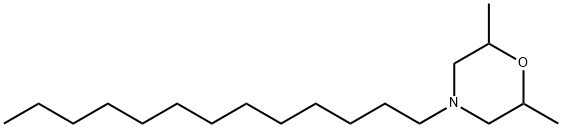
What is Tridemorph?
Chemical properties
Clear Pale Yellow Oil
The Uses of Tridemorph
Tridemorph is a known fungicide that is used to control the fungus Erysiphe graminis in cereals. Tridemorph is also utilized for agriculture purposes such as fungicidal control of crops.
Definition
ChEBI: 2,6-dimethyl-4-tridecylmorpholine is a member of the class of morpholines that is 2,6-dimethylmorpholine in which the hydrogen attached to the nitrogen is replaced by a tridecyl group. The configuration at positions 2 and 6 is unknown or unspecified. It has a role as an antifungal agrochemical. It is a member of morpholines and a tertiary amino compound.
Properties of Tridemorph
| Melting point: | <25 °C |
| Boiling point: | bp0.7 130-133°; bp1.3 139-142° |
| Density | 0.8600 |
| refractive index | nD25 1.4568 |
| storage temp. | 0-6°C |
| solubility | Chloroform (Slightly), Methanol (Slightly) |
| pka | 7.63±0.10(Predicted) |
| form | neat |
| CAS DataBase Reference | 24602-86-6(CAS DataBase Reference) |
| EPA Substance Registry System | 2,6-Dimethyl-4-tridecylmorpholine (24602-86-6) |
Safety information for Tridemorph
| Signal word | Danger |
| Pictogram(s) |
 Exclamation Mark Irritant GHS07  Health Hazard GHS08  Environment GHS09 |
| GHS Hazard Statements |
H315:Skin corrosion/irritation H410:Hazardous to the aquatic environment, long-term hazard |
| Precautionary Statement Codes |
P202:Do not handle until all safety precautions have been read and understood. P273:Avoid release to the environment. P301+P312:IF SWALLOWED: call a POISON CENTER or doctor/physician IF you feel unwell. P302+P352:IF ON SKIN: wash with plenty of soap and water. P308+P313:IF exposed or concerned: Get medical advice/attention. |
Computed Descriptors for Tridemorph
New Products
2-(2-Chlorophenyl)glycine Propiolic Acid 1-(3-Hydroxy-4-methoxyphenyl)-2-nitroethene (±)-amino(2-fluorophenyl)acetic acid trans-3-Benzyloxy-4-methoxy-beta-nitrostyrene 1-Pentadecanol 2,4-Dihydroxybenzaldehyde Dipropyl disulfide Pyrrolo[1,2-a]pyrimidine-6-carboxylic acid, 4,6,7,8-tetrahydro-4-oxo-, sodium salt (1:1), (6S) Obidoxime hydrochloride API 4 pentyn 1 ol N-Vinylformamide Methacrylate-PEG-Methacrylate, Mn:35000 2,4-Dihydroxyacetophenone 2-Chloro 5-Fluoro Pyridine Vasicinone 2-Chloroisonicotinic Acid Tween 80 or Polysorbate 80 2-Butyn-1-oL N-(4-Cyano-3-(trifluoromethyl)phenyl)-2-methyloxirane-2-carboxamide N-(4-fluoro-2-methoxy-5-nitrophenyl)-4-(1-methyl-1H-indol-3-yl)pyrimidin-2-amine Pirtobrutinib intd. 2-Pentyn-1-oL 4-NitrobenzotrifluorideRelated products of tetrahydrofuran





You may like
-
 40216-83-9 trans-4-Hydroxy-L-proline methyl ester hydrochloride 98+View Details
40216-83-9 -
471-25-0 Propiolic Acid 98+View Details
471-25-0 -
84145-28-8 98+View Details
84145-28-8 -
trans-3-Benzyloxy-4-methoxy-beta-nitrostyrene 98+View Details
63909-29-5 -
2-(2-Chlorophenyl)glycine 88744-36-9 98+View Details
88744-36-9 -
40216-83-9 trans-4-Hydroxy-L-proline methyl ester hydrochloride 98+View Details
40216-83-9 -
629-76-5 98+View Details
629-76-5 -
1-(3-Hydroxy-4-methoxyphenyl)-2-nitroethene 98+View Details
39816-35-8
Statement: All products displayed on this website are only used for non medical purposes such as industrial applications or scientific research, and cannot be used for clinical diagnosis or treatment of humans or animals. They are not medicinal or edible.