
TRIALLYL PHOSPHITE
- CAS NO.:102-84-1
- Empirical Formula: C9H15O3P
- Molecular Weight: 202.19
- MDL number: MFCD00014948
- EINECS: 203-060-8
- SAFETY DATA SHEET (SDS)
- Update Date: 2026-11-09 13:45:28
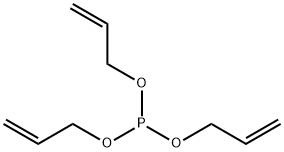
What is TRIALLYL PHOSPHITE?
The Uses of TRIALLYL PHOSPHITE
Triallyl phosphite is employed as a radical precursor.
Properties of TRIALLYL PHOSPHITE
| Boiling point: | 84°C 12mm |
| Density | 0.9983 |
| RTECS | TH1772500 |
| Flash point: | 84°C/12mm |
| solubility | Not miscible or difficult to mix. |
| form | Liquid |
| color | Colorless |
| Sensitive | Air & Moisture Sensitive |
| EPA Substance Registry System | Phosphorous acid, tri-2-propenyl ester (102-84-1) |
Safety information for TRIALLYL PHOSPHITE
| Pictogram(s) |
 Skull and Crossbones Acute Toxicity GHS06 |
| GHS Hazard Statements |
H301:Acute toxicity,oral H312:Acute toxicity,dermal |
| Precautionary Statement Codes |
P309:IF exposed or if you feel unwell: P310:Immediately call a POISON CENTER or doctor/physician. |
Computed Descriptors for TRIALLYL PHOSPHITE
New Products
2-(2-Chlorophenyl)glycine Propiolic Acid 1-(3-Hydroxy-4-methoxyphenyl)-2-nitroethene (±)-amino(2-fluorophenyl)acetic acid trans-3-Benzyloxy-4-methoxy-beta-nitrostyrene 1-Pentadecanol 4-(4-Αminophenyl)-3-Morpholinone 3-Morpholino-1-(4-(2-oxopiperidin-1-yl) phenyl)-5,6-dihyropyridin-2-(1H)-one 1-(4-Aminophenyl)-3-morpholino-5,6-dihydropyridin-2(1H)-one N-cyanoacetylurethane 1H-IndazoleRelated products of tetrahydrofuran


You may like
-
 Triallyl phosphite CAS 102-84-1View Details
102-84-1 -
Triallyl phosphite CAS 102-84-1View Details
102-84-1 -
471-25-0 Propiolic Acid 98+View Details
471-25-0 -
84145-28-8 98+View Details
84145-28-8 -
trans-3-Benzyloxy-4-methoxy-beta-nitrostyrene 98+View Details
63909-29-5 -
2-(2-Chlorophenyl)glycine 88744-36-9 98+View Details
88744-36-9 -
40216-83-9 trans-4-Hydroxy-L-proline methyl ester hydrochloride 98+View Details
40216-83-9 -
1-(3-Hydroxy-4-methoxyphenyl)-2-nitroethene 98+View Details
39816-35-8
Statement: All products displayed on this website are only used for non medical purposes such as industrial applications or scientific research, and cannot be used for clinical diagnosis or treatment of humans or animals. They are not medicinal or edible.