
Tolclofos-methyl
Synonym(s):O-(2,6-Dichloro-4-methylphenyl) O,O-dimethyl phosphorothioate
- CAS NO.:57018-04-9
- Empirical Formula: C9H11Cl2O3PS
- Molecular Weight: 301.13
- MDL number: MFCD00078741
- EINECS: 260-515-3
- SAFETY DATA SHEET (SDS)
- Update Date: 2026-05-28 00:29:17
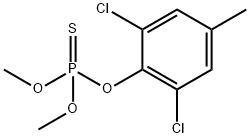
What is Tolclofos-methyl?
The Uses of Tolclofos-methyl
Tolclofos-methyl is a non-systemic organophosphorus fungicide with both protective and curative activities that control soil-borne diseases caused by Rhizoctonia solani, Corticium rolfsii, Tphula incamata and Typhula ishikariensis in/on potatoes, sugar beet, cotton and peanuts.
The Uses of Tolclofos-methyl
Agricultural fungicide.
Definition
ChEBI: An organic thiophosphate that is 2,6-dichloro-4-methylphenol in which the hydrogen of the hydroxy group group has been replaced by a dimethoxyphosphorothioyl group. Tolclofos-methyl is a phospholipid biosynthesis inhibitor and fungicide that is used for co trolling soil-borne diseases caused by Typhula incarnata, Corticium rolfsii, Typhula ishikariensis, and Rhizoctonia solani.
Metabolic pathway
Tolclofos-methyl underwent common degradation and metabolic pathways in water, soil, plants and animals. These reactions are well documented for most organophosphorus compounds and include oxidative desulfuration, hydroxylation/oxidation of the 4-methyl group to the alcohol and carboxylic acid, cleavage of the P-O-aryl linkage, O-demethylation and conjugation. In addition to the above reactions, photolytic isomerisation to the thionate (P=S) was also observed. A schematic presentation of the primary metabolic pathways for tolclofosmethyl is illustrated in Scheme 1.
Degradation
[14C-phenyl]Tolclofos-methyl(1) was stable to hydrolytic degradation at
pH 5, 7 and 9 at 22°C with DT50 values of 139, 417 and 238 days,
respectively. Higher temperature led to a more rapid hydrolysis and two
hydrolysis products were detected. O-Demethylation and oxidative desulfuration
were the major reactions to yield 2,6-dichloro-p-tolyl methyl
hydrogen phosphorothioate (2) and toclofos-methyl oxon (O-2,6-dichlorop-
tolyl O,O-dimethyl phosphate, 3), respectively. Cleavage of the P-O-aryl
linkage yielded 2,6-dichloro-4-methylphenol(4) as a minor degradation
product (WHO, 1994).
Tolclofos-methyl degraded in water under natural sunlight irradiation
with DT50 values of 44 days (in distilled water), 15-28 days (in natural
river and pond water) and less than 2 days in 2% acetone/water. The
major degradation reactions included oxidative desulfuration to yield
compound 3 and O-demethylation to yield compound 2. The major
photodegradation products in river and pond waters and soil thinlayer
surfaces were compounds 2, 3, 4 and the O-demethylated 3 (2,6-
dichloro-p-tolyl methyl hydrogen phosphate, 5) (Mikami et al., 1984).
In acetone solution, demethylation of the isomerisation product [2,6-
dichloro-p-tolyl O,S-dimethyl phosphorothioate (6)] yielded 2,6-dichlorop-
tolyl S-methyl hydrogen phosphorothioate (7) and 2,6-dichloro-p-tolyl
dihydrogen phosphate (8) as the major photodegradates (Mikami et al.,
1984).
Toxicity evaluation
Its acute oral toxicity is very low in comparison with a thio-ester type of other organophosphorus fungicides (edifenphos, iprobenfos, and pyrazophos).
Properties of Tolclofos-methyl
| Melting point: | 78-80°C |
| Boiling point: | 338.5±52.0 °C(Predicted) |
| Density | 1.401±0.06 g/cm3(Predicted) |
| vapor pressure | 1.84 x 10⁻³ (Pa 25 °C) |
| Flash point: | >100 °C |
| storage temp. | 2-8°C |
| solubility | Chloroform (Slightly), DMSO (Slightly) |
| form | Solid |
| form | neat |
| Water Solubility | 1.10 mg l-1 (25 °C) |
| color | White to off-white |
| Merck | 13,9587 |
| BRN | 2136521 |
| CAS DataBase Reference | 57018-04-9(CAS DataBase Reference) |
| NIST Chemistry Reference | Phosphorothioic acid, o-(2,6-dichloro-4-methylphenyl) o,o-dimethyl ester(57018-04-9) |
| EPA Substance Registry System | Tolclofos-methyl (57018-04-9) |
Safety information for Tolclofos-methyl
| Signal word | Warning |
| Pictogram(s) |
 Exclamation Mark Irritant GHS07  Environment GHS09 |
| GHS Hazard Statements |
H317:Sensitisation, Skin H410:Hazardous to the aquatic environment, long-term hazard |
| Precautionary Statement Codes |
P261:Avoid breathing dust/fume/gas/mist/vapours/spray. P272:Contaminated work clothing should not be allowed out of the workplace. P273:Avoid release to the environment. P280:Wear protective gloves/protective clothing/eye protection/face protection. P302+P352:IF ON SKIN: wash with plenty of soap and water. P333+P313:IF SKIN irritation or rash occurs: Get medical advice/attention. |
Computed Descriptors for Tolclofos-methyl
| InChIKey | OBZIQQJJIKNWNO-UHFFFAOYSA-N |
New Products
Cis-Tosylate Dibenzo[b,f][1,4]thiazepin-11(10H)-one 1,2,3,9-Tetrahydro-9-Methyl-4H-Carbazole-4-One Dibenzoyl-L-tartaric acid Anhydrous (Resolution Reagent) N-BOC-piperidine-4-carboxylic acid 1-Benzhydrylazetane-3-carbonitrile AMINO-(3-CHLORO-PHENYL)-ACETIC ACID 2-(2-Chlorophenyl)glycine (±)-amino(2-fluorophenyl)acetic acid 8-oxa-1,3-diazaspiro[4.5]decane-2,4-dione BENZOIC ACID-D5 TRIFLOURO ACETICACID-D METHANE SULFONIC ACID-D4 PHOSPORIC ACID-D3 85 W% IN D2O TOLUENE-D3 BENZENE-D6 1-Acetyl-4-(4-hydroxyphenyl)piperazine 1-(3-Chlorophenyl)piperazine hydrochlorideRelated products of tetrahydrofuran



You may like
-
 Tolclofos-methyl CAS 57018-04-9View Details
57018-04-9 -
Tolclofos-methyl CAS 57018-04-9View Details
57018-04-9 -
7292-71-9 AMINO-(3-CHLORO-PHENYL)-ACETIC ACID 98+View Details
7292-71-9 -
2-(2-Chlorophenyl)glycine 98+View Details
88744-36-9 -
7292-71-9 AMINO-(3-CHLORO-PHENYL)-ACETIC ACID 98+View Details
7292-71-9 -
84145-28-8 98+View Details
84145-28-8 -
2-(2-Chlorophenyl)glycine 98+View Details
88744-36-9 -
8-oxa-1,3-diazaspiro[4.5]decane-2,4-dione 39124-19-1 98+View Details
39124-19-1