
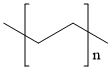
Thermoplastic elastomers
- CAS NO.:308079-71-2
- Molecular Weight: 0
What is Thermoplastic elastomers?
Chemical properties
The characteristic properties of the styrene-butadiene thermoplastic elastomers
stem from the inherent incompatibility of the polystyrene and polybutadien
blocks. In the bulk material the two different blocks aggregate into
separate domains leading to a dispersion of polystyrene domains (as the
lesser component) in a continuous matrix of polybutadiene. At ordinary
temperatures the polystyrene domains are rigid and immobilize the ends of
the polybutadiene segments, in effect serving both as cross-links and filler
particles. Thus the system has the strength of a filler-reinforced vulcanized
amorphous elastomer. At temperatures above the glasstransition
temperature of polystyrene (l00°C), the polystyrene domains are
readily disrupted and the material may be melt-processed. The maximum
service temperature of components fabricated from the copolymers is
about 60°C.
The chemical properties of the block copolymers are similar to those of
unvulcanized styrene-butadiene rubber. Thus the block copolymers are soluble
in a range of solvents, including chlorinated and aromatic hydrocarbons,
esters and ketones.
The Uses of Thermoplastic elastomers
Styrene-butadiene thermoplastic elastomers find use in such applications as footwear soles and heels, elastic bands and adhesives.
Industrial uses
Proper choice of catalyst and order of procedure in polymerization have led to development of thermoplastic elastomers. The leading commercial types are styrene block copolymers with a structure that, unlike the random distribution of monomer units in conventional polymers, consists of polystyrene segments or blocks connected by rubbery polymers such as polybutadiene, polyisoprene, or ethylene-butylene polymer. These types can be designated SBS, SIS, and SEBS, respectively. Other types of thermoplastic elastomers, such as the polyester type, have also been developed.
Thermoplastic elastomers are very useful in providing a fast and economical method of producing a variety of products, including molded goods, toys, sporting goods, and footwear.
Safety information for Thermoplastic elastomers
New Products
2-(2-Chlorophenyl)glycine Propiolic Acid 1-(3-Hydroxy-4-methoxyphenyl)-2-nitroethene (±)-amino(2-fluorophenyl)acetic acid trans-3-Benzyloxy-4-methoxy-beta-nitrostyrene 1-Pentadecanol 2,4-Dihydroxybenzaldehyde Dipropyl disulfide Pyrrolo[1,2-a]pyrimidine-6-carboxylic acid, 4,6,7,8-tetrahydro-4-oxo-, sodium salt (1:1), (6S) Obidoxime hydrochloride API 4 pentyn 1 ol N-Vinylformamide Methacrylate-PEG-Methacrylate, Mn:35000 2,4-Dihydroxyacetophenone 2-Chloro 5-Fluoro Pyridine Vasicinone 2-Chloroisonicotinic Acid Tween 80 or Polysorbate 80 2-Butyn-1-oL N-(4-Cyano-3-(trifluoromethyl)phenyl)-2-methyloxirane-2-carboxamide N-(4-fluoro-2-methoxy-5-nitrophenyl)-4-(1-methyl-1H-indol-3-yl)pyrimidin-2-amine Pirtobrutinib intd. 2-Pentyn-1-oL 4-NitrobenzotrifluorideRelated products of tetrahydrofuran

You may like
-
 40216-83-9 trans-4-Hydroxy-L-proline methyl ester hydrochloride 98+View Details
40216-83-9 -
471-25-0 Propiolic Acid 98+View Details
471-25-0 -
84145-28-8 98+View Details
84145-28-8 -
trans-3-Benzyloxy-4-methoxy-beta-nitrostyrene 98+View Details
63909-29-5 -
2-(2-Chlorophenyl)glycine 88744-36-9 98+View Details
88744-36-9 -
40216-83-9 trans-4-Hydroxy-L-proline methyl ester hydrochloride 98+View Details
40216-83-9 -
629-76-5 98+View Details
629-76-5 -
1-(3-Hydroxy-4-methoxyphenyl)-2-nitroethene 98+View Details
39816-35-8