
Thallium chlorate
- CAS NO.:13453-30-0
- Empirical Formula: ClO3Tl
- Molecular Weight: 287.8345
- SAFETY DATA SHEET (SDS)
- Update Date: 2026-04-01 16:59:24
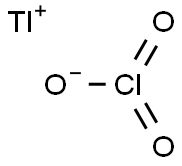
What is Thallium chlorate?
Chemical properties
needles [LAN05]
General Description
A white crystalline solid. Denser than water. Contact may cause irritation to skin, eyes, and mucous membranes. May be toxic by ingestion. Used to make other chemicals.
Air & Water Reactions
Slightly soluble in cold water; soluble in hot water.
Reactivity Profile
Thallium chlorate is an oxidizing agent. May initiate combustion when exposed to organic materials. May liberate explosive chlorine dioxide gas when heated in the presence of strong acid. May liberate chlorine dioxide and carbon dioxide if heated in contact with moist dibasic carboxylic acids. Mixtures with ammonium salts, powdered metals, silicon, sulfur, or sulfides are readily ignited and potentially explosive [Bretherick 1979 p. 806]. A combination with finely divided aluminum may explode by heat, percussion, or friction [Mellor 2:310 1946-47].
Health Hazard
Toxic by ingestion. Inhalation of dust is toxic. Fire may produce irritating, corrosive and/or toxic gases. Contact with substance may cause severe burns to skin and eyes. Runoff from fire control or dilution water may cause pollution.
Fire Hazard
These substances will accelerate burning when involved in a fire. May explode from heat or contamination. Some may burn rapidly. Some will react explosively with hydrocarbons (fuels). May ignite combustibles (wood, paper, oil, clothing, etc.). Containers may explode when heated. Runoff may create fire or explosion hazard.
Safety Profile
A poison and oxidner. When heated to decomposition it emits toxic fumes of T1 and Cl-.
Purification Methods
It crystallises from hot water (2mL/g) on cooling. Its solubility in H2O (w/w) is 0.17% at 0o, 0.32% at 20o, and 2.4% at 100o. [D.nges in Handbook of Preparative Inorganic Chemistry (Ed. Brauer) Academic Press Vol I p 870 1963]. POISONOUS.
Properties of Thallium chlorate
| Density | 5.500 |
| form | colorless hexagonal crystals |
| color | colorless hexagonal, hexane crystals, crystalline |
| Water Solubility | g/100g H2O: 2.00 (0°C), 3.92 (20°C), 57.3 (100°C) [LAN05] |
| EPA Substance Registry System | Chloric acid, thallium(1+) salt (13453-30-0) |
Safety information for Thallium chlorate
Computed Descriptors for Thallium chlorate
New Products
2-(2-Chlorophenyl)glycine Propiolic Acid 1-(3-Hydroxy-4-methoxyphenyl)-2-nitroethene (±)-amino(2-fluorophenyl)acetic acid trans-3-Benzyloxy-4-methoxy-beta-nitrostyrene 1-Pentadecanol 2,4-Dihydroxybenzaldehyde Dipropyl disulfide Pyrrolo[1,2-a]pyrimidine-6-carboxylic acid, 4,6,7,8-tetrahydro-4-oxo-, sodium salt (1:1), (6S) Obidoxime hydrochloride API 4 pentyn 1 ol N-Vinylformamide Methacrylate-PEG-Methacrylate, Mn:35000 2,4-Dihydroxyacetophenone 2-Chloro 5-Fluoro Pyridine Vasicinone 2-Chloroisonicotinic Acid Tween 80 or Polysorbate 80 2-Butyn-1-oL N-(4-Cyano-3-(trifluoromethyl)phenyl)-2-methyloxirane-2-carboxamide N-(4-fluoro-2-methoxy-5-nitrophenyl)-4-(1-methyl-1H-indol-3-yl)pyrimidin-2-amine Pirtobrutinib intd. 2-Pentyn-1-oL 4-NitrobenzotrifluorideRelated products of tetrahydrofuran



You may like
-
 40216-83-9 trans-4-Hydroxy-L-proline methyl ester hydrochloride 98+View Details
40216-83-9 -
471-25-0 Propiolic Acid 98+View Details
471-25-0 -
84145-28-8 98+View Details
84145-28-8 -
trans-3-Benzyloxy-4-methoxy-beta-nitrostyrene 98+View Details
63909-29-5 -
2-(2-Chlorophenyl)glycine 88744-36-9 98+View Details
88744-36-9 -
40216-83-9 trans-4-Hydroxy-L-proline methyl ester hydrochloride 98+View Details
40216-83-9 -
629-76-5 98+View Details
629-76-5 -
1-(3-Hydroxy-4-methoxyphenyl)-2-nitroethene 98+View Details
39816-35-8