
tert-Butyldichlorophosphine
Synonym(s):(1,1-Dimethylethyl)phosphonous dichloride solution;tert-Butylphosphine dichloride;tert-Butylphosphonous dichloride
- CAS NO.:25979-07-1
- Empirical Formula: C4H9Cl2P
- Molecular Weight: 158.99
- MDL number: MFCD00013615
- EINECS: 247-386-9
- SAFETY DATA SHEET (SDS)
- Update Date: 2026-05-28 06:31:34
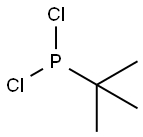
What is tert-Butyldichlorophosphine?
Chemical properties
white to light yellow crystal powde
The Uses of tert-Butyldichlorophosphine
Reactant for the synthesis of alkali metal complexes. As intermediates. tert-Butyldichlorophosphine (TBDCP) is used primarily in the preparation of monoand bidentate phosphine ligands in metal complexes for catalytic chiral asymmetric hydrogenations and other asymmetric reactions as well as transition metal coupling reactions. This reagent is also used in the preparation of other phosphines in catalytic polymerization reactions.
Properties of tert-Butyldichlorophosphine
| Melting point: | 44-49 °C(lit.) |
| Boiling point: | 142-150 °C |
| Density | 0.766 g/mL at 25 °C |
| storage temp. | Inert atmosphere,2-8°C |
| form | Low Melting Crystalline Mass |
| color | White to light yellow |
| Water Solubility | Reacts with water. Soluble in n-Pentane, n-Hexane, Ether, Toluene,THF. tert-Butyldichlorophosphine is infinitely soluble in hydrocarbon and ethereal solvents. |
| Sensitive | Air Sensitive |
| Hydrolytic Sensitivity | 8: reacts rapidly with moisture, water, protic solvents |
| CAS DataBase Reference | 25979-07-1(CAS DataBase Reference) |
| NIST Chemistry Reference | Tert-butyldichlorophosphine(25979-07-1) |
Safety information for tert-Butyldichlorophosphine
| Signal word | Danger |
| Pictogram(s) |
 Corrosion Corrosives GHS05 |
| GHS Hazard Statements |
H314:Skin corrosion/irritation |
| Precautionary Statement Codes |
P260:Do not breathe dust/fume/gas/mist/vapours/spray. P280:Wear protective gloves/protective clothing/eye protection/face protection. P363:Wash contaminated clothing before reuse. P303+P361+P353:IF ON SKIN (or hair): Remove/Take off Immediately all contaminated clothing. Rinse SKIN with water/shower. P305+P351+P338:IF IN EYES: Rinse cautiously with water for several minutes. Remove contact lenses, if present and easy to do. Continuerinsing. |
Computed Descriptors for tert-Butyldichlorophosphine
New Products
1-(4-methoxyphenyl)-4-(4-Nitrophenyl)Piperazine (IT-1) 1,2,3,9-Tetrahydro-9-Methyl-4H-Carbazole-4-One Dibenzo[b,f][1,4]thiazepin-11(10H)-one Cis-Tosylate Dibenzoyl-L-tartaric acid Anhydrous (Resolution Reagent) 1-Benzhydrylazetane-3-carbonitrile 8-oxa-1,3-diazaspiro[4.5]decane-2,4-dione (±)-amino(2-fluorophenyl)acetic acid 2-(2-Chlorophenyl)glycine AMINO-(3-CHLORO-PHENYL)-ACETIC ACID 2'-Fluoroacetophenone METHANOL-D1(OD) N-ETHYL-D5-AMINE HYDROCHLORIDE BENZOIC ACID-D CHLOROFORM-D BENZENE-D6 TOLUENE-D3 2-Hydroxybutanenitrile 1-Benzylindolin-2-one Ethyl 2-bromo-3-oxobutanoate 4-(3-chloropropyl)morpholine 1-Benzylindoline-2,3-dione 3-Oxocyclobutanecarboxylic acid 1-(3-Chlorophenyl)piperazine hydrochlorideRelated products of tetrahydrofuran




You may like
-
 tert-Butyldichlorophosphine solution CAS 25979-07-1View Details
25979-07-1 -
tert-Butyldichlorophosphine CAS 25979-07-1View Details
25979-07-1 -
5-Bromo-2-chloro- benzoic acid 21739-92-4 98%View Details
21739-92-4 -
Guar Hydroxypropyltrimonium Chloride 98%View Details
65497-29-2 -
52092-43-0 2-Bromo-4-nitropyridine-N-oxide 98%View Details
52092-43-0 -
2,4,6-Trichloro-5-nitropyrimidine 98%View Details
4359-87-9 -
1-Methylpiperidine-4-thiol 1072-99-7 98%View Details
1072-99-7 -
68886-07-7 98%View Details
68886-07-7
Statement: All products displayed on this website are only used for non medical purposes such as industrial applications or scientific research, and cannot be used for clinical diagnosis or treatment of humans or animals. They are not medicinal or edible.