
TAU-FLUVALINATE
- CAS NO.:69409-94-5
- Empirical Formula: C26H22ClF3N2O3
- Molecular Weight: 502.91
- MDL number: MFCD00137382
- SAFETY DATA SHEET (SDS)
- Update Date: 2026-07-31 15:25:14
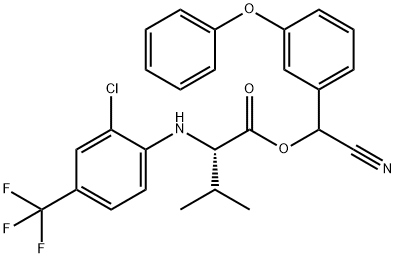
What is TAU-FLUVALINATE?
Description
Fluvalinate is a viscous amber oil with a moderate or weak sweetish odor (technical grade)
Chemical properties
Yellow to yellow-amber, viscous oil. Sweet, weak odor.
The Uses of TAU-FLUVALINATE
Fluvalinate is a pesticide.
The Uses of TAU-FLUVALINATE
Insecticide.
Definition
ChEBI: Fluvalinate is an organochlorine insecticide, an organochlorine acaricide, an organofluorine insecticide, an organofluorine acaricide, a member of monochlorobenzenes, a nitrile, a member of (trifluoromethyl)benzenes and an aromatic ether. It has a role as a pyrethroid ester insecticide, a pyrethroid ester acaricide and an agrochemical. It is functionally related to a valine.
General Description
A viscous heavy oil (technical). Formerly used as an insecticide. Production discontinued by Sandoz Agro, Inc. Insoluble in water.
Air & Water Reactions
Insoluble in water.
Reactivity Profile
TAU-FLUVALINATE is a trifluoromethyl pyrethroid. May react with acids to liberate heat. Strong oxidizing acids may cause a reaction that is sufficiently exothermic to ignite the reaction products. Heat is also generated in contact with caustic solutions. Flammable or toxic gases may be generated by mixing with alkali metals and hydrides.
Agricultural Uses
Insecticide: Not listed for use in EU countries. Some applications may be classified as a U.S. EPA restricted Use Pesticide (RUP). Used as a broad-spectrum insecticide to control moths, beetles and other pests on cereals, potatoes, fruit trees, vegetables, cotton, turf and ornamentals. It is used in Apistan? to control varroa mites in honey bees.
Trade name
APISTAN®; KARTAN®; KLARTAN®; MAVRIK®; MAVRIK AQUAFLOW®; SPUR®[C]; TAUFLUALINATE®; YARDER®; ZEOCON®; ZR 3210®
Potential Exposure
Pyrethroid insecticide used as a broad spectrum insecticide to control moths, beetles and other pests on cereals, potatoes, fruit trees, vegetables, fleas, cot ton, turf and ornamentals. It is also used to control varroa mites in honey bees. Some applications may be classified as a United States Environmental Protection Agency Restricted Use Pesticide (RUP). Formerly used as an insec ticide. Production discontinued by Sandoz Agro, Inc. Incompatibilities: Corrosive to some metals. Keep away from strong oxidizers and alkaline materials. Decomposes in temperatures above 350℃ releasing toxic vapors of hydrogen chloride, nitrogen oxides, and hydrogen fluoride.
Metabolic pathway
Metabolism of 14C-fluvalinate by chickens produces 3-phenoxybenzoic acid, which is further degraded by two pathways. The first pathway involves O-dephenylation and is the major metabolic route. The second pathway converts the carboxylic metabolites into four conjugates of benzoylornithine together with the conjugate of acetylornithine. The predominant conjugate is 2N-(3-hydroxybenzoyl)-5N- benzoylornithine.
Shipping
UN2902 Pesticides, liquid, toxic, n.o.s., Hazard Class: 6.1; Labels: 6.1-Poisonous materials, Technical Name Required. UN3077 Environmentally hazardous substances, solid, n.o.s., Hazard class: 9; Labels: 9-Miscellaneous hazardous material, Technical Name Required.
Toxicity evaluation
Acute oral LD50 for rats: >3,000 mg/kg
Waste Disposal
Incineration would be an effective disposal procedure where permitted. If an efficient incinerator is not available, the product should be mixed with large amounts of combustible material and contact with the smoke should be avoided. In accordance with 40CFR165, follow recommendations for the disposal of pesticides and pesticide containers.
Properties of TAU-FLUVALINATE
| Melting point: | <25 °C |
| Boiling point: | >450℃ |
| Density | 1.29 g/cm3(Temp: 25 °C) |
| storage temp. | 0-6°C
|
| pka | -1.16±0.50(Predicted) |
| CAS DataBase Reference | 69409-94-5 |
| EPA Substance Registry System | Fluvalinate (69409-94-5) |
Safety information for TAU-FLUVALINATE
Computed Descriptors for TAU-FLUVALINATE
New Products
5-bromo-4-fluoro-2-nitrobenzaldehyde (R)-(-)-2-Amino-1-propanol Cyclobutanone Fmoc-OSu 1-(2-Chloroethyl)pyrrolidine Hydrochloride 2-Amino-2-(4-methylphenyl)acetic acid β-Bromostyrene Ethyl 3-phenylpropanoate Phenethyl cinnamate Dipropyl disulfide 4 pentyn 1 ol N-Vinylformamide Methacrylate-PEG-Methacrylate, Mn:35000 2,4-Dihydroxyacetophenone 2-Chloro 5-Fluoro Pyridine Vasicinone 2-Chloroisonicotinic Acid Tween 80 or Polysorbate 80 2-Butyn-1-oL 2-Pentyn-1-oL 4-Nitrobenzotrifluoride N-(4-fluoro-2-methoxy-5-nitrophenyl)-4-(1-methyl-1H-indol-3-yl)pyrimidin-2-amine Pirtobrutinib intd. N-(4-Cyano-3-(trifluoromethyl)phenyl)-2-methyloxirane-2-carboxamideRelated products of tetrahydrofuran
You may like
-
 69409-94-5 Fluvalinate 98%View Details
69409-94-5 -
69409-94-5 98%View Details
69409-94-5 -
 7250-67-1 1-(2-Chloroethyl)pyrrolidine Hydrochloride 98+View Details
7250-67-1 -
13227-01-5 98+View Details
13227-01-5 -
7250-67-1 1-(2-Chloroethyl)pyrrolidine Hydrochloride 98+View Details
7250-67-1 -
13227-01-5 98+View Details
13227-01-5 -
7250-67-1 1-(2-Chloroethyl)pyrrolidine Hydrochloride 98+View Details
7250-67-1 -
13227-01-5 98+View Details
13227-01-5