
TAK-875
- CAS NO.:1000413-72-8
- Empirical Formula: C29H32O7S
- Molecular Weight: 524.63
- MDL number: MFCD18251445
- SAFETY DATA SHEET (SDS)
- Update Date: 2026-06-03 11:24:09
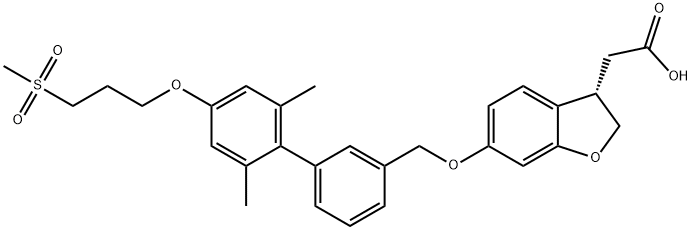
What is TAK-875?
Description
The free fatty acid receptor 1 (FFAR1; GPR40) is highly expressed in pancreatic β-cells and activated by medium and long-chain fatty acids. There is evidence of a link between FFAR1 (GPR40) and the ability of fatty acids to amplify glucose-stimulated insulin secretion, making this signaling pathway a potential target for regulating diabetes, obesity, and other metabolic disorders. TAK-875 is a selective FFAR1 (GPR40) agonist (EC50 = 26 nM) that does not exhibit activity on the related FFARs FFAR2 (GPR43) or FFAR3 (GPR41).
The Uses of TAK-875
TAK-876 is a selective G protein-coupled receptor 40 (GPR40) agonist. TAK-876 is a novel oral medication that has been developed to improve the secretion of insulin in a glucose-dependent manner, whic h has the potential to improve the control of blood sugar levels without the risk of hypoglycemia.
The Uses of TAK-875
TAK-876 is a selective G protein-coupled receptor 40 (GPR40) agonist (1,2). TAK-876 is a novel oral medication that has been developed to improve the secretion of insulin in a glucose-dependent manner, which has the potential to improve the control of blood sugar levels with a low risk of hypoglycemia.
What are the applications of Application
TAK-875 is A selective G protein-coupled receptor 40 (GPR40) agonist.
Definition
ChEBI: Fasiglifam is a member of biphenyls.
in vitro
tak-875 exhibited potent agonist activity and high binding affinity to the human receptor. in addition, tak-875 showed excellent agonist potency selectivity for gpr40 receptor over other members of the ffa receptor family (for which ec50>10 μm) [1].
in vivo
tak-875 showed potent plasma glucose-lowering action and insulinotropic action during an oral glucose tolerance test in female wistar fatty rats with impaired glucose tolerance [2].
References
[1] negoro n, sasaki s, mikami s, ito m, suzuki m, tsujihata y, ito r, harada a, takeuchi k, suzuki n, miyazaki j, santou t, odani t, kanzaki n, funami m, tanaka t1, kogame a, matsunaga s, yasuma t, momose y. discovery of tak-875: a potent, selective, and orally bioavailable gpr40 agonist. acs med chem lett. 2010 jun 18;1(6):290-4.
[2] leifke e, naik h, wu j, viswanathan p, demanno d, kipnes m, vakilynejad m. a multiple-ascending-dose study to evaluate safety, pharmacokinetics, and pharmacodynamics of a novel gpr40 agonist, tak-875, in subjects with type 2 diabetes. clin pharmacol ther. 2012 jul;92(1):29-39.
Properties of TAK-875
| Melting point: | 123-127°C |
| Boiling point: | 739.1±60.0 °C(Predicted) |
| Density | 1.252 |
| storage temp. | Refrigerator |
| solubility | Acetonitrile (Slightly), DMSO (Slightly), Methanol (Slightly) |
| form | Solid |
| pka | 4.36±0.10(Predicted) |
| color | White to Off-White |
Safety information for TAK-875
| Signal word | Warning |
| Pictogram(s) |
 Exclamation Mark Irritant GHS07 |
| GHS Hazard Statements |
H315:Skin corrosion/irritation H319:Serious eye damage/eye irritation H335:Specific target organ toxicity, single exposure;Respiratory tract irritation |
| Precautionary Statement Codes |
P261:Avoid breathing dust/fume/gas/mist/vapours/spray. P305+P351+P338:IF IN EYES: Rinse cautiously with water for several minutes. Remove contact lenses, if present and easy to do. Continuerinsing. |
Computed Descriptors for TAK-875
New Products
9-Mesityl-10-methylacridinium perchlorate Sulfapyridine Fmoc-OSu (R)-(-)-2-Amino-1-propanol Cyclobutanone 5-bromo-4-fluoro-2-nitrobenzaldehyde 4 pentyn 1 ol N-Vinylformamide Phenethyl cinnamate Pyrrolo[1,2-a]pyrimidine-6-carboxylic acid, 4,6,7,8-tetrahydro-4-oxo-, sodium salt (1:1), (6S) Ethyl 3-phenylpropanoate β-Bromostyrene Methacrylate-PEG-Methacrylate, Mn:35000 2,4-Dihydroxyacetophenone 2-Chloro 5-Fluoro Pyridine Vasicinone 2-Chloroisonicotinic Acid Tween 80 or Polysorbate 80 5-Bromo-1-Pentyne 1-(2-Methyl-5-nitrophenyl)guanidine Nitrate Methyl trans-4-Aminocyclohexanecarboxylate Hydrochloride N-(4-Cyano-3-(trifluoromethyl)phenyl)-2-methyloxirane-2-carboxamide 4-Nitrobenzotrifluoride 2-Pentyn-1-oLRelated products of tetrahydrofuran
![6-[(7S)-7-Hydroxy-6,7-dihydro-5H-pyrrolo[1,2-c]imidazol-7-yl]-N-methyl-2-naphthalenecarboxamide](https://img.chemicalbook.in/CAS/GIF/566939-85-3.gif)
![Benzoic acid, 4-[[(cyclopropylmethyl)[4-(2-fluorophenoxy)benzoyl]amino]methyl]-](https://img.chemicalbook.in/CAS/20200515/GIF/1664335-55-0.gif)
You may like
-
 1191-95-3 Cyclobutanone 98+View Details
1191-95-3 -
213382-45-7 98+View Details
213382-45-7 -
Fmoc-OSu 98+View Details
82911-69-1 -
(R)-(-)-2-Amino-1-propanol 35320-23-1 98+View Details
35320-23-1 -
1191-95-3 Cyclobutanone 98+View Details
1191-95-3 -
213382-45-7 98+View Details
213382-45-7 -
Fmoc-OSu 98+View Details
82911-69-1 -
(R)-(-)-2-Amino-1-propanol 35320-23-1 98+View Details
35320-23-1