
SULBENICILLIN
- CAS NO.:41744-40-5
- Empirical Formula: C16H18N2O7S2
- Molecular Weight: 414.46
- MDL number: MFCD00869408
- EINECS: 255-528-6
- SAFETY DATA SHEET (SDS)
- Update Date: 2026-05-20 15:45:17
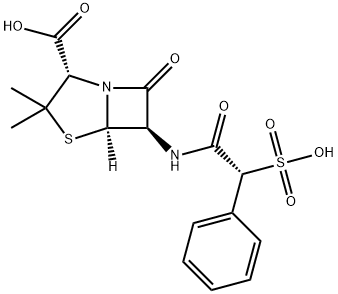
What is SULBENICILLIN?
Originator
Lillacillin,Takeda,Japan,1973
Definition
ChEBI: A penicillin antibiotic having a 6beta-[phenyl(sulfo)acetamido] side-chain.
Manufacturing Process
To a suspension of 1.08 parts by weight of 6-aminopenicillanic acid in 8 parts by volume of water is added 1.48 parts by weight of sodium bicarbonate. After the mixture is dissolved, a solution of 1.18 parts by weight of α-sulfophenylacetyl chloride in 10 parts by volume of diethylether is gradually added thereto. The mixture is stirred at a temperature in the neighborhood of 0°C for 1 hour. The aqueous layer is washed twice with 10 parts by volume of portions of ether and adjusted to pH 1.2 with cation exchange resin of polystyrene sulfonic acid type under constant cooling. Then the solution is washed twice with 15 parts by volume of portions of ethyl acetate, followed by extraction twice with 15 parts by volume of portions of n-butanol. The extracts are combined and washed twice with 15 parts by volume of portions of water and, then, extracted with an aqueous solution of sodium bicarbonate. The extract is adjusted to pH 6.5, washed with ether and lyophilized to give the sodium salt of α-sulfobenzylpenicillin. Yield is 1.2 parts by weight.
Therapeutic Function
Antibacterial
Antimicrobial activity
α-Sulfobenzylpenicillin, a semisynthetic penicillin supplied as the disodium salt. Its antimicrobial spectrum and pharmacokinetic pharmacokinetic behavior closely resemble those of carbenicillin. Following intravenous administration of 4 g, the mean plasma concentration at 1 h was approximately 160 mg/L, with a plasma elimination half-life of around 70 min. It is largely excreted in the urine, about 80% of the dose appearing in the first 24 h, less than 5% as the penicilloic acid. It has been noted that the penicilloic acid causes much stronger platelet aggregation than its parent. It is of very limited availability.
Properties of SULBENICILLIN
| Melting point: | 197 °C (decomp) |
| Density | 1?+-.0.1 g/cm3(Predicted) |
| pka | 0.28±0.50(Predicted) |
Safety information for SULBENICILLIN
Computed Descriptors for SULBENICILLIN
New Products
5-bromo-4-fluoro-2-nitrobenzaldehyde (R)-(-)-2-Amino-1-propanol Cyclobutanone Fmoc-OSu 1-(2-Chloroethyl)pyrrolidine Hydrochloride 2-Amino-2-(4-methylphenyl)acetic acid β-Bromostyrene Ethyl 3-phenylpropanoate Phenethyl cinnamate Dipropyl disulfide 4 pentyn 1 ol N-Vinylformamide Methacrylate-PEG-Methacrylate, Mn:35000 2,4-Dihydroxyacetophenone 2-Chloro 5-Fluoro Pyridine Vasicinone 2-Chloroisonicotinic Acid Tween 80 or Polysorbate 80 2-Butyn-1-oL 2-Pentyn-1-oL 4-Nitrobenzotrifluoride N-(4-fluoro-2-methoxy-5-nitrophenyl)-4-(1-methyl-1H-indol-3-yl)pyrimidin-2-amine Pirtobrutinib intd. N-(4-Cyano-3-(trifluoromethyl)phenyl)-2-methyloxirane-2-carboxamideRelated products of tetrahydrofuran


You may like
-
 Fmoc-OSu 98+View Details
82911-69-1 -
(R)-(-)-2-Amino-1-propanol 35320-23-1 98+View Details
35320-23-1 -
7250-67-1 1-(2-Chloroethyl)pyrrolidine Hydrochloride 98+View Details
7250-67-1 -
13227-01-5 98+View Details
13227-01-5 -
7250-67-1 1-(2-Chloroethyl)pyrrolidine Hydrochloride 98+View Details
7250-67-1 -
13227-01-5 98+View Details
13227-01-5 -
7250-67-1 1-(2-Chloroethyl)pyrrolidine Hydrochloride 98+View Details
7250-67-1 -
13227-01-5 98+View Details
13227-01-5