
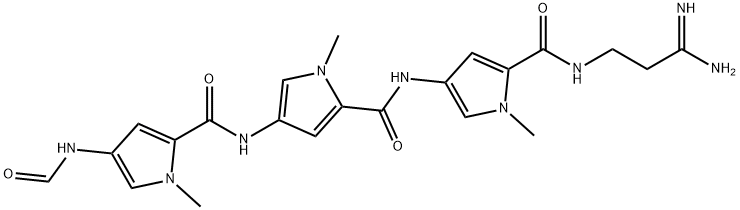
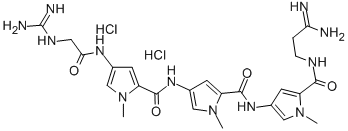
Stallimycin
- CAS NO.:636-47-5
- Empirical Formula: C22H27N9O4
- Molecular Weight: 481.51
- SAFETY DATA SHEET (SDS)
- Update Date: 2026-04-24 14:58:37
What is Stallimycin?
Originator
Herperal,Farmitalia,Italy,1978
Manufacturing Process
A spore suspension obtained upon washing a culture of Streptomyces
distallicus is added to 3,000 ml of a sterile medium consisting of the
following:Dextrose 2%
Corn steep liquor extract 2%
CaCO3 1%
(NH4)2SO4 0.3%
NaCl 0.3%Fermentation is continued at 28°C for 40 hours at a stirring rate of 150 to 250
rpm and a rate of air flow of 1 to 2 l/min/l of culture medium.
300 ml of a suspension of the vegetative mycelium of this culture are used for
inoculating 6,000 ml of a similar sterile culture medium. At this production
stage, the culture is kept fermenting for 85 to 100 hours (pH 7.6 at 28°C) at
a stirring rate of 350 to 450 rpm and a rate of air flow of 1 to 1.5 l/min/l of
culture medium.
To 17 l of a culture obtained by submerged fermentation as mentioned above,
siliceous earth is added and the batch is filtered. The mixture of mycelium and
the siliceous earth are agitated for 1 hour with 2.5 l of butanol. This treatment
is repeated twice. The butanolic extracts are combined, washed with water,
evaporated to dryness (about 10 g) and boiled with acetone (80 ml). The 5 g of distamycin is extracted six times with ethanol. The ethanolic extracts
are combined, concentrated and filtered through a column containing 70 g of
alumina. Elution is carried out with the same solvent. The effluent (central
fractions) is collected and evaporated to dryness to yield 0.43 g of pure
distamycin A: decomposition point, 183°C to 185°C. The product can be
further purified by crystallization from aqueous n-butanol.
Therapeutic Function
Antibiotic
Properties of Stallimycin
| Melting point: | 154-156° |
| Boiling point: | 579.2°C (rough estimate) |
| Density | 1.3298 (rough estimate) |
| refractive index | 1.6910 (estimate) |
Safety information for Stallimycin
Computed Descriptors for Stallimycin
New Products
2-(2-Chlorophenyl)glycine Propiolic Acid 1-(3-Hydroxy-4-methoxyphenyl)-2-nitroethene (±)-amino(2-fluorophenyl)acetic acid trans-3-Benzyloxy-4-methoxy-beta-nitrostyrene 1-Pentadecanol 4-(4-Αminophenyl)-3-Morpholinone 3-Morpholino-1-(4-(2-oxopiperidin-1-yl) phenyl)-5,6-dihyropyridin-2-(1H)-one 1-(4-Aminophenyl)-3-morpholino-5,6-dihydropyridin-2(1H)-one N-cyanoacetylurethane 1H-IndazoleRelated products of tetrahydrofuran
You may like
-
 40216-83-9 trans-4-Hydroxy-L-proline methyl ester hydrochloride 98+View Details
40216-83-9 -
471-25-0 Propiolic Acid 98+View Details
471-25-0 -
84145-28-8 98+View Details
84145-28-8 -
trans-3-Benzyloxy-4-methoxy-beta-nitrostyrene 98+View Details
63909-29-5 -
2-(2-Chlorophenyl)glycine 88744-36-9 98+View Details
88744-36-9 -
40216-83-9 trans-4-Hydroxy-L-proline methyl ester hydrochloride 98+View Details
40216-83-9 -
629-76-5 98+View Details
629-76-5 -
1-(3-Hydroxy-4-methoxyphenyl)-2-nitroethene 98+View Details
39816-35-8