
SQ 22,536
Synonym(s):9-(Tetrahydro-2ʹ-furyl)adenine;9-(Tetrahydro-2-furanyl)-9H-purin-6-amine;9-THF-Ade;SQ 22536 - CAS 17318-31-9 - Calbiochem
- CAS NO.:17318-31-9
- Empirical Formula: C9H11N5O
- Molecular Weight: 205.22
- MDL number: MFCD00210216
- EINECS: 633-987-7
- SAFETY DATA SHEET (SDS)
- Update Date: 2026-05-28 01:12:03
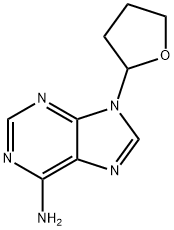
What is SQ 22,536?
Description
SQ 22,536 is an inhibitor of adenylyl cyclase with an IC50 value of 13 μM for inhibition of prostaglandin E1-
The Uses of SQ 22,536
SQ 22,536 was used to study the role of adenylate cyclase in differentiation of PC12 cells and in gap junctional intercellular communication in breast cancer cells.
What are the applications of Application
SQ 22536 is an A cyclase inhibitor
Definition
ChEBI: A nucleoside analogue that is adenine in which the nitrogen at position 9 has been substituted by a tetrahydrofuran-2-yl group. It is an adenylate cyclase inhibitor.
Biological Activity
Inhibitor of adenylyl cyclase (IC 50 = 1.4 μ M). Inhibits PGE 1 -stimulated increases in cAMP levels in intact human platelets.
Biochem/physiol Actions
SQ 22,536 is an effective inhibitor of not only basal but also prosptaglandin E1-activated adenylate cyclase activities in platelets.1 It reverses hyperalgesia contralaterally and ipsilaterally when injected intramuscularly in rats.2
Storage
Store at +4°C
Properties of SQ 22,536
| Melting point: | 160-161℃ |
| Boiling point: | 474.8±55.0 °C(Predicted) |
| Density | 1.70±0.1 g/cm3(Predicted) |
| storage temp. | Keep in dark place,Inert atmosphere,2-8°C |
| solubility | H2O: 21 mg/mL |
| form | solid |
| pka | 3.82±0.10(Predicted) |
| color | white to off-white |
Safety information for SQ 22,536
| Signal word | Warning |
| Pictogram(s) |
 Exclamation Mark Irritant GHS07 |
| GHS Hazard Statements |
H315:Skin corrosion/irritation H319:Serious eye damage/eye irritation H335:Specific target organ toxicity, single exposure;Respiratory tract irritation |
| Precautionary Statement Codes |
P261:Avoid breathing dust/fume/gas/mist/vapours/spray. P304+P340:IF INHALED: Remove victim to fresh air and Keep at rest in a position comfortable for breathing. P305+P351+P338:IF IN EYES: Rinse cautiously with water for several minutes. Remove contact lenses, if present and easy to do. Continuerinsing. P405:Store locked up. |
Computed Descriptors for SQ 22,536
New Products
Dibenzoyl-L-tartaric acid Anhydrous (Resolution Reagent) Cis-Tosylate Dibenzo[b,f][1,4]thiazepin-11(10H)-one 1,2,3,9-Tetrahydro-9-Methyl-4H-Carbazole-4-One 1-(4-methoxyphenyl)-4-(4-Nitrophenyl)Piperazine (IT-1) BOC Piperazine 1-Benzhydrylazetane-3-carbonitrile 8-oxa-1,3-diazaspiro[4.5]decane-2,4-dione (±)-amino(2-fluorophenyl)acetic acid 2-(2-Chlorophenyl)glycine AMINO-(3-CHLORO-PHENYL)-ACETIC ACID 2'-Fluoroacetophenone METHANOL-D1(OD) TERTIARY BUTANOL-D9 N-ETHYL-D5-AMINE HYDROCHLORIDE BENZOIC ACID-D CHLOROFORM-D TOLUENE-D3 Trans,trans muconic acid HC Blue-16 4-Amino-2-chloro-6,7-dimethoxyquinazoline Ethyl 4,5-bis(2-methoxyethoxy)-2-nitrobenzoate 2,3-Dimethoxypyridine 1-(3-Chlorophenyl)piperazine hydrochlorideRelated products of tetrahydrofuran
You may like
-
 SQ 22,536 99% (HPLC) CAS 17318-31-9View Details
17318-31-9 -
SQ 22536 CAS 17318-31-9View Details
17318-31-9 -
SQ 22536 CAS 17318-31-9View Details
17318-31-9 -
SQ 22,536 CAS 17318-31-9View Details
17318-31-9 -
 Product InrtroductionView Details
 -
 DGO24View Details
 -
 DGO29View Details
 -
 DGO32View Details