
Sodium 4-Aminophenylarsonate
- CAS NO.:127-85-5
- Empirical Formula: C6H6AsNNa2O3
- Molecular Weight: 240.04
- MDL number: MFCD00067431
- EINECS: 204-869-9
- SAFETY DATA SHEET (SDS)
- Update Date: 2026-05-28 00:55:24
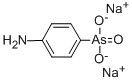
What is Sodium 4-Aminophenylarsonate?
Definition
ChEBI: Sodium arsanilate is an organoarsonic acid salt and an organic sodium salt. It has a role as an antisyphilitic drug. It contains an arsanilate(1-).
General Description
A white crystalline, odorless powder. Slightly denser than water. Contact may irritate skin, eyes, and mucous membranes. May be toxic by ingestion. Used to make other chemicals.
Air & Water Reactions
Soluble in water.
Health Hazard
TOXIC; inhalation, ingestion or skin contact with material may cause severe injury or death. Contact with molten substance may cause severe burns to skin and eyes. Avoid any skin contact. Effects of contact or inhalation may be delayed. Fire may produce irritating, corrosive and/or toxic gases. Runoff from fire control or dilution water may be corrosive and/or toxic and cause pollution.
Fire Hazard
Non-combustible, substance itself does not burn but may decompose upon heating to produce corrosive and/or toxic fumes. Some are oxidizers and may ignite combustibles (wood, paper, oil, clothing, etc.). Contact with metals may evolve flammable hydrogen gas. Containers may explode when heated.
Pharmaceutical Applications
Bechamp,teaching medicinal chemistry at the University of Montpellier, synthesised in 1863 a compound from aniline and arsenic acid, which became known later as Atoxyl. The name Atoxyl stems from its decreased toxicity. Bechamp characterised his compound as an anilide.
In 1905, Thomas and Breinl showed that Atoxyl was effective in the treatment of trypanosomas, mainly Trypanosoma brucei gambiense-the cause of the African sleeping sickness, which was the main health problem around that time in Africa. Nevertheless, very high doses were required to show any pronounced effect, and as a result severe side effects such as blindness and damage to the optical nerve were common issues.
Inspired by this research, Ehrlich hired the chemist Bertheim in 1905. Bertheim revised the structure of Atoxyl and the correct chemical formula was assigned. Atoxyl was identified as an p-anilinyl arsenic acid derivative on the basis of its properties to reduce Tollen’s reagent [Ag(NH3)2]+ to metallic silver and its potential use to synthesise the corresponding diazo dye.
Safety Profile
Poison by subcutaneous route. Can cause blindness. When heated to decomposition it emits very toxic fumes of As and NOx.
Properties of Sodium 4-Aminophenylarsonate
| Water Solubility | Soluble in water |
| form | powder to crystal |
| color | Tetrahydrate: white, crystalline powder |
| Odor | odorless |
| Merck | 14,8578 |
| EPA Substance Registry System | Sodium arsanilate (127-85-5) |
Safety information for Sodium 4-Aminophenylarsonate
Computed Descriptors for Sodium 4-Aminophenylarsonate
New Products
2-(2-Chlorophenyl)glycine Propiolic Acid 1-(3-Hydroxy-4-methoxyphenyl)-2-nitroethene (±)-amino(2-fluorophenyl)acetic acid trans-3-Benzyloxy-4-methoxy-beta-nitrostyrene 1-Pentadecanol 2,4-Dihydroxybenzaldehyde Dipropyl disulfide Pyrrolo[1,2-a]pyrimidine-6-carboxylic acid, 4,6,7,8-tetrahydro-4-oxo-, sodium salt (1:1), (6S) Obidoxime hydrochloride API 4 pentyn 1 ol N-Vinylformamide Methacrylate-PEG-Methacrylate, Mn:35000 2,4-Dihydroxyacetophenone 2-Chloro 5-Fluoro Pyridine Vasicinone 2-Chloroisonicotinic Acid Tween 80 or Polysorbate 80 2-Butyn-1-oL N-(4-Cyano-3-(trifluoromethyl)phenyl)-2-methyloxirane-2-carboxamide N-(4-fluoro-2-methoxy-5-nitrophenyl)-4-(1-methyl-1H-indol-3-yl)pyrimidin-2-amine Pirtobrutinib intd. 2-Pentyn-1-oL 4-NitrobenzotrifluorideRelated products of tetrahydrofuran


You may like
-
 Sodium 4-aminophenylarsonate 95% CAS 127-85-5View Details
127-85-5 -
Sodium 4-Aminophenylarsonate CAS 127-85-5View Details
127-85-5 -
471-25-0 Propiolic Acid 98+View Details
471-25-0 -
84145-28-8 98+View Details
84145-28-8 -
trans-3-Benzyloxy-4-methoxy-beta-nitrostyrene 98+View Details
63909-29-5 -
2-(2-Chlorophenyl)glycine 88744-36-9 98+View Details
88744-36-9 -
40216-83-9 trans-4-Hydroxy-L-proline methyl ester hydrochloride 98+View Details
40216-83-9 -
1-(3-Hydroxy-4-methoxyphenyl)-2-nitroethene 98+View Details
39816-35-8