
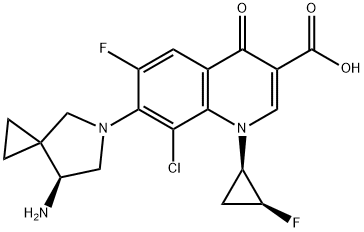
Sitafloxacin
- CAS NO.:127254-12-0
- Empirical Formula: C19H18ClF2N3O3
- Molecular Weight: 409.81
- MDL number: MFCD00903720
- EINECS: 1308068-626-2
- SAFETY DATA SHEET (SDS)
- Update Date: 2026-08-30 11:39:11
What is Sitafloxacin?
Description
Sitafloxacin hydrate is the newest member (fourth generation) of the fluoroquinolone family of antibiotics that exhibits broad spectrum activity against many Gram-positive, Gramnegative, and anaerobic clinical isolates, including strains resistant to other fluoroquinolones. Since the launch of the first fluoroquinolone norfloxacin (patented in 1978), 20 other versions have made it to market with ciprofloxacin and levofloxacin experiencing the most prevalent usage. The mechanism of action involves inhibition of bacterial type II topoisomerases, both DNA gyrase and topoisomerase IV. By inhibiting these enzymes and preventing DNA supercoiling, cell division is disrupted leading to cell death. In Gram-negative bacteria, the primary target appears to be gyrase, whereas topoisomerase IV is involved in Gram-positive bacteria. Dual inhibition is attractive for widespread activity and avoidance of resistance as both encoding genes would have to acquire mutations.
Originator
Daiichi Sankyo (Japan)
The Uses of Sitafloxacin
Antibacterial (DNA-gyrase inhibitor).
Definition
ChEBI: Sitafloxacin is a member of quinolines, a quinolone antibiotic and a fluoroquinolone antibiotic.
brand name
Gracevit
Pharmaceutical Applications
A group 4 quinolone formulated for oral or intravenous use. In-vitro activity is similar to or better than that of moxifloxacin. The antibacterial spectrum covers Gram-positive and Gram-negative bacteria including anaerobes. It has a chlorine atom at the C-8 position, and therefore has potential for phototoxicity. Early interest in this compound has not been maintained, but it is available in Japan.
Side Effects
As a class, the major adverse events for fluoroquinolones are cardiac arrhythmia (due to QT interval 622 Shridhar Hegde and Michelle Schmidt prolongation), major phototoxicity, CNS disturbances (seizures, dizziness, and headaches), and tendonitis. The GI side effects, common to most antimicrobials, include Clostridium difficile-associated diarrhea (CDAD) and alterations in glucose homeostasis. From the clinical safety profile of sitafloxacin (1,059 patients receiving either 50 mg b.i.d. or 100 mg b.i.d.), about a third of patients experienced an adverse event with the most common being diarrhea, liver enzyme elevations, and headaches; however, the risk of QT prolongation, hypoglycemia, and hepatotoxicity were all considered to be low. Phototoxicity appears to be the limiting toxicity, particularly in non-Asian patients.
Properties of Sitafloxacin
| Boiling point: | 629.2±55.0 °C(Predicted) |
| Density | 1.63±0.1 g/cm3(Predicted) |
| storage temp. | Store at -20°C |
| solubility | DMF: slightly soluble; DMSO: slightly soluble; Methanol: slightly soluble |
| form | A crystalline solid |
| pka | 6.39±0.50(Predicted) |
| CAS DataBase Reference | 127254-12-0(CAS DataBase Reference) |
Safety information for Sitafloxacin
| Signal word | Warning |
| Pictogram(s) |
 Exclamation Mark Irritant GHS07 |
| GHS Hazard Statements |
H302:Acute toxicity,oral H315:Skin corrosion/irritation H319:Serious eye damage/eye irritation H335:Specific target organ toxicity, single exposure;Respiratory tract irritation |
| Precautionary Statement Codes |
P261:Avoid breathing dust/fume/gas/mist/vapours/spray. P264:Wash hands thoroughly after handling. P264:Wash skin thouroughly after handling. P270:Do not eat, drink or smoke when using this product. P271:Use only outdoors or in a well-ventilated area. P280:Wear protective gloves/protective clothing/eye protection/face protection. P330:Rinse mouth. P362:Take off contaminated clothing and wash before reuse. P301+P312:IF SWALLOWED: call a POISON CENTER or doctor/physician IF you feel unwell. P302+P352:IF ON SKIN: wash with plenty of soap and water. P304+P340:IF INHALED: Remove victim to fresh air and Keep at rest in a position comfortable for breathing. P305+P351+P338:IF IN EYES: Rinse cautiously with water for several minutes. Remove contact lenses, if present and easy to do. Continuerinsing. P332+P313:IF SKIN irritation occurs: Get medical advice/attention. P337+P313:IF eye irritation persists: Get medical advice/attention. P405:Store locked up. P403+P233:Store in a well-ventilated place. Keep container tightly closed. P501:Dispose of contents/container to..… |
Computed Descriptors for Sitafloxacin
New Products
2-(2-Chlorophenyl)glycine Propiolic Acid trans-3-Benzyloxy-4-methoxy-beta-nitrostyrene 1-(3-Hydroxy-4-methoxyphenyl)-2-nitroethene (±)-amino(2-fluorophenyl)acetic acid 1-Pentadecanol N-Vinylformamide 4 pentyn 1 ol 4-(4-Αminophenyl)-3-Morpholinone 3-Morpholino-1-(4-(2-oxopiperidin-1-yl) phenyl)-5,6-dihyropyridin-2-(1H)-one 1-(4-Aminophenyl)-3-morpholino-5,6-dihydropyridin-2(1H)-one N-cyanoacetylurethane 1H-IndazoleRelated products of tetrahydrofuran
![3-Quinolinecarboxylic acid, 7-[(7S)-7-aMino-5-azaspiro[2.4]hept-5-yl]-8-chloro-6-fluoro-1-[(1R,2S)-2-fluorocyclopropyl]-1,4-dihydro-4-oxo-, hydrate](https://img.chemicalbook.in/CAS/GIF/163253-37-0.gif)

You may like
-
 Sitafloxacin 127254-12-0 97 %View Details
127254-12-0 -
471-25-0 Propiolic Acid 98+View Details
471-25-0 -
84145-28-8 98+View Details
84145-28-8 -
trans-3-Benzyloxy-4-methoxy-beta-nitrostyrene 98+View Details
63909-29-5 -
2-(2-Chlorophenyl)glycine 88744-36-9 98+View Details
88744-36-9 -
40216-83-9 trans-4-Hydroxy-L-proline methyl ester hydrochloride 98+View Details
40216-83-9 -
629-76-5 98+View Details
629-76-5 -
1-(3-Hydroxy-4-methoxyphenyl)-2-nitroethene 98+View Details
39816-35-8